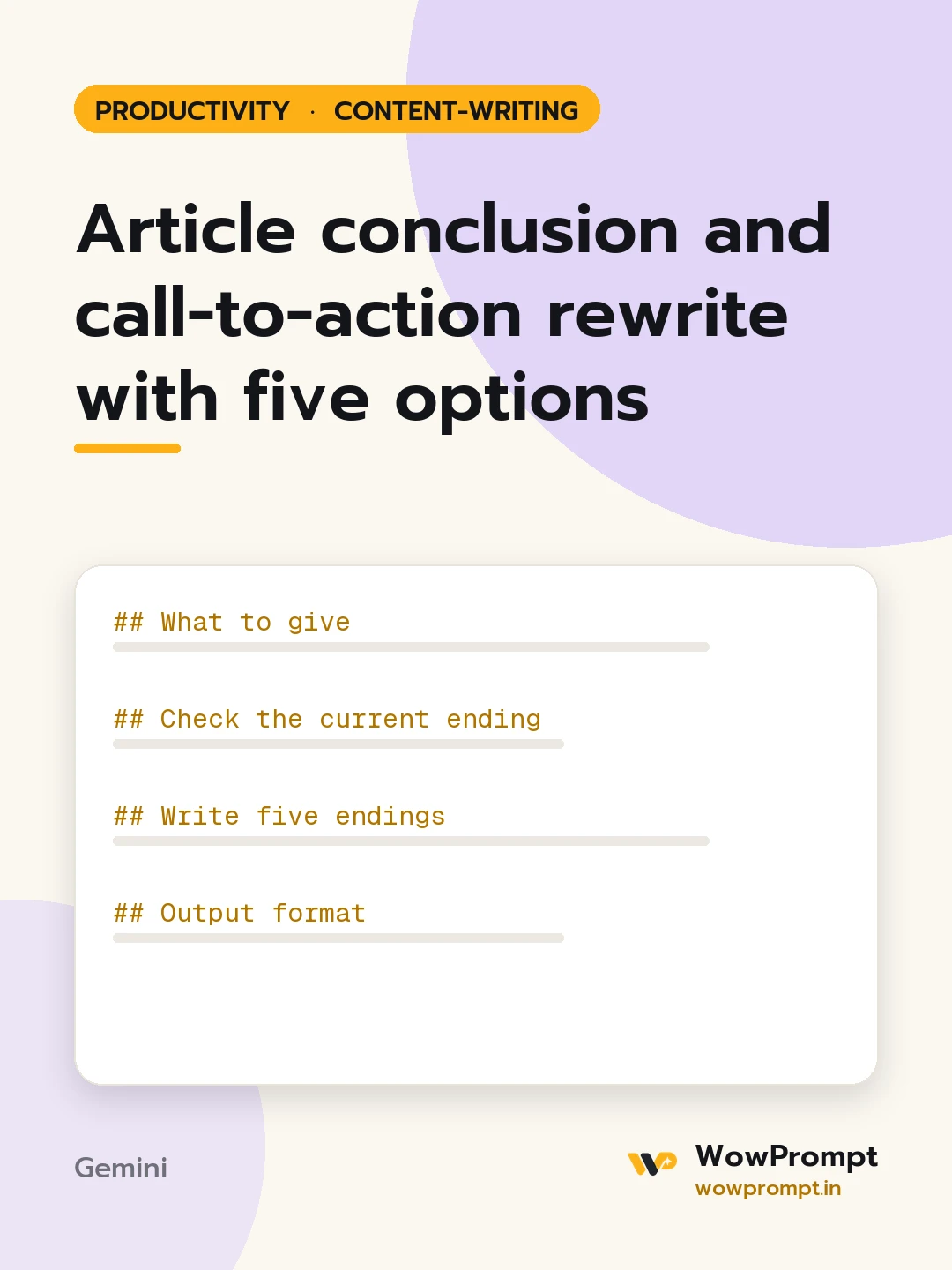
Article conclusion and call-to-action rewrite with five options
Replaces a weak closing paragraph with endings that sum up the one point a reader should remember and give one clear next step, in five different styles to choose from. Use it on blog posts, guides and newsletters that end with "In conclusion" and a generic line.
The output this prompt produced, unedited.
The prompt
What to give
The article, or its headings and the last three paragraphs: [paste]
The one thing a reader should remember: [e.g. you can switch a home loan without paying twice for paperwork, or leave blank to have it found]
The next step you want: [e.g. use the EMI calculator, book a call, read the next guide, subscribe]
Where the reader is in their decision: [e.g. just learning, comparing, ready to act]
Tone of the site: [e.g. friendly expert, plain and calm]
Check the current ending
Does it start with "In conclusion", "To sum up" or a restatement of the title.
Does it add a new point that belongs in the body.
Does it ask for more than one action.
Does the action match how ready the reader is.
Write five endings
Key takeaway: the main point in one sentence, then the step.
Quick checklist: three short bullets the reader can act on, then the step.
Look ahead: what changes for the reader if they act, then the step.
Common mistake: the one error to avoid, then the step.
Question back: a question that helps the reader decide, then the step.
Output format
A two-line diagnosis of the current ending.
Five endings of 50 to 90 words each, with the call to action in bold.
One line for each on the kind of article it suits.
Three button or link labels of up to four words for the call to action.
blog conclusionarticle endingcall to action writingcta copyclosing paragraphcontent writing
How to run this
Copy the prompt and paste it into Gemini, then set the aspect ratio to 3:4. No reference photo is needed for this one.
The prompt is written in Markdown with each part under its own heading, which is what the copy action hands over. Change one section at a time, keeping the rest intact, so you can tell which change did the work.