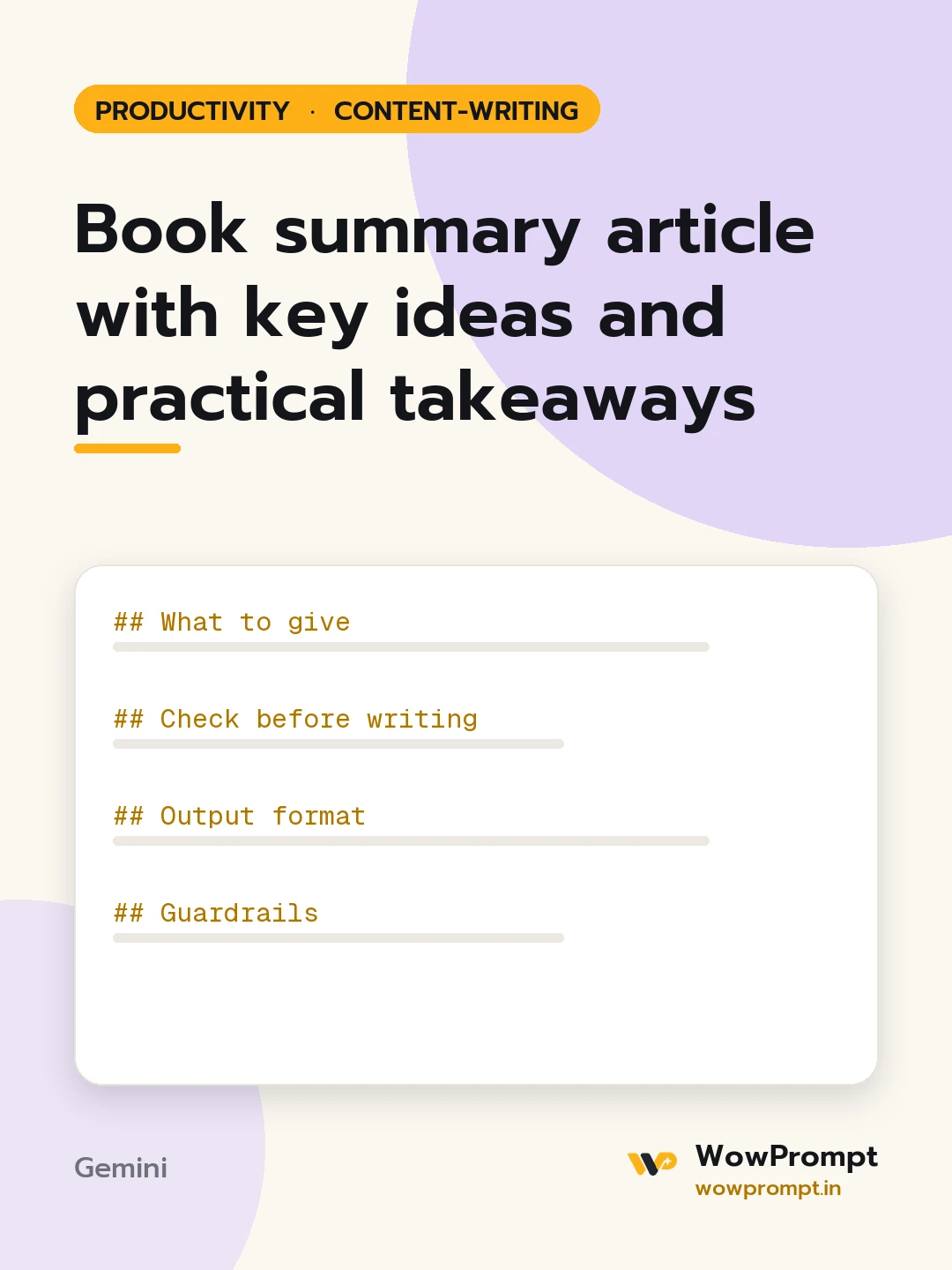
Book summary article with key ideas and practical takeaways
Writes an original summary article of a non-fiction book from the reader's own notes: the core argument, the key ideas in the writer's own words, how to apply them, and who should and should not read it. Use it for book review blogs, newsletter features or team reading clubs.
The output this prompt produced, unedited.
The prompt
What to give
Book title and author: [title, author, year]
Your reading notes: [paste highlights paraphrased in your own words, page numbers optional]
Your audience: [e.g. first-time managers in tech companies]
What you agreed with and doubted: [short notes]
Length: [e.g. 1,000 words]
Check before writing
The core argument fits in two sentences.
Each key idea is explained in new words, not copied from the book.
Every idea has one action a reader could take this week.
The critique is fair: what the book does well and where it is thin or dated.
Nothing in the notes is presented as the author's view unless the notes say so.
Output format
Title options: three, each with the book name.
Summary in three bullets at the top.
Core argument in a short section.
Five key ideas, each with a heading, a short explanation and one practical action.
A fair critique in one section.
Who should read it and who can skip it.
Three questions for a reading group.
Guardrails
Do not quote more than one short line from the book, and attribute it.
Do not reconstruct chapters in order; summarise ideas, not the book's text.
If the notes are thin on a section, say the article does not cover it rather than guessing.
book summarybook review articlekey takeawaysnon fiction summaryreading notes to articlebook club notes
How to run this
Copy the prompt and paste it into Gemini, then set the aspect ratio to 3:4. No reference photo is needed for this one.
The prompt is written in Markdown with each part under its own heading, which is what the copy action hands over. Change one section at a time, keeping the rest intact, so you can tell which change did the work.