Logline
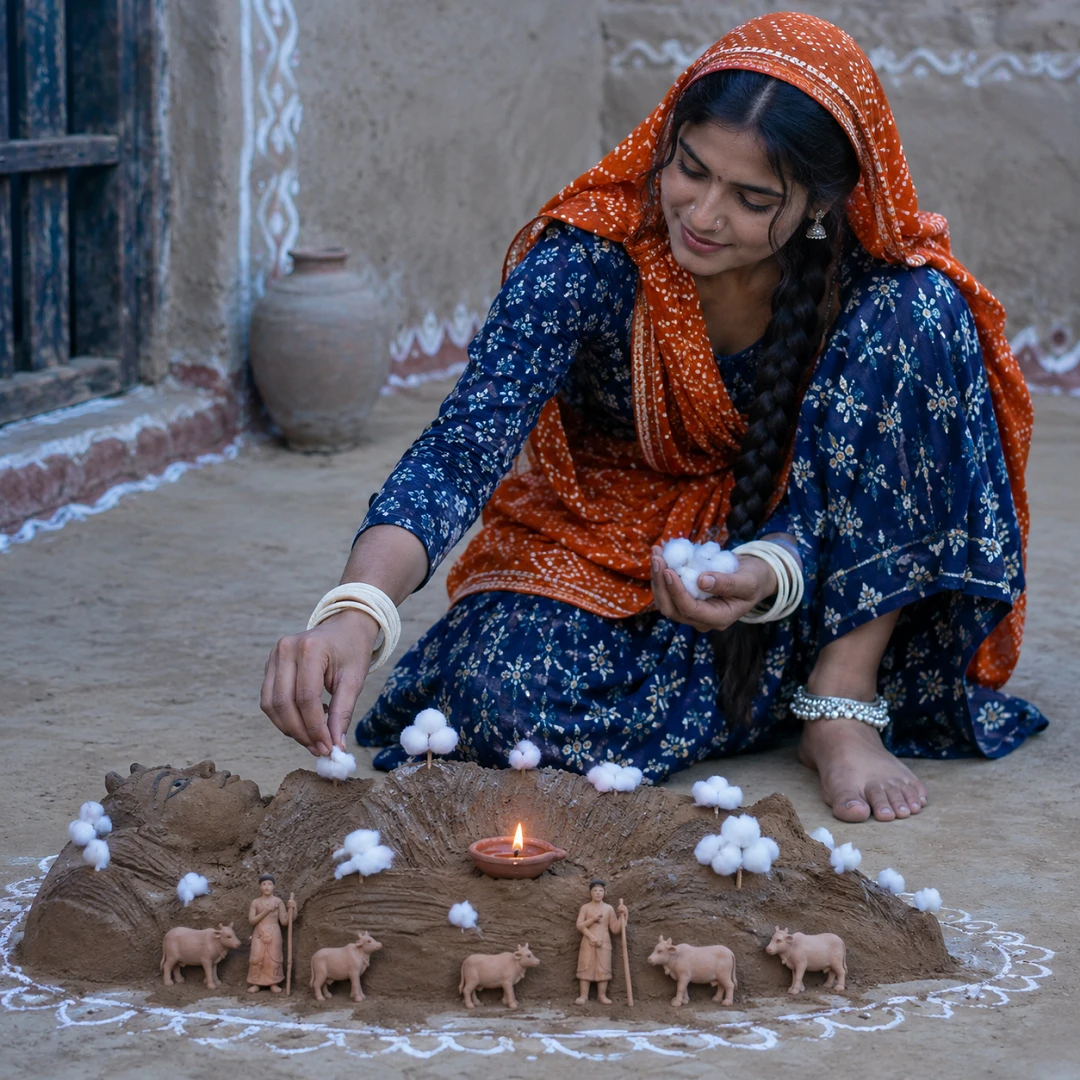
The morning after Diwali, a young woman finishes the Govardhan she has shaped on the courtyard floor, dotting the low cow-dung hill with white cotton tufts for trees and setting tiny clay cows along its foot.
Identity
With a photo attached: the person in the photo is the subject. Keep their face exactly as it is, with bone structure, eye shape and spacing, nose, lips, jawline, hairline, skin tone and apparent age all unchanged, and keep their own body: build, height and proportions, shoulders, arms, hands and legs, with the same skin tone on face, neck, arms and hands. Use the photo only for who the person is. Ignore its pose, expression, clothing, hairstyle, background, framing and light, and rebuild all of them exactly as described below, even when the photo shows them standing straight or dressed differently.
Shot 1, the figure
A low cow-dung hill about an arm long on the smoothed earth floor, shaped like a reclining figure, its surface ridged with finger marks. Cotton tufts dot its slopes; six small unpainted clay cows and two clay cowherds stand along its base; a clay diya sits at its navel.
Shot 2, the woman
She kneels at the right of the figure, sitting back on her left heel, right knee raised, torso leaning forward over it. Her right hand presses one cotton tuft onto the slope with two fingers; her left hand, forearm on her knee, holds three more tufts. Head tilted down, eyes on her work, a small proud smile. She wears an indigo dabu-print cotton lehenga to the ankle, a full-sleeve indigo blouse, an opaque orange bandhani odhni over her head and across her waist, silver kade on her ankles and white bangles.
Shot 3, the light and lens
Cool blue dawn from the open sky over the courtyard, the ochre mud walls soft grey-brown. The diya is a tiny warm point. 50mm at f/2, a slight high angle, the figure and her face both sharp. Natural cool colour, real skin with pores, fine grain.