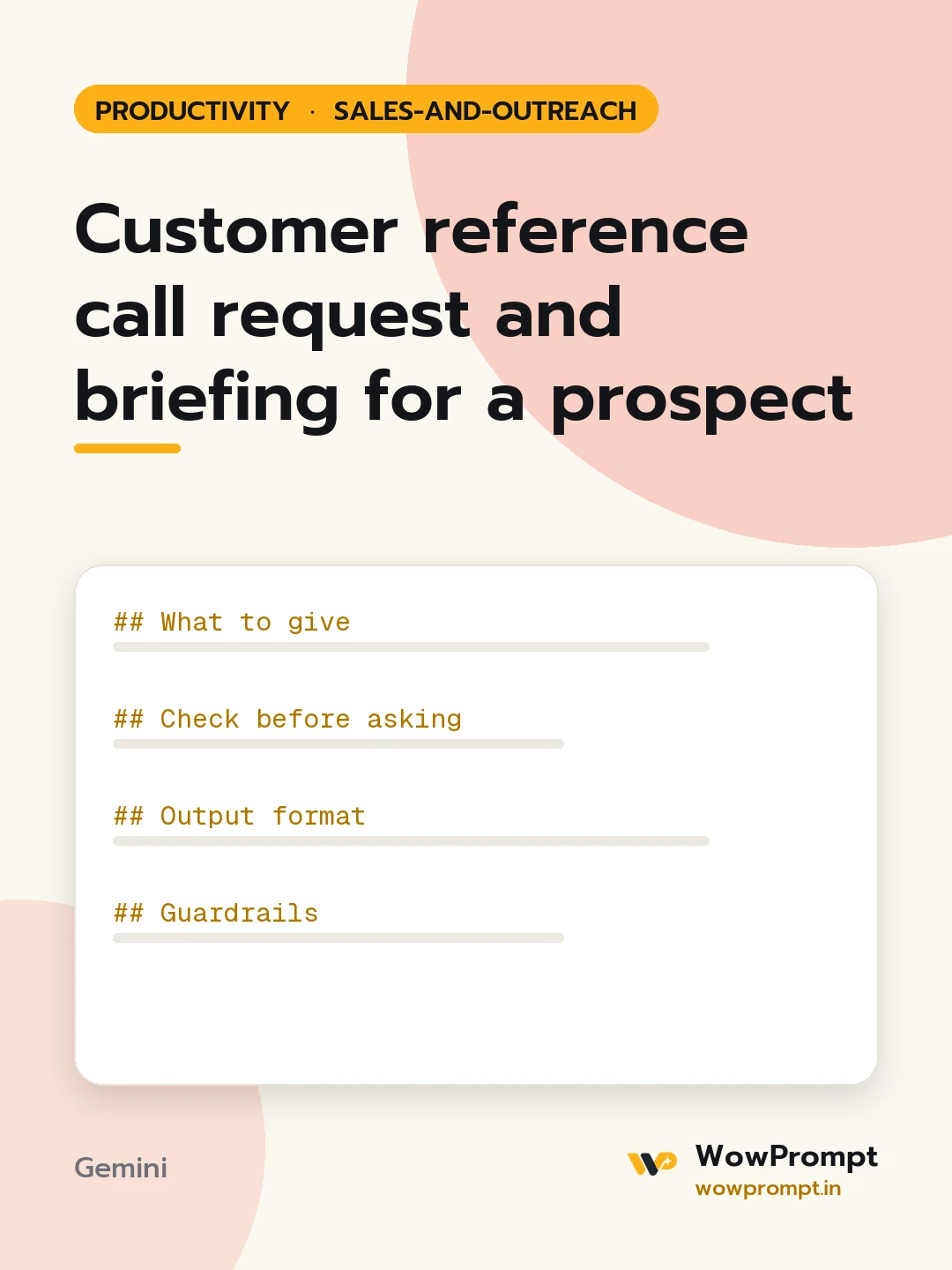
Customer reference call request and briefing for a prospect
Prepares a reference call late in a sales cycle: the request to a happy customer, a briefing note for that customer on who is calling and why, a prep sheet for the prospect with good questions, and a thank-you afterwards. Use it when a prospect asks to speak with an existing client before signing.
The output this prompt produced, unedited.
The prompt
What to give
Your company and offer: [e.g. a facility management services firm]
Reference customer: [company placeholder, contact role, how long a client, results achieved]
Prospect: [company type, their main concern, stage of the deal]
Why the prospect wants a reference: [e.g. worried about the switch-over period]
Times you have asked this reference before: [e.g. twice this year]
Thank-you you can offer: [e.g. a handwritten note, early access to a new feature, none]
Check before asking
The reference is a close match on industry, size or problem.
The reference has not been asked more than a few times this year.
Any open issue with the reference customer is resolved.
The prospect is genuinely late stage, not early browsing.
Output format
Request message to the reference, under 100 words, easy to decline.
Briefing note for the reference: who is calling, the prospect's concern, length of the call, topics they may want to avoid.
Prospect prep sheet: eight questions that get honest answers, such as what went wrong at first and how it was handled.
Suggested 20-minute agenda.
Thank-you message to the reference after the call.
Note for the sales rep: what to ask the prospect afterwards.
Guardrails
Never script the reference's answers or ask them to exaggerate.
Do not share the prospect's confidential details with the reference beyond what is needed.
Respect a "no" from the reference without asking twice.
Copy the prompt and paste it into Gemini, then set the aspect ratio to 3:4. No reference photo is needed for this one.
The prompt is written in Markdown with each part under its own heading, which is what the copy action hands over. Change one section at a time, keeping the rest intact, so you can tell which change did the work.