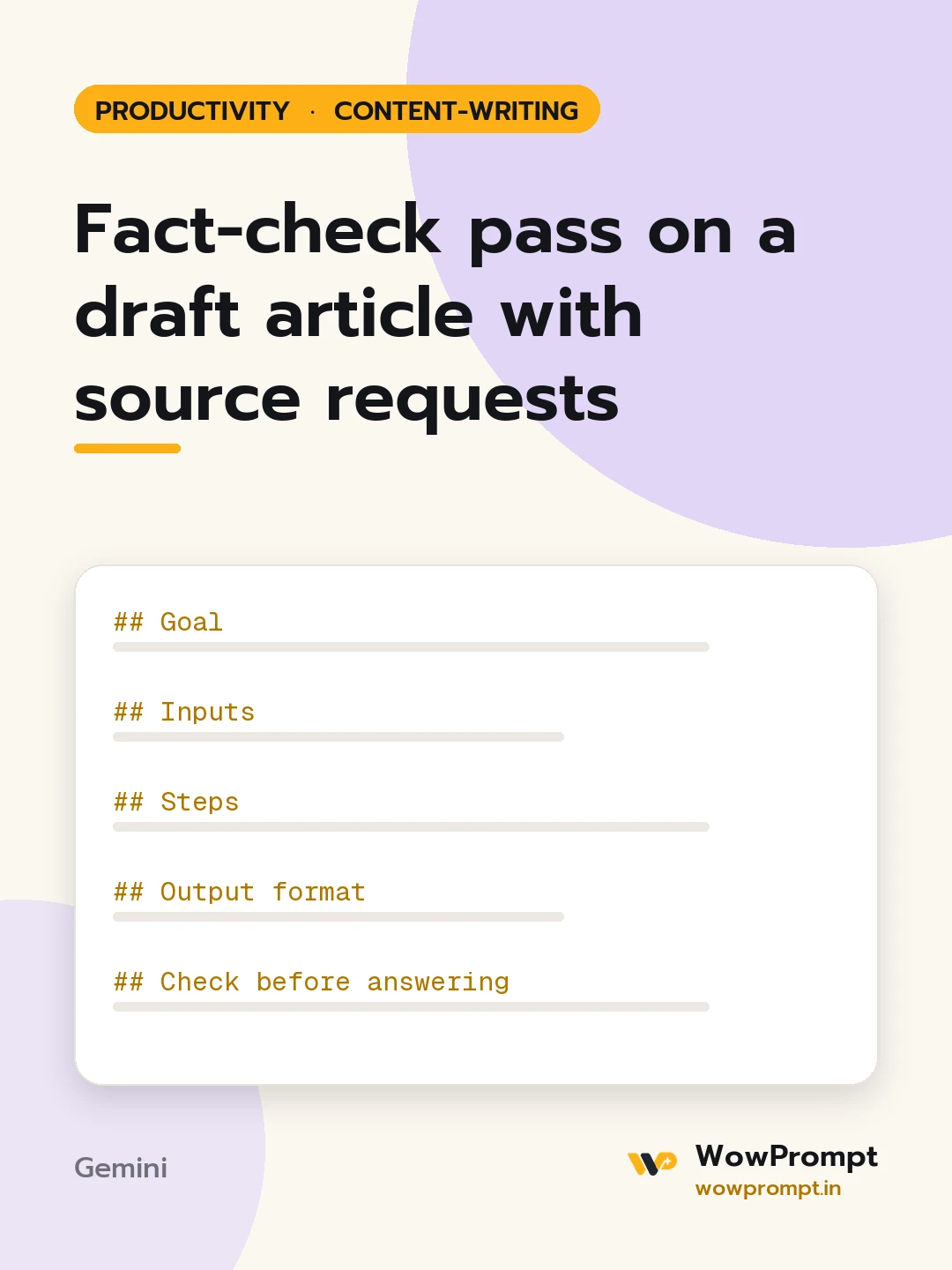
Goal
Find every statement in the draft that a careful editor would need to verify, and say what evidence would confirm it. Do not confirm claims from memory.
Inputs
- Draft: [paste the article]
- Topic area: [e.g. personal finance, health, technology, travel]
- Region and date of publication: [country, date]
- Sources already used: [paste links or names, or none]
Steps
- Extract each checkable claim: numbers, dates, names, quotes, rankings, laws, prices, health or money outcomes, and "studies show" statements.
- Rate each claim's risk: high if wrong information could cause harm or legal trouble, medium if it would damage trust, low otherwise.
- Name the type of source that would verify it, such as an official statistics release, a regulator's page, the original study or the company's own documentation.
- Write a safer version for any claim that cannot be verified quickly.
Output format
| # | Claim as written | Risk | Problem | Source needed | Safer rewrite |
Then:
- Time-sensitive facts: a list of claims likely to go out of date, with how often to recheck them.
- Missing attribution: quotes or figures with no named source.
- Summary: two sentences on whether the draft is ready to publish.
Check before answering
- Every number, date and quote in the draft appears in the table.
- No claim is marked as verified; the output lists what to check, not verdicts.
- Absolute words such as "always", "never", "guaranteed" and "best" are flagged.
- Health, money and legal claims are rated high risk by default.
- Safer rewrites keep the writer's meaning while removing the unverified part.