The commission
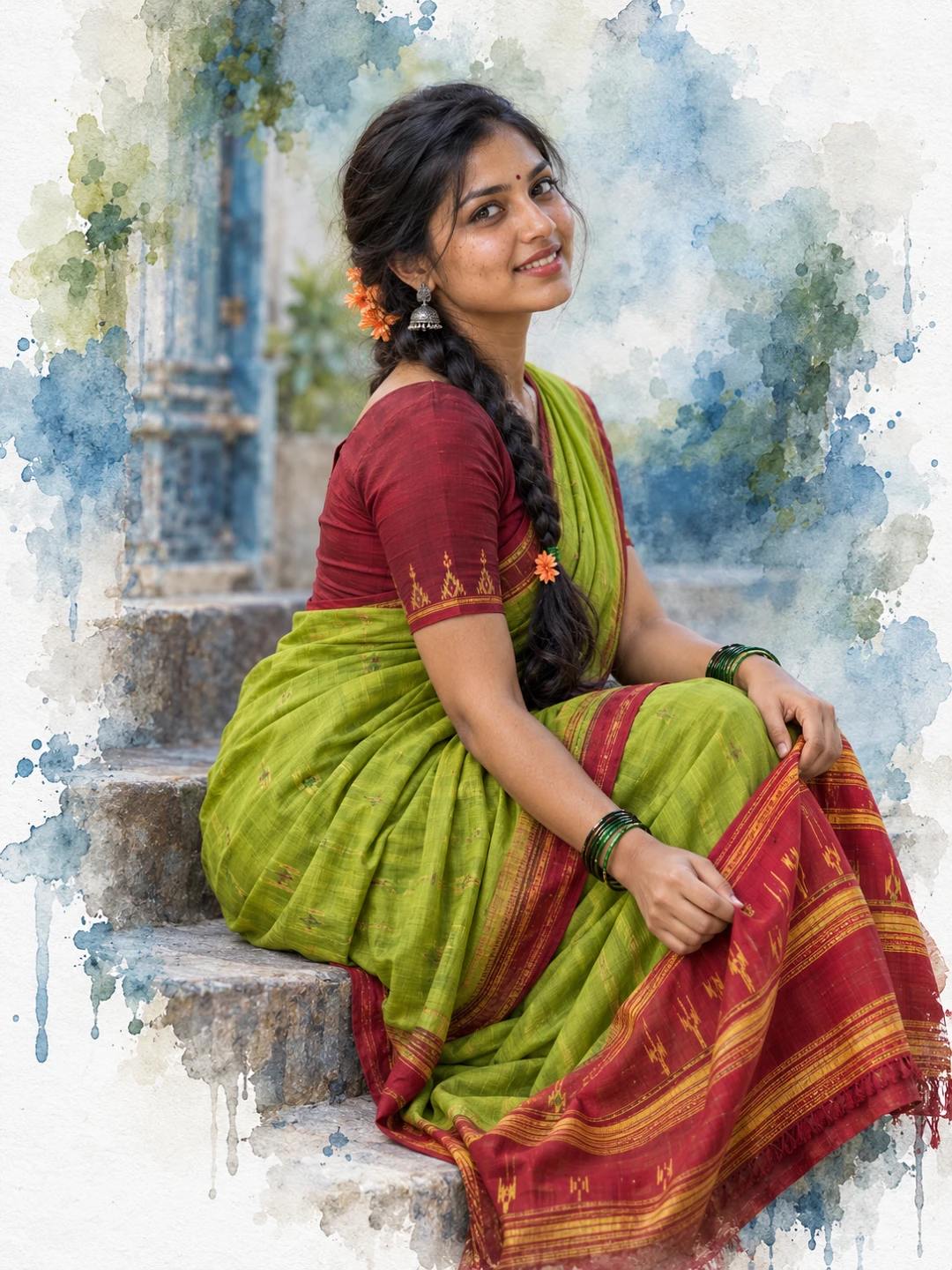
You are making a gallery print that is half photograph, half painting: the woman and her saree photographically sharp, the world around her dissolving into watercolour.
Identity
With a photo attached: the person in the photo is the subject. Keep their face exactly as it is, with bone structure, eye shape and spacing, nose, lips, jawline, hairline, skin tone and apparent age all unchanged, and keep their own body: build, height and proportions, shoulders, arms, hands and legs, with the same skin tone on face, neck, arms and hands. Use the photo only for who the person is. Ignore its pose, expression, clothing, hairstyle, background, framing and light, and rebuild all of them exactly as described below, even when the photo shows them standing straight or dressed differently.
Pose
Seated sideways on a low stone step, knees together and angled to camera left, back straight. Left hand resting on her knee, right hand lifting the pallu across her lap to show its border. Head turned to the camera over her right shoulder, a soft open smile.
Wardrobe
A parrot-green Ilkal cotton-silk saree with the red tope teni pallu and a red border with small kasuti motifs; a maroon short-sleeve blouse. Silver oxidised jhumkas, green glass bangles on both wrists, hair in a side plait with a few kanakambara flowers.
The set
Only the step and her shadow are photographic; from mid-frame outward the background turns into loose watercolour washes of sea blue, sage and pale grey on white cold-press paper, with soft blooms and a few paint drips at the bottom edge.
The light
Soft window light from camera left, gentle shadow on the right cheek, even exposure on the fabric.
How it is shot
85mm at f/2.8 for the photographic centre, knee-up. The transition from photo to paint is gradual and believable, real paper texture visible in the wash areas, true natural colour on skin and saree.