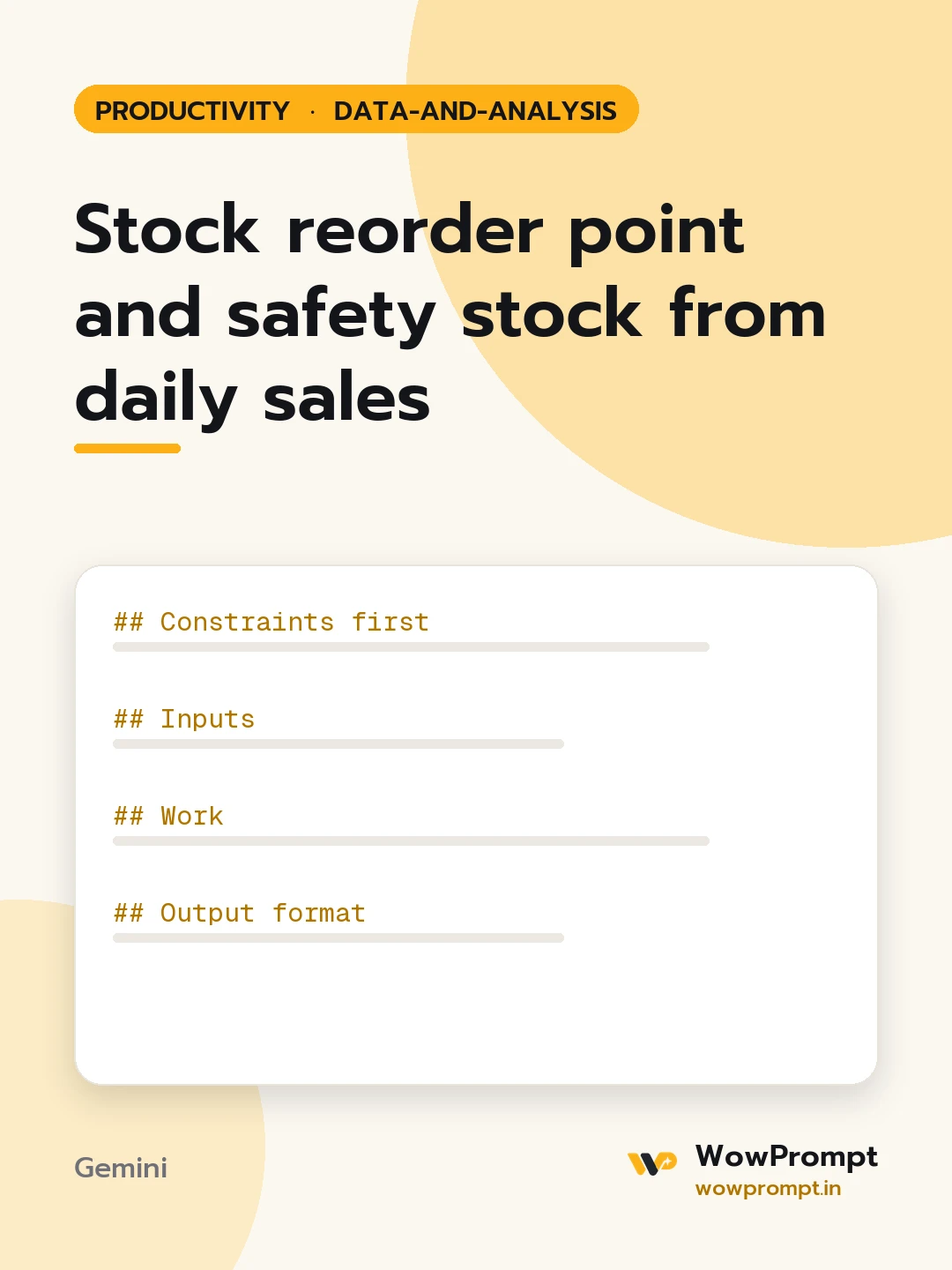
Stock reorder point and safety stock from daily sales
Calculates when to reorder each item and how much buffer to keep, from daily sales history and supplier lead times, so a shop or warehouse stops running out of fast sellers while cash is not locked in slow ones. Use it before a busy season or whenever stockouts and overstock happen together.
The output this prompt produced, unedited.
The prompt
Constraints first
Use only the sales and lead times given; never assume a demand figure.
Show the formula once, then apply it the same way to every item.
Round order quantities to the supplier's pack size.
Mark items with fewer than 30 days of history as low confidence.
Inputs
Daily sales per item: [paste rows: date, SKU, item name, units sold]
Supplier lead time per item, normal and worst case: [e.g. 5 days, 9 days]
Current stock on hand and on order: [paste rows]
Pack size or minimum order: [e.g. cartons of 24]
Service level wanted: [e.g. avoid stockouts on 95 percent of days]
Known events ahead: [e.g. Diwali week, a sale on 1 November]
Work
Average and variation of daily sales for each item.
Safety stock from the variation, the lead time and the service level.
Reorder point equals lead time demand plus safety stock.
Adjust for the listed events and explain the change.
Output format
| SKU | Avg daily sales | Lead time | Safety stock | Reorder point | Stock now | Order now? | Order quantity |
Items to order today, in one list.
Items carrying more than 60 days of stock.
reorder pointsafety stock calculationinventory planningstockout preventionreorder quantitylead time demand
How to run this
Copy the prompt and paste it into Gemini, then set the aspect ratio to 3:4. No reference photo is needed for this one.
The prompt is written in Markdown with each part under its own heading, which is what the copy action hands over. Change one section at a time, keeping the rest intact, so you can tell which change did the work.