Must hold
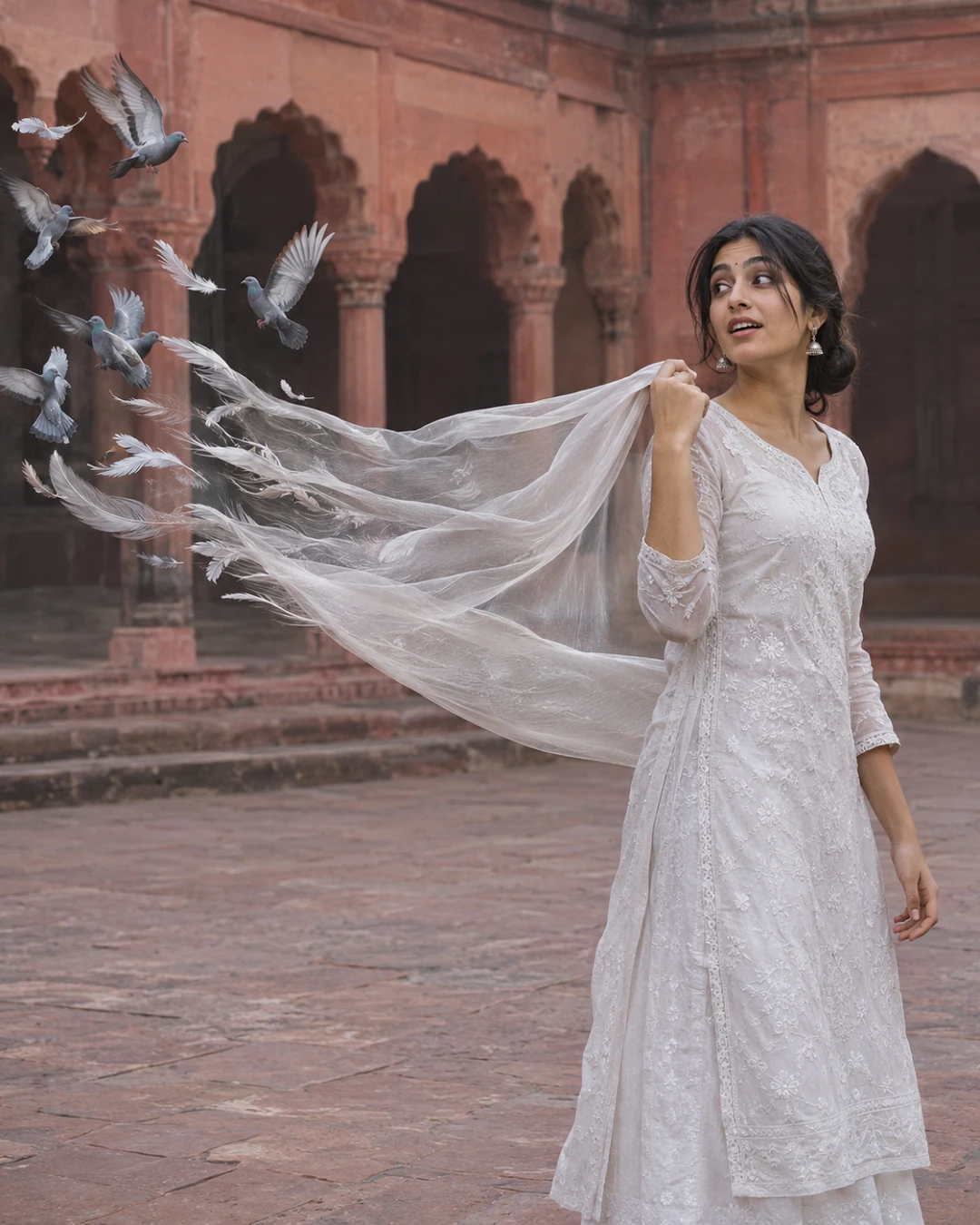
The key idea: only the trailing end of her dupatta changes. Its last metre frays into white threads, the threads become feathers, the feathers become real grey pigeons in flight. Her face, hands and the kurta stay a true photograph and are never broken, cracked or turned into particles.
Identity
With a photo attached: the person in the photo is the subject. Keep their face exactly as it is, with bone structure, eye shape and spacing, nose, lips, jawline, hairline, skin tone and apparent age all unchanged, and keep their own body: build, height and proportions, shoulders, arms, hands and legs, with the same skin tone on face, neck, arms and hands. Use the photo only for who the person is. Ignore its pose, expression, clothing, hairstyle, background, framing and light, and rebuild all of them exactly as described below, even when the photo shows them standing straight or dressed differently.
Pose
Standing three-quarter to the camera, weight on the right leg. Her right hand lifts the dupatta behind her shoulder so it streams to the left; the left hand rests at her side, fingers relaxed. Head turned to watch the birds, lips parted in surprise.
Wardrobe
A white straight chikankari kurta with shadow-work flowers, white palazzo, a sheer white dupatta, small silver jhumkas, bare face, kajal.
Setting and light
An empty red sandstone courtyard with arches, a cool grey winter morning, soft even light, true red stone, true white fabric. 85mm look, real skin with fine pores.