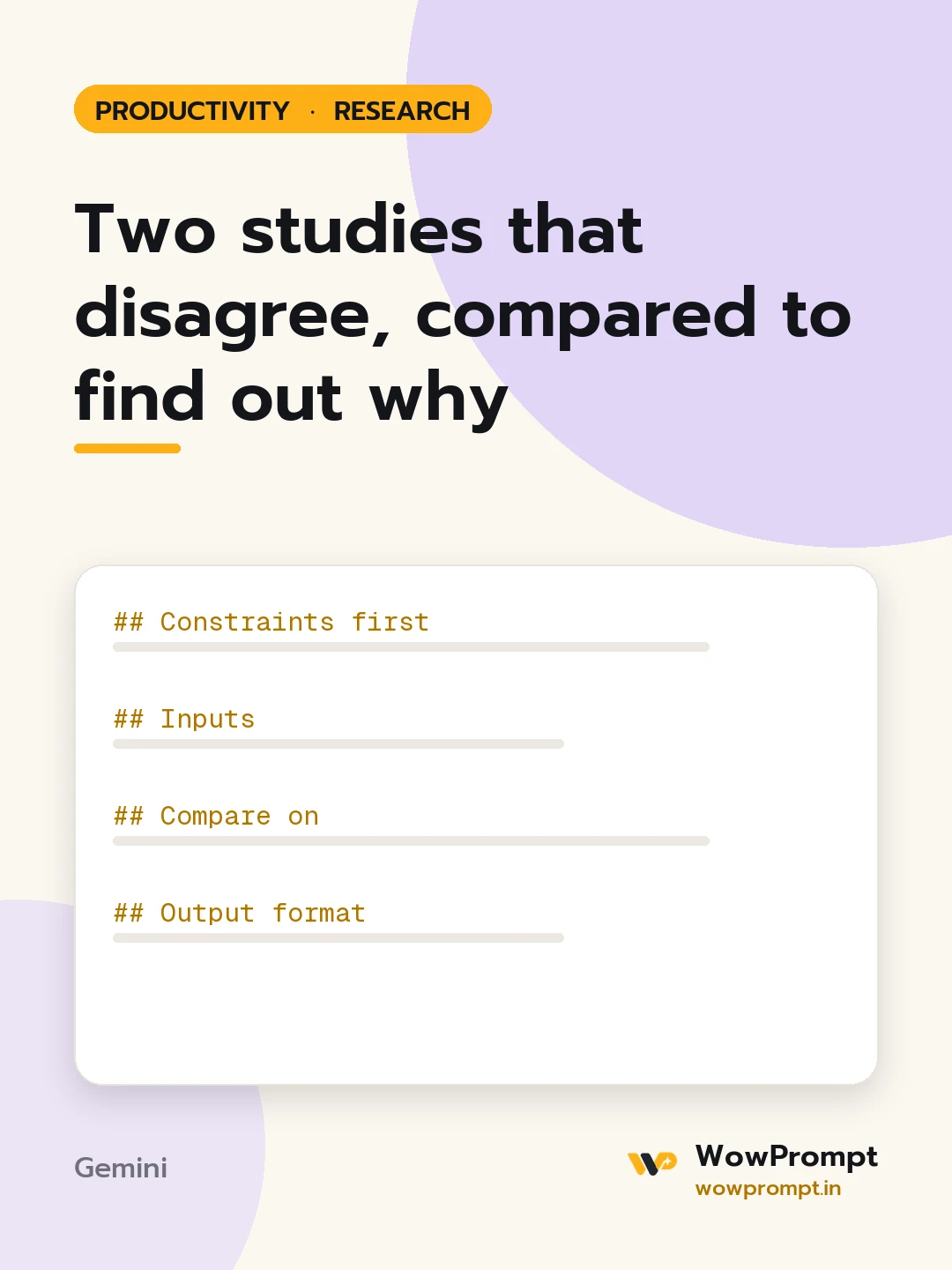
Constraints first
- Use only what the inputs say about each study. If a detail is missing, write "not reported" and say whether it matters.
- Do not pick a winner because of the journal name, the country or how recent it is alone.
- The conclusion may be "both can be true in different conditions" or "not enough evidence"; say so when that is the honest answer.
- No medical, legal or financial advice for a person; describe the evidence only.
Inputs
- The question both studies address: [e.g. does homework improve maths scores in primary school]
- Study A: [paste the abstract, methods and key results, or a summary with the citation]
- Study B: [paste the same]
- Any further studies: [paste, or none]
Compare on
Population and setting, sample size, design, how the outcome was measured, definition of the key term, follow-up length, effect size and uncertainty, missing data and dropouts, funding and conflicts of interest, and when the data was collected.
Output format
- | Factor | Study A | Study B | Could this explain the difference: yes, maybe, no |
- The likely reasons they disagree, ranked, each in two or three lines.
- What can be concluded, written for a non-expert in under 120 words, with a confidence level: low, moderate or high.
- The one study that would settle it: its design and population.