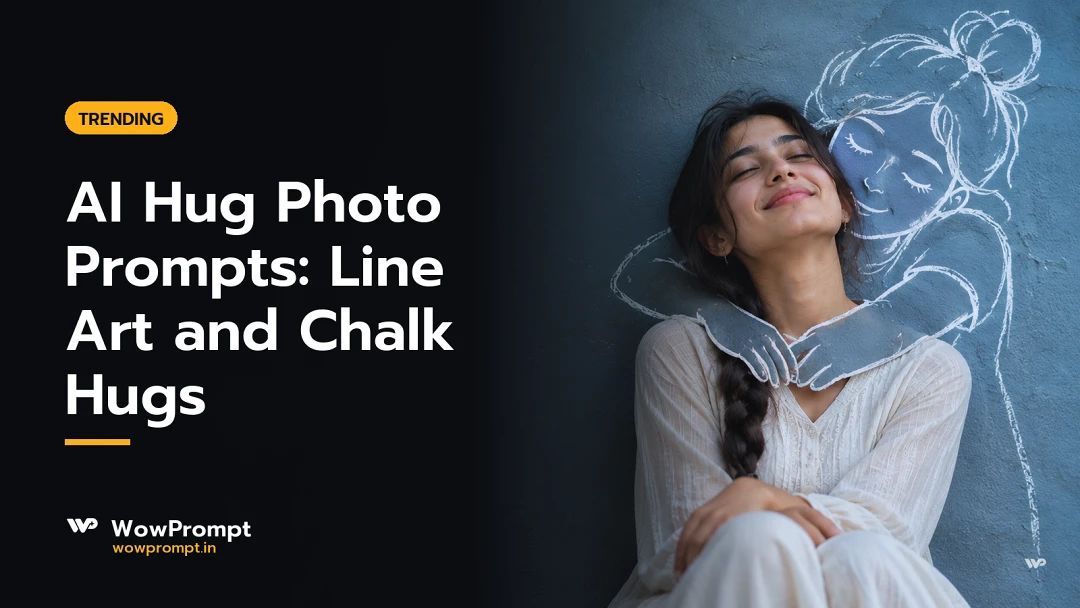
AI Hug Photo Prompts: 9 Line Art and Chalk Drawing Hugs
Copy-ready AI hug photo prompts for ChatGPT and Gemini: hug your younger self, a parent abroad or a pet you miss in line art or chalk, each with its result.
An AI hug photo prompt turns one clear photo of you into a real-looking photograph in which a drawn figure on the wall behind you, sketched in white line art, chalk, charcoal, pen or spray paint, wraps its arms around you: your six-year-old self, a parent who works abroad, a friend in another city or a dog you still miss. To make one, open ChatGPT or Gemini, attach your photo, paste one of the nine prompts below and send it. Each prompt is shown with the exact picture it made, so you can see the result before you try it.
What a drawing hug photo is and why it works
The idea is simple. You stand, sit or kneel against a plain wall, and a drawing on that wall reaches around you as if it were a person. Everything in the frame is a real photograph except the drawing. Your face, your clothes, the wall, the floor and the light all look like a phone or camera picture; only the lines of the figure are flat marks on the plaster. That contrast is what makes the picture feel personal rather than like a filter. The drawing stands for someone who cannot be in the photo, and your real pose, leaning into an arm that is only chalk, does the emotional work.
The format grew out of the "hug my younger self" edits that spread on Instagram and WhatsApp, where people merged a childhood photo with a current one. Those edits often looked like a cut-and-paste job, two photographs of different quality stuck together. The drawn version solves that problem. A line drawing does not have to match the light, the grain or the age of a real photo, so the model only has to get one real person right. That is also why it works so well for people who are gone or far away: a sketch says "this person is with me in spirit" without pretending to be a photograph of them.
Line art and chalk hugs are now among the fastest-rising formats on prompt sites. The self-hug line art birthday idea in particular was copied more than two hundred times in three days on one prompt site, but most pages that rank for an AI hug photo prompt are tool vendors with a generic list and no sample pictures. The prompts below are written to a stricter standard, and every one of them lives in our library with its own page and result.
How to use these AI hug photo prompts with your own photo
- Open ChatGPT or Google Gemini in a new chat. A fresh chat stops earlier images from leaking into the new one.
- Attach one clear, front-facing photo of the person who will be hugged. A photo that shows the shoulders helps the model keep your real build, which matters here because the drawn arms have to fit around them.
- Copy the whole prompt from the box and paste it under the photo. Keep every line, including the Identity line at the top and the Avoid line at the end.
- Change only what you need: the handwritten words in the Text line, the outfit in the Wardrobe line or the city in the Setting line. Leave the drawing description and the camera line as they are.
- Send it, then judge the arms first. If the drawn arms do not wrap around you, reply with one line: "Line the drawn arms up from the camera's view so they pass around my shoulders, and change nothing else."
The Identity line is what keeps your face. It tells the model to use your photo only for who you are and to rebuild the pose, clothes and background from the prompt. If you want to understand how that works, read our guide to identity lock prompts for a reference photo.
Hug your younger self: self hug AI photo prompts
The self-hug is the version most people search for first. The drawn figure is you as a child, so the prompt asks the model to give the drawing your face at a younger age. You only need one photo of yourself today.
1. Happy 25th from little me: self-hug line art birthday portrait
A pale lilac wall, a single continuous white line drawing of the same girl at six reaching round from behind, and the words "Happy 25th, from little me" in white brush script. Change the age in the Text line to your own birthday. It sits in our birthday prompts section, where you will find more milestone ideas.
Identity: With a photo attached: the person in the photo is the subject. Keep their face exactly as it is, with bone structure, eye shape and spacing, nose, lips, jawline, hairline, skin tone and apparent age all unchanged, and keep their own body: build, height and proportions, shoulders, arms, hands and legs, with the same skin tone on face, neck, arms and hands. Use the photo only for who the person is. Ignore its pose, expression, clothing, hairstyle, background, framing and light, and rebuild all of them exactly as described below, even when the photo shows them standing straight or dressed differently. The drawn child has the same face at age six.
The commission: A twenty-fifth birthday portrait with her younger self. She stands in front of a pale lilac wall; drawn on the wall in a single continuous white line, the line art of the same girl at six reaches round her from behind and hugs her, the drawn arms passing over her shoulders and the small hands meeting at her collarbone.
In frame: She stands facing the camera, shoulders relaxed, head tilted toward her right shoulder into the drawn child's cheek, eyes closed, a wide happy smile. Her right hand rises to rest over one drawn hand at her collarbone; her left arm hangs loosely at her side. The child's line-drawn face, with two pigtails, peeks over her left shoulder.
Wardrobe: An ivory cotton midi dress with a square neck and short puff sleeves, small pearl studs, a thin gold chain.
Text: - "Happy 25th, from little me" Handwritten in white brush script at the upper right of the wall. Nothing else is written anywhere; spell it exactly.
The light and lens: Soft, cool daylight from the front left. 50mm at f/2.8, her face and the line art both sharp. Natural true colour, real skin with pores, fine grain.
Avoid: airbrushed skin, plastic skin, waxy face, changed face, distorted hands, extra fingers, misspelled text, extra words, coloured drawing, broken lines, orange cast, warm wash, extra people, logo, watermark
Aspect ratio 4:5.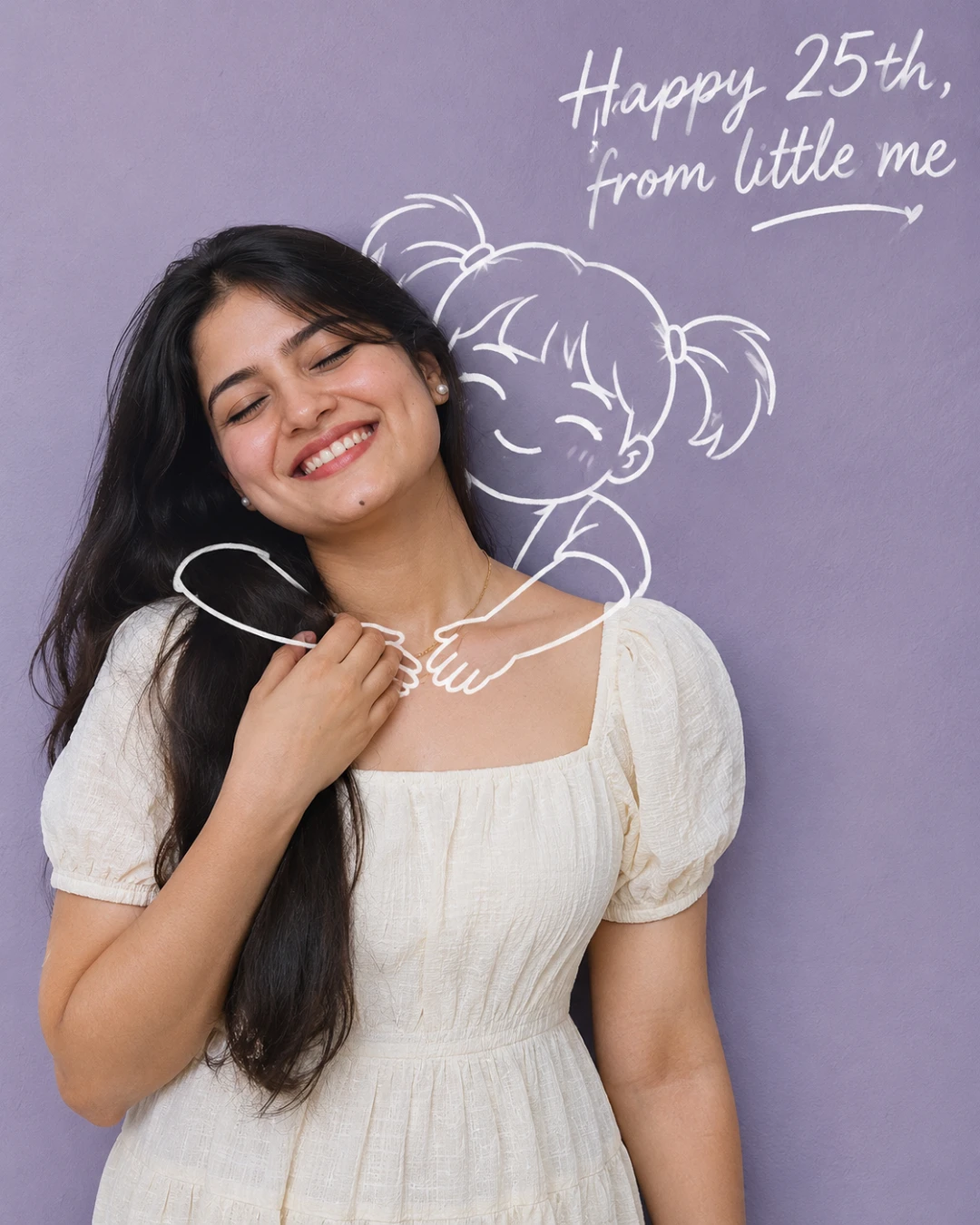
Open this prompt on its own page: Happy 25th from little me self-hug line art birthday portrait
2. Graduate in a blue ballpoint hug from her school-uniform self
Convocation day, a black gown and a mortarboard, and a quick blue pen drawing of a fourteen-year-old in a pinafore uniform on tiptoe behind her. The blue ballpoint look reads like a doodle in the margin of an old notebook, which suits a graduation picture perfectly. Swap "We made it" for your own line if you like.
Identity: With a photo attached: the person in the photo is the subject. Keep their face exactly as it is, with bone structure, eye shape and spacing, nose, lips, jawline, hairline, skin tone and apparent age all unchanged, and keep their own body: build, height and proportions, shoulders, arms, hands and legs, with the same skin tone on face, neck, arms and hands. Use the photo only for who the person is. Ignore its pose, expression, clothing, hairstyle, background, framing and light, and rebuild all of them exactly as described below, even when the photo shows them standing straight or dressed differently.
Base: On convocation day, a young woman in a black gown stands against a pale blue corridor wall of a college in Pune, hugged from behind by a blue ballpoint-style line drawing of her younger self in a school uniform. Everything is a real photograph except the drawing, which is flat blue ballpoint-style line work on the wall surface.
Add: pose: She stands with her back to the wall, weight on her left leg, torso turned a quarter to her right, shoulders lifted, head tipped back and to her right in a big open laugh, eyes squeezed shut. Her left hand holds a rolled degree scroll tied with a red ribbon against her hip; her right hand rests over the drawn hands at her collarbone.
Add: the drawing: A girl of about fourteen, drawn shorter than her, standing on tiptoe behind her right shoulder: a pinafore uniform with a tie, two plaits, a school bag strap, in quick hatched blue pen lines. Her drawn arms come around the woman's neck from behind, lined up from the camera's view so they wrap her shoulders and meet at her collarbone.
Add: wardrobe: A black polyester graduation gown with wide sleeves, a black mortarboard with a black tassel, a white cotton shirt collar showing, small silver hoops, her hair loose.
Add: text: Handwritten in the same blue pen, above the drawing: - "We made it"
Lock: The drawing stays flat blue line work on the wall; the wall stays pale blue plaster with a grey skirting band.
Camera: 85mm at f/1.8, eye level, full length with headroom, corridor arches soft behind.
Grade: Cool daylight from the open corridor arches, natural cool colour, real skin with pores, fine grain.
Avoid: airbrushed skin, plastic skin, waxy face, changed face, distorted hands, extra fingers, drawn arms not wrapping her, real child, colour-filled drawing, college name, logo, misspelled text, extra words, orange cast, watermark
Aspect ratio 9:16.
Open this prompt on its own page: Graduate in a blue ballpoint hug from her school-uniform self in Pune
More solo portrait ideas live in our portrait prompts section.
Hugs from someone far away
These prompts are for the people who are alive and well but not in the same city: a husband on a posting, a father working in the Gulf, a best friend who moved for a job. The drawing stands in for them, and the handwritten line says what you would say on a call.
3. Chalk-line hug from her army husband on a Ranikhet slate wall
A slate-grey hill-station wall, a life-size white chalk figure in a peaked cap and service uniform with no detailed face, and "Counting days" chalked beside her shoulder. She holds a folded letter. It belongs to our couple prompts section; for partners the same idea works with any uniform or work outfit.
Identity: With a photo attached: the person in the photo is the subject. Keep their face exactly as it is, with bone structure, eye shape and spacing, nose, lips, jawline, hairline, skin tone and apparent age all unchanged, and keep their own body: build, height and proportions, shoulders, arms, hands and legs, with the same skin tone on face, neck, arms and hands. Use the photo only for who the person is. Ignore its pose, expression, clothing, hairstyle, background, framing and light, and rebuild all of them exactly as described below, even when the photo shows them standing straight or dressed differently.
Subject: A young woman stands against the slate-grey outer wall of an old cantonment-town house in Ranikhet, hugged from behind by a white chalk-line drawing of her husband, an army officer posted far away. Everything is a real photograph except the drawing, which is flat white chalk on the wall surface.
The drawing: A life-size figure in simple, confident chalk lines: a tall man in a peaked cap and service uniform, sketched with no detailed face, only a calm profile. He stands behind her; his drawn arms come around her from behind, lined up from the camera's view so they pass outside her shoulders and cross at her waist, his drawn chin resting above her left shoulder.
Pose: She stands with her back against the wall and her weight on her right leg, torso square to the camera, head tilted back and to her left into the drawn shoulder, eyes closed, a small aching smile. Her right hand rests flat on her waist over the drawn hands; her left hand holds a folded letter against her chest. Feet together, slightly turned out.
Wardrobe: A rust hand-knitted wool cardigan, open, over an ivory cotton kurta to the knee, straight blue jeans, brown leather ankle boots, a thin gold chain, small gold studs, her hair loose.
Setting: The dark slate-grey wall is rough lime plaster; a green wooden window frame sits to the left, a potted red geranium on the step. The words under Text are handwritten in white chalk beside her right shoulder.
Text: - "Counting days"
Light: Soft overcast hill daylight, cool blue-grey, pine haze far behind.
Camera: 85mm at f/2, eye level, three-quarter length. Natural cool colour, real skin with pores, fine grain.
Avoid: airbrushed skin, plastic skin, waxy face, changed face, distorted hands, extra fingers, drawn arms not wrapping her, raised or 3D chalk, real man, detailed drawn face, rank insignia, misspelled text, extra words, orange cast, watermark
Aspect ratio 4:5.
Open this prompt on its own page: Chalk-line hug from her army husband on a Ranikhet slate wall
4. Girl in a chalk hug from her father abroad on a Kerala veranda wall
A small girl in a mustard frock against a deep navy veranda wall, wrapped in a kneeling chalk father, with a small suitcase, a tiny plane on a dotted path and "Papa, come home soon" in a child's uneven capitals. Attach a photo of your child. The dark wall makes the white chalk read clearly even on a small phone screen.
Identity: With a photo attached: the person in the photo is the subject. Keep their face exactly as it is, with bone structure, eye shape and spacing, nose, lips, jawline, hairline, skin tone and apparent age all unchanged, and keep their own body: build, height and proportions, shoulders, arms, hands and legs, with the same skin tone on face, neck, arms and hands. Use the photo only for who the person is. Ignore its pose, expression, clothing, hairstyle, background, framing and light, and rebuild all of them exactly as described below, even when the photo shows them standing straight or dressed differently.
Subject: A little girl stands against the deep navy wall of her family's veranda in Kerala, wrapped in a life-size white chalk line drawing of her father, who works abroad, kneeling so his chalk arms circle her shoulders.
Text: - "Papa, come home soon"
Pose: She stands with her back to the wall, feet together, torso turned slightly left, her cheek pressed to the chalk father's chest, eyes closed. Her right hand rests flat on his drawn forearm; her left hand holds a small piece of white chalk at her side. A quiet, happy smile with the gap showing.
The drawing: Clear single-line chalk: a kneeling man with short wavy hair, a thick moustache and a collared shirt, smiling down at her. Beside him a small suitcase and a tiny plane with a dotted path. The line sits above her head in a child's uneven capitals.
Wardrobe: A mustard-yellow cotton frock with puff sleeves to the knee, small gold ear studs, black glass bangles, bare feet.
Setting and light: Red oxide floor, a brass lamp unlit in the corner, a coconut palm soft beyond the pillars. Soft cool morning daylight from the open side.
Camera and finish: 85mm at f/2, at her eye level, full length. Natural cool colour, true navy and mustard, real skin with pores, fine grain.
Avoid: airbrushed skin, plastic skin, waxy face, changed face, distorted hands, extra fingers, orange cast, misspelled text, extra words, coloured chalk, photographic father, ghost figure, adult in frame, logo, watermark
Aspect ratio 4:5.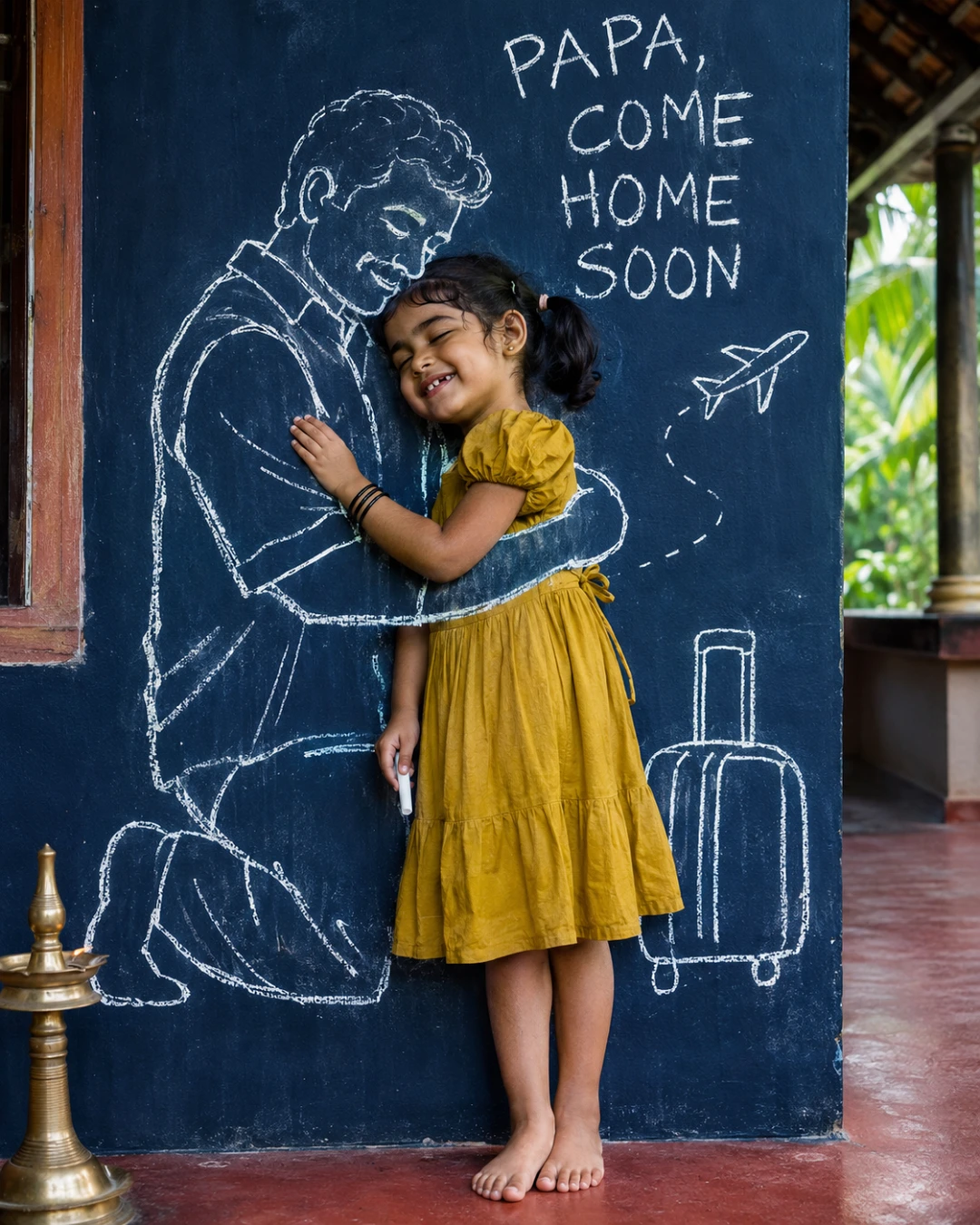
Open this prompt on its own page: Girl in a chalk hug from her father abroad on a Kerala veranda wall
5. Neon-pink spray-paint hug from a faraway best friend
Night under a flyover in Guwahati, raw concrete, and a best friend in loose neon-pink spray lines with a cap and a backpack, one drawn arm across his chest and the other hand ruffling his hair. "Same time next year" is sprayed above his shoulder. It is the louder, street version of the trend, and the only one where colour is part of the drawing.
Identity: With a photo attached: the person in the photo is the subject. Keep their face exactly as it is, with bone structure, eye shape and spacing, nose, lips, jawline, hairline, skin tone and apparent age all unchanged, and keep their own body: build, height and proportions, shoulders, arms, hands and legs, with the same skin tone on face, neck, arms and hands. Use the photo only for who the person is. Ignore its pose, expression, clothing, hairstyle, background, framing and light, and rebuild all of them exactly as described below, even when the photo shows them standing straight or dressed differently.
Must hold: One real person only. Everything is a real photograph except the drawing, which is flat neon-pink spray paint on the wall surface, with soft overspray at its edges. The drawn arms visibly wrap him. The only words are the ones under Text, spelled exactly. Colour stays cool blue-grey apart from the pink paint; nothing turns orange.
Text: - "Same time next year"
The picture: Late at night under a flyover in Guwahati, near the Brahmaputra, he stands with his left shoulder and back against a raw concrete wall, body angled a quarter to the camera, weight on his right leg, left ankle crossed over it. His head leans toward his left into the drawn friend's cheek, chin up, eyes on the lens, a wide grin. The drawn friend, his height, in loose bold neon-pink spray lines with a cap and a backpack, stands at his left side; the drawn right arm comes round behind his neck and across his chest, lined up from the camera's view so it appears to wrap him, the drawn left hand ruffling his hair. His right hand (on the left of the frame) is in his jacket pocket; his left hand (on the right of the frame) reaches up and grips the drawn forearm on his chest. He wears a black nylon puffer jacket, a charcoal hoodie, black cargo trousers and white sneakers. The text is sprayed in pink above his right shoulder. A spray can lies at his feet.
Technical: A cool white LED streetlight from frame right, blue-grey night. 50mm at f/1.8, chest height, knees up. Real skin with pores, fine grain.
Avoid: airbrushed skin, plastic skin, waxy face, changed face, distorted hands, extra fingers, drawn arm not wrapping him, glowing neon tube, real second person, misspelled text, extra words, orange cast, watermark
Aspect ratio 2:3.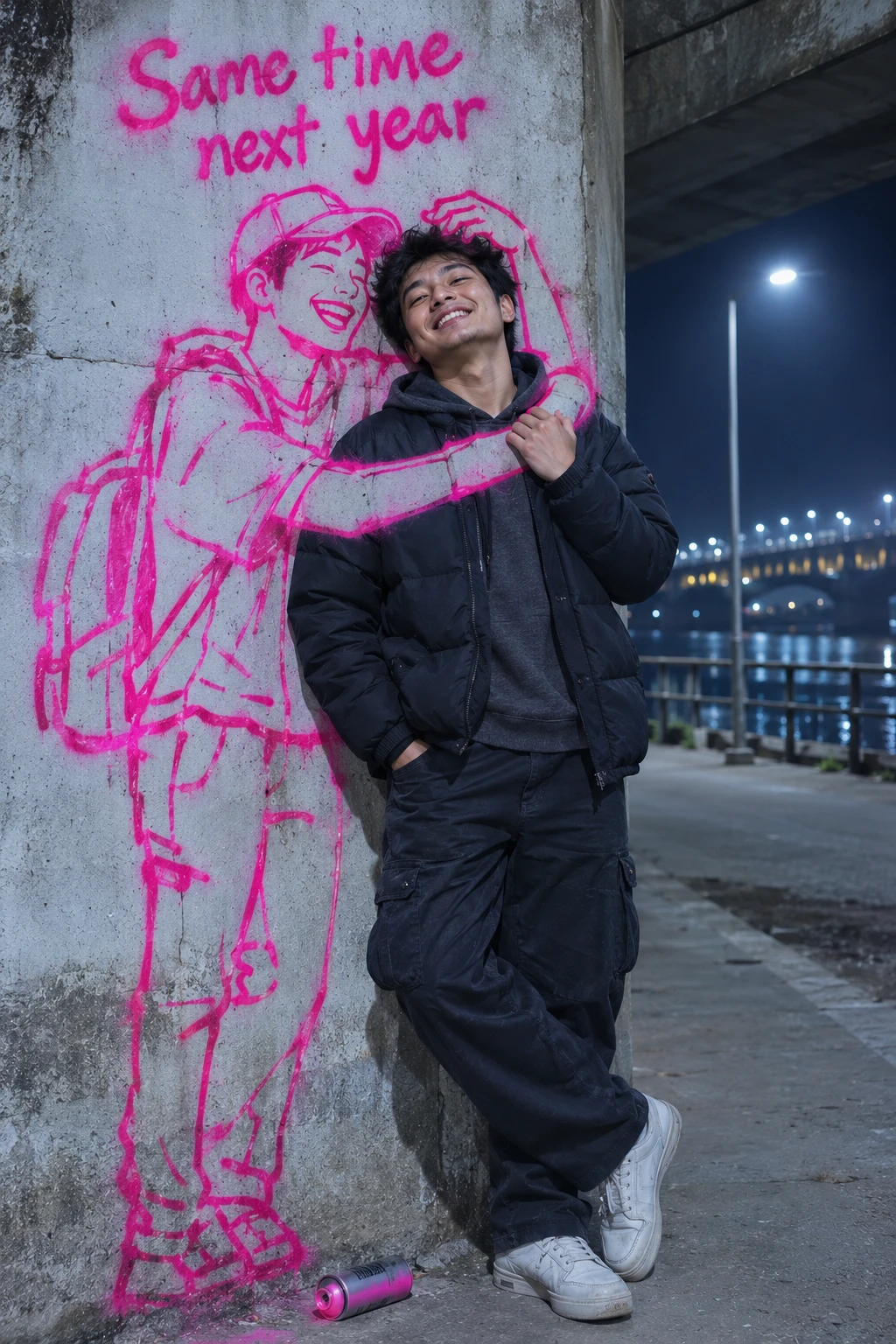
Open this prompt on its own page: Neon-pink spray-paint hug from a faraway best friend in Guwahati
Hugs from someone you miss
These are the gentlest prompts in the set. They are made for remembering a parent, a grandparent or a pet, so the drawings are kept soft and simple, with faces only suggested and no ghostly glow.
6. New mother and baby in a charcoal hug from her late mother
A new mother holds her sleeping baby against a whitewashed wall in a Goan village house, and a smudged charcoal drawing of her late mother wraps them both. It is the meeting that never happened. Attach one photo of the mother, or one with both mother and baby; if only the mother is in it, the prompt creates the baby. Browse our baby and family prompts for more family scenes.
Identity: With a photo attached: the two people in the photo are the subjects. Keep each face exactly as it is, with bone structure, eye shape and spacing, nose, lips, jawline, hairline, skin tone and apparent age all unchanged, and keep each person's own body: build, height and proportions, shoulders, arms, hands and legs, with the same skin tone on face, neck, arms and hands. Use the photo only for who they are. Ignore its poses, expressions, clothing, hairstyles, background, framing and light, and rebuild all of them exactly as described below, even when the photo shows them standing straight or dressed differently. If the photo shows only the mother, keep her face and create the baby as described below.
The commission: Photograph the meeting that never happened: a new mother stands with her baby against a whitewashed wall in her family's village house in Chandor, Goa, and a charcoal line drawing of her late mother wraps them both in a hug. Everything is a real photograph except the drawing, which is flat charcoal on the wall surface.
In frame: The mother stands with her back to the wall, torso turned a quarter to her left, head bowed toward the baby, eyes wet and soft, a trembling smile. Her left arm cradles the sleeping baby against her chest, her right hand supporting the baby's head. The drawn grandmother stands behind them, a little shorter: an older woman in soft, smudged charcoal lines, a sari pallu over one shoulder, her face only suggested. Her drawn arms reach around both, lined up from the camera's view so one passes outside the mother's left shoulder and the other curves round the baby's back, her drawn cheek tilted against the mother's hair.
Wardrobe: The mother wears a pale blue cotton house dress to mid-calf with short puff sleeves and a round neck, a thin gold chain with a small cross, a gold wedding band. The baby is wrapped in a white muslin swaddle.
The set: A thick lime-whitewashed wall, faintly uneven, a red oxide floor, a blue-painted wooden door ajar to the right, a carved rosewood chair edge at frame left.
The light: Cool morning daylight from an open window at frame right, soft and blue-white.
How it is shot: 85mm at f/1.8, eye level, framed from the knees up. Natural cool colour, real skin with pores, fine grain.
Avoid: airbrushed skin, plastic skin, waxy face, changed face, distorted hands, extra fingers, drawn arms not wrapping them, ghostly glow, translucent figure, real older woman, detailed drawn face, text, orange cast, watermark
Aspect ratio 3:4.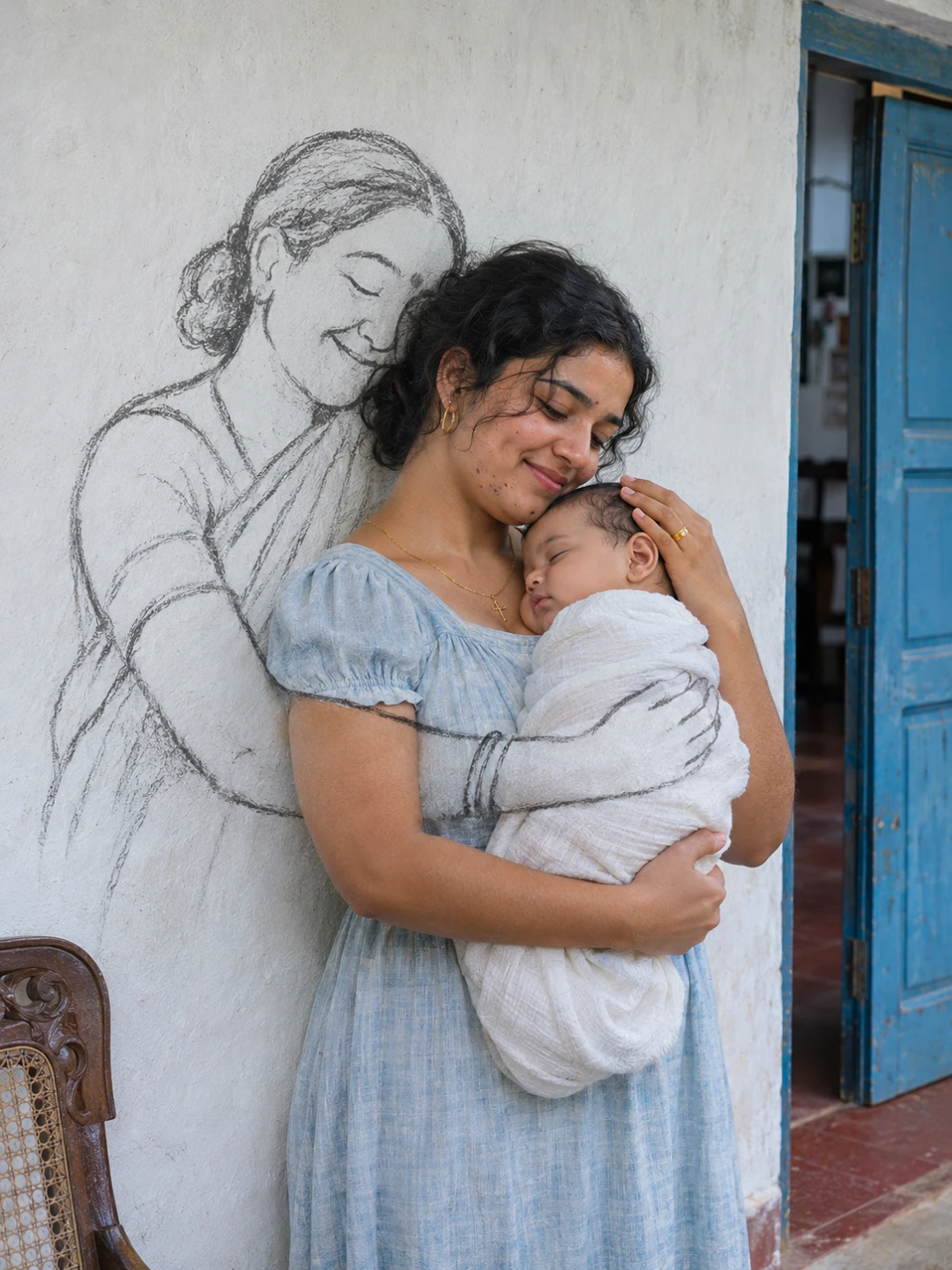
Open this prompt on its own page: New mother and baby in a charcoal hug from her late mother in Goa
7. Paint-marker hug from his late dog on a mustard Jaipur lane wall
A young man kneels at a mustard lime-plaster wall while a white paint-marker drawing of his old indie dog leans in with its front legs over his shoulders, and his real new puppy sits at his knee. The prompt bans halos and angel wings on purpose: the picture is about the dog, not about heaven. Find more animal portraits in our pets and animals prompts.
Identity: With a photo attached: the person in the photo is the subject. Keep their face exactly as it is, with bone structure, eye shape and spacing, nose, lips, jawline, hairline, skin tone and apparent age all unchanged, and keep their own body: build, height and proportions, shoulders, arms, hands and legs, with the same skin tone on face, neck, arms and hands. Use the photo only for who the person is. Ignore its pose, expression, clothing, hairstyle, background, framing and light, and rebuild all of them exactly as described below, even when the photo shows them standing straight or dressed differently.
Logline: On a quiet lane in Jaipur's old city, a young man kneels at a mustard-yellow wall while a white paint-marker drawing of his old dog leans into his chest in a hug, and his real new puppy sits at his feet. Everything is a real photograph except the drawing, which is flat white paint marker on the wall surface.
Subject: He kneels on both knees with his back against the wall, torso upright and turned slightly to his right, head tilted down and to his left, his cheek pressed against the drawn dog's head, eyes closed, a quiet broken smile. The drawn dog is a big floppy-eared indie, life-size, in clean white lines, standing on its hind legs; its two front legs come over his shoulders and around his neck, lined up from the camera's view so they appear to wrap him. His right arm reaches up, his hand flat on the wall behind the drawn neck as if holding it; his left hand rests on the head of the real puppy.
Puppy: A real fawn-brown indie puppy of about ten weeks with a white chest patch and a thin red cotton collar, sitting against his left knee, looking up at him.
Wardrobe: An olive cotton overshirt, open, over a plain white crew-neck T-shirt, faded black jeans, white canvas sneakers, a steel kada on his right wrist.
Set: A mustard-yellow lime-plaster wall with faded patches, a pale blue wooden door at frame left, an empty stone lane behind.
Light: Cool morning shade in the lane, soft blue-white sky light.
Lens: 50mm at f/2, from his eye level, framed from the head to the knees.
Grade: Natural cool colour, true mustard, real skin with pores, fine grain.
Avoid: airbrushed skin, plastic skin, waxy face, changed face, distorted hands, extra fingers, drawn paws not wrapping him, raised paint, cartoon puppy, second real dog, angel wings, halo, text, orange cast, watermark
Aspect ratio 1:1.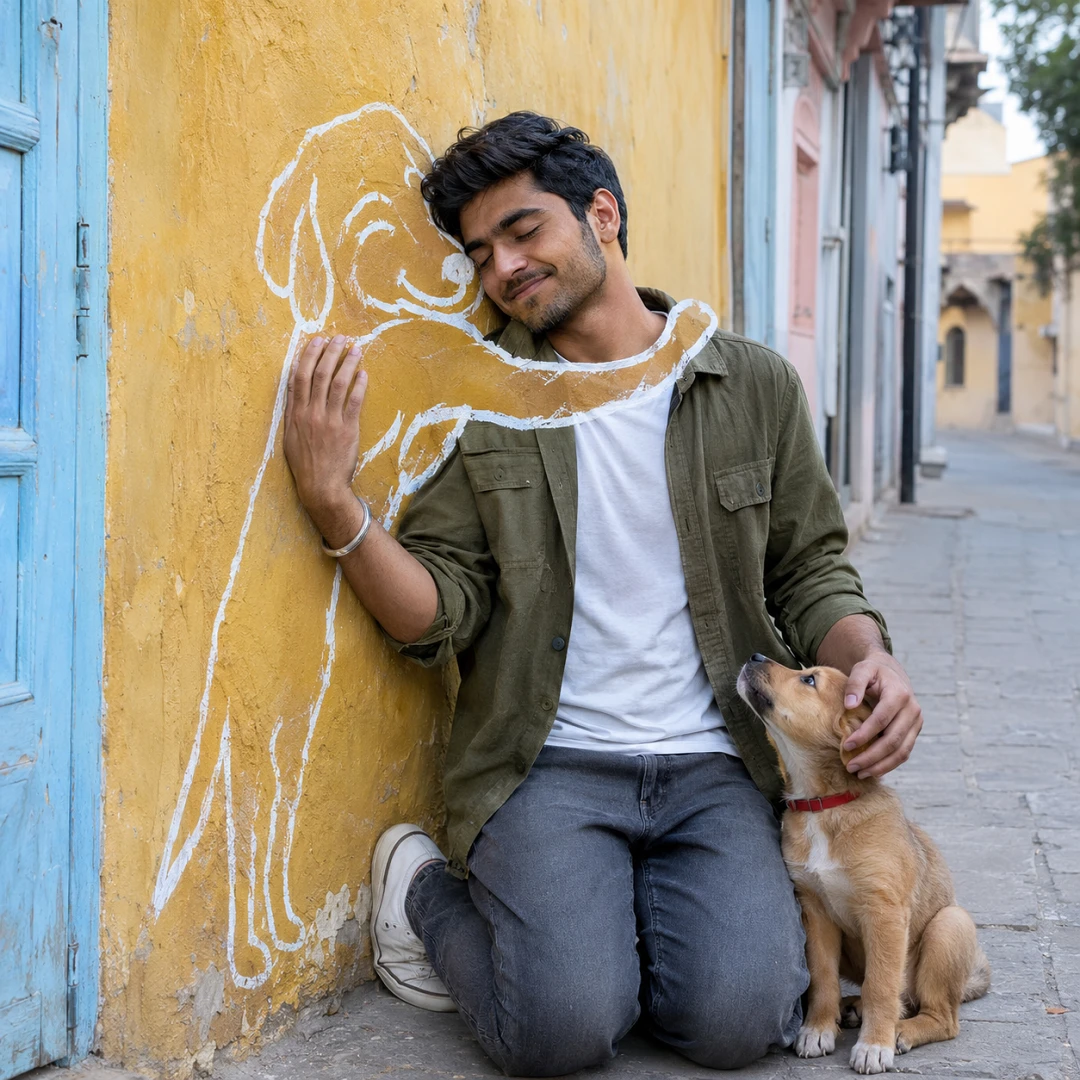
Open this prompt on its own page: Paint-marker hug from his late dog on a mustard Jaipur lane wall
8. Toddler in a chalk hug from his grandfather on a blue school wall
A laughing toddler in a mustard sweater leans back into a big white chalk grandfather with round glasses and a moustache, beside the words "a hug from [Name]". Replace [Name] with what your child calls the grandparent, such as Dadu, Nanu or Thatha, and spell it exactly. It works just as well for a grandparent who lives far away as for one who has passed.
Identity: With a photo attached: the child in the photo is the subject. Keep their face exactly as it is, with bone structure, eye shape and spacing, nose, lips, jawline, hairline, skin tone and apparent age all unchanged, and keep their own body: build, height and proportions, shoulders, arms, hands and legs, with the same skin tone on face, neck, arms and hands. Use the photo only for who the child is. Ignore its pose, expression, clothing, hairstyle, background, framing and light, and rebuild all of them exactly as described below, even when the photo shows them standing straight or dressed differently.
Subject: The key idea: the drawn figure is someone he loves. A laughing toddler stands against a sky-blue painted school wall, and a big white chalk drawing of his grandfather wraps its arms round him, so the line art reads as a real hug from a real person.
Pose: He stands with his back against the wall, feet apart in small white sneakers, leaning his shoulders into the chalk chest. His torso faces the camera. His left arm reaches across to hold the chalk hand that rests on his right shoulder; his right arm hugs the drawn forearm crossing his tummy, fingers spread on the chalk. Head tipped back to look up at the drawn face, eyes squeezed, mouth wide open in a belly laugh.
Wardrobe: A mustard cable-knit cotton sweater with a round neck, slightly long in the sleeves, navy corduroy dungarees rolled once at the ankle, white socks. Hair a little messy.
Setting: Above and around him, drawn in thick white chalk lines: an old man's face with round glasses, a moustache and a wide smile, his shoulders, and two long arms closing round the boy. Beside the drawing, in loose handwritten chalk, the words from Text. A grey cement ledge at the wall's foot holds a stub of chalk.
Text: - "a hug from [Name]" (sample: a hug from Dadu) Nothing else is written anywhere.
Light: Soft cool daylight from an open sky on the right, gentle shadow under his chin, the blue wall true and clean.
Camera: 50mm at f/2.8, at his eye height, full length, wall and chalk lines sharp.
Finish: Natural true colour, real skin, chalk dust visible on the blue, fine grain.
Avoid: airbrushed skin, plastic skin, waxy face, changed face, distorted hands, extra fingers, extra people, real grandfather in frame, coloured chalk, misspelled text, extra words, orange cast, logo, watermark
Aspect ratio 4:5.
Open this prompt on its own page: Toddler in a chalk hug from his grandfather on a blue school wall
Hugs with friends: line doodle AI hug photo prompt
Not every drawing has to be a person. The lightest version of the trend uses small doodles that seem to have come alive around you.
9. Line-doodle friends hugging a reader on a library floor
A young woman reads cross-legged between tall library shelves while white marker doodles keep her company: a smiling cloud hugging her shoulder, a round cat curled at the edge of the book, and stars and a crescent moon peeking out of the pages. Here the lines are drawn over the photograph rather than on a wall, so it works in any room. It sits in our illustration and 3D prompts section.
Identity: With a photo attached: the person in the photo is the subject. Keep their face exactly as it is, with bone structure, eye shape and spacing, nose, lips, jawline, hairline, skin tone and apparent age all unchanged, and keep their own body: build, height and proportions, shoulders, arms, hands and legs, with the same skin tone on face, neck, arms and hands. Use the photo only for who the person is. Ignore its pose, expression, clothing, hairstyle, background, framing and light, and rebuild all of them exactly as described below, even when the photo shows them standing straight or dressed differently.
Base: A real photograph of a young woman reading on the floor between library shelves, with simple white hand-drawn line doodles drawn on top of the photo as if they have come alive around her.
Add: pose: Sitting cross-legged on the floor, back against the lower shelf, torso turned slightly to the camera's left. Head tilted toward her right shoulder, eyes down on the page, a small private smile. Both hands hold an open hardback book on her knees, the left thumb keeping the page flat, the right fingers lifting the corner of the next page.
Add: wardrobe: A dusty-lilac cotton knit cardigan, buttoned, over a white round-neck tee; wide-leg indigo denim jeans; white socks. Thin gold-rimmed round glasses. Hair in a loose low bun with a pencil pushed through it.
Add: the doodles: Clean white marker lines, slightly uneven like a real hand: a small cloud with a smiling face wrapping both arms around her right shoulder; a round cat curled at the edge of the open book; three stars and a tiny crescent moon peeking out of the book's pages.
Add: set and light: Tall dark wooden shelves of worn spines on both sides. Soft cool daylight from a high window on the left.
Camera and finish: 50mm at f/2, eye level from seated height. Natural colour, real skin texture.
Avoid: airbrushed skin, plastic skin, waxy face, changed face, coloured doodles, cartoon person, thick clumsy lines, orange cast, distorted hands, extra fingers, text, logo, watermark
Aspect ratio 3:4.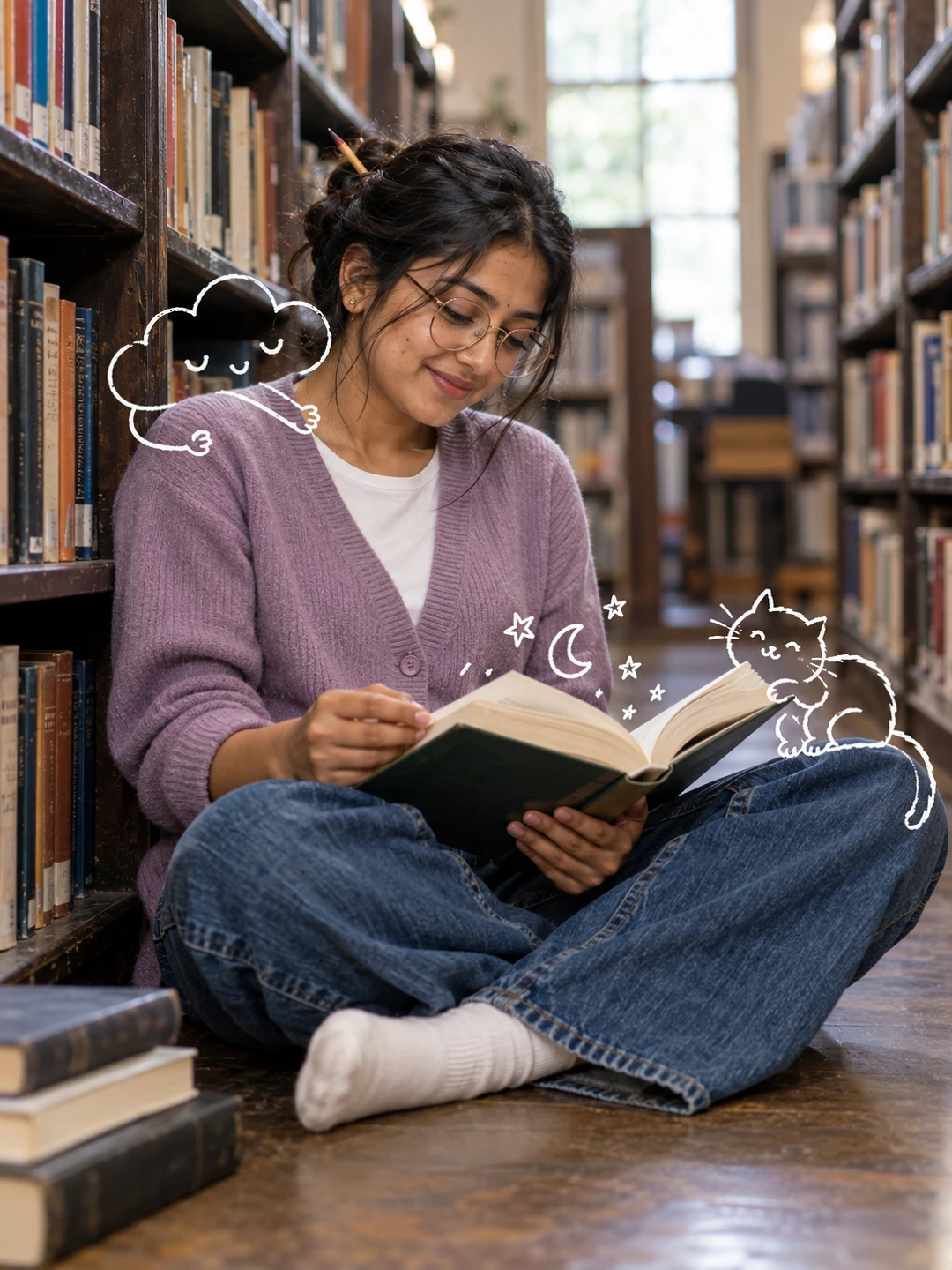
Open this prompt on its own page: Line-doodle friends hugging a reader on a library floor
How to make a drawing hug photo look right
Most failed hug pictures fail in the same few ways, and every prompt above already contains the fix. If you write your own, or edit one of these, keep these rules.
- Everything is a real photograph except the drawing. Put that sentence in the prompt in those words. Without it, the model often turns the whole picture into an illustration, or turns the drawn figure into a second real person.
- Line the arms up from the camera's view. A drawing on a wall cannot really go behind you, so the arms only look like a hug if they are drawn to pass outside your shoulders and meet or cross in front of you from where the camera stands. Say where the hands land: at the collarbone, across the chest or at the waist.
- Keep the drawing flat on the wall. Name the medium and the surface: flat white chalk on slate, blue ballpoint on plaster, spray paint with soft overspray on concrete. Add "raised or 3D chalk", "glowing neon tube" or "translucent figure" to the Avoid line.
- Give the real person a job. A hand resting over the drawn hand, a cheek pressed into the drawn shoulder or eyes closed against a drawn chest is what sells the hug. A person standing straight next to a drawing looks pasted in.
- Keep the handwritten text short and spell it exactly. Two to five words work best. Put them in quotes, say where on the wall they go, and add "Nothing else is written anywhere; spell it exactly."
- Keep the colour cool. Soft daylight, overcast light or a white streetlight keeps skin real and the lines crisp. Words like "golden hour" and "warm glow" wash the wall orange and soften the drawing.
Common mistakes with AI hug photos
- Asking for "a hug from my grandmother" with no drawing medium. The model will invent a real grandmother, often with a face that is not hers. Naming chalk or charcoal keeps the figure as a drawing.
- Detailed drawn faces for people you have lost. A detailed sketch rarely looks like the real person and can feel wrong. A suggested face, a profile or a back view lets the viewer fill it in.
- Busy backgrounds. Brick, posters and graffiti swallow thin lines. A plain painted or plastered wall makes the drawing read at a glance.
- Too many words on the wall. Long messages come back misspelled. Put the long message in your caption and keep the wall short.
- Rewriting the whole prompt to change one thing. Change one line at a time, such as Wardrobe or Text, and leave the rest alone.
Frequently asked questions
Which app makes AI hug photos?
ChatGPT and Google Gemini both make them from a photo you attach. Paste the full prompt under your photo in either app. Both follow the drawn-arm placement well when the prompt says exactly where the drawn hands land, so the result depends more on the prompt than on the app.
Can I hug my younger self with AI?
Yes. Prompts 1 and 2 are written for exactly that. Attach one photo of yourself today, and the prompt draws the child version with your face at a younger age as line art on the wall.
How do I add my own childhood photo?
Attach two photos: your current photo first and the childhood photo second. Then add one line after the Identity line: "The drawn child is based on the second photo, drawn as simple line art, not as a photograph." Keep the rest of the prompt unchanged.
Why do the drawn arms not wrap around me?
The model is drawing the arms flat on the wall behind you. Reply with: "Line the drawn arms up from the camera's view so they pass outside my shoulders and meet at my collarbone, and change nothing else." Naming where the hands land fixes it in most cases.
Is it free to make an AI hug photo?
Yes, within limits. Both ChatGPT and Gemini let free accounts create a few images a day, and paid plans raise that limit. The prompts on this page are free to copy and use.
Where to find more
Every prompt above has its own page in our image prompt library, with the sample picture and a one-click copy button. For more family ideas, read our ChatGPT family photo prompts guide; for birthday edits beyond the self-hug, see our birthday AI photo editing prompts; and for the other formats people are copying this week, see our trending photo editing prompts.