
Indian Wedding AI Photo Editing Prompts for 2026: 10 Ideas
Copy-ready Indian wedding AI photo editing prompts for ChatGPT and Gemini: haldi, mehendi, sangeet, baraat, pheras and vidaai, each with its picture.
An Indian wedding AI photo editing prompt turns one clear photo of you, or of you and your partner, into a picture from a real wedding day: turmeric on your cheek at the haldi, a lehenga spinning into a full circle at the sangeet, the seven pheras seen from straight above the mandap. Most wedding prompts online give you one of two results, a stiff studio pose or a picture washed in orange "golden glow" that makes red silk look brown and skin look plastic. This guide gives you ten tested prompts for ChatGPT and Gemini that cover the whole wedding week, from haldi to vidaai, each with the exact picture it made and its own page in our library.
Why Indian wedding AI photo editing prompts need more detail
The 2026 wedding season opens in late November, once Dev Uthani Ekadashi has passed, and runs through the winter into February. For most families that means a week of functions, each with its own outfit, its own place and its own light. A single vague line such as "make me look like a bride" cannot carry all of that, so the model fills the gaps with stock choices: a generic red lehenga, a blurred hall and a warm wash over everything.
Every prompt below does the opposite. It names one moment of one ritual, says exactly what each person wears, where each hand is and how the light falls, and asks for cool natural colour so that red stays red, ivory stays ivory and turmeric stays a true yellow. The result looks like a frame from a wedding photographer's gallery rather than an AI poster.
You will find many more scenes in our wedding prompts section, the couple prompts section and the traditional wear prompts section, all with sample pictures.
How to use these wedding prompts with your own photo
- Open ChatGPT or Google Gemini in a new chat.
- Attach one clear, front-facing photo of each person who should appear. For a couple prompt, one photo of the two of you together works well, as long as both faces are sharp and evenly lit.
- Copy the full prompt from the box and paste it under the photo.
- Keep the wardrobe and pose lines as they are the first time. They are what make the picture read as a real ceremony instead of a fancy-dress shoot.
- Keep the aspect ratio line. 4:5 suits an Instagram post and WhatsApp; 2:3 suits a printed portrait.
The first paragraph of each prompt tells the model to keep your face and body exactly as in your photo and to rebuild everything else: the outfit, the jewellery, the place and the light. That is why an everyday selfie in a T-shirt still comes back as a bride in a Banarasi lehenga or a groom on a white mare. Without a photo, the model invents an original person, which is how our sample pictures were made.
Indian wedding AI photo editing prompts for every function
1. Kerala bride at her haldi in a tharavad courtyard
The haldi is the most playful function of the week, and the hardest to get right in AI, because turmeric so easily turns the whole picture orange. This prompt keeps the yellow clean by placing the bride in cool shade under tiled eaves, laughing as a friend's hand smears paste across her cheek.
With a photo attached: the person in the photo is the subject. Keep their face exactly as it is, with bone structure, eye shape and spacing, nose, lips, jawline, hairline, skin tone and apparent age all unchanged, and keep their own body: build, height and proportions, shoulders, arms, hands and legs, with the same skin tone on face, neck, arms and hands. Use the photo only for who the person is. Ignore its pose, expression, clothing, hairstyle, background, framing and light, and rebuild all of them exactly as described below, even when the photo shows them standing straight or dressed differently.
Logline: Haldi morning in the nadumuttam of an old tharavad home near Thrissur: a bride laughs with her eyes squeezed shut as a friend's hand smears turmeric paste across her cheek.
Subject: She sits on a low teak stool, knees together, torso turned three quarters to the camera and leaning away from the hand, shoulders lifted in a giggle. Her left hand grips the stool edge; her right hand rises to her collarbone, fingers spread. Head tilted back to her left, eyes shut, mouth open in laughter. A friend's right hand enters from the frame edge, two fingers yellow on her cheek; only the hand shows.
Wardrobe: A pale yellow cotton kasavu skirt and a matching elbow-sleeve blouse with a thin muted gold border, a white mulmul dupatta over both shoulders, white jasmine strands in the braid, small gold jhumkas and a thin black bindi. Turmeric paste in true yellow streaks her cheeks, forearms and the backs of her hands.
Set: A laterite courtyard with a square open sky above, teak pillars, red oxide edging and dark tiled eaves; a brass uruli of turmeric paste beside her stool.
Light: Cool soft shade under the eaves, open daylight bouncing from the courtyard floor.
Lens: 50mm at f/2, eye level, waist up, the pillars soft behind.
Grade: Natural cool colour, true turmeric yellow, real skin with pores, fine grain.
Avoid: airbrushed skin, plastic skin, waxy face, changed face, distorted hands, extra fingers, orange cast, orange turmeric, warm wash, marigolds, a second face, crowd, text, logo, watermark
Aspect ratio 4:5.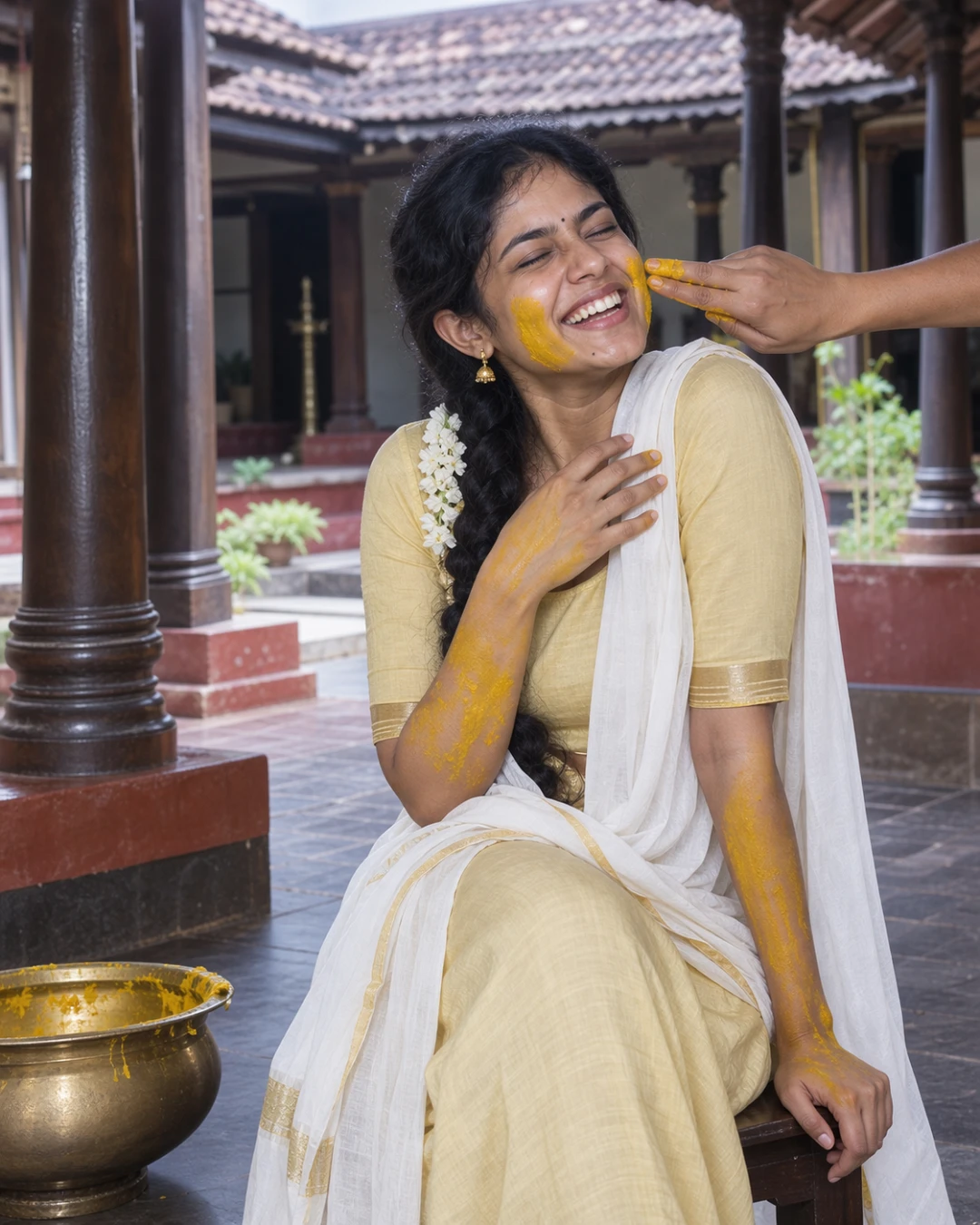
Open this prompt on its own page: Kerala bride at her haldi in a tharavad courtyard
For a louder North Indian haldi, try the haldi powder throw frozen mid-air over a laughing bride.
2. Bridal mehendi close-up with the groom tracing his hidden initial
Hiding the groom's initial in the bride's mehendi is a tradition every family loves to photograph. This one needs no photo at all: it is a hands-only overhead close-up, so it works for anyone. Swap the letter in the Text line for the groom's real initial.
Must hold: Hands only, no faces. Two open palms of the bride side by side, each with five fingers, plus one fingertip of the groom. The henna is fresh, a true green-brown, never black and never orange. The hidden letter is drawn in the same henna line as the rest, small, and only once.
Text: "[INITIAL]" The single letter sits inside a small lotus in the centre of her right palm, drawn into the pattern. Nothing else is written anywhere. Spell each line exactly.
The picture: Shot from directly above. Her palms lie open and slightly cupped on an ivory raw-silk cushion, wrists together, fingers relaxed. The mehendi runs from the fingertips to mid-forearm: fine paisleys, peacocks, a bride and groom in a small arch, net fills and dotted borders. Thin red and ivory chooda bangles stack at both wrists, and a slim silver ring sits on her left ring finger. From the top edge of the frame, the groom's right index finger, in the cuff of an ivory sherwani, touches the lotus in her right palm. Loose white jasmine buds lie on the cushion.
Technical: Soft cool daylight from a window on the left, even with gentle shadow. 100mm macro at f/4, every henna line crisp. Natural cool colour, true green-brown henna, real skin texture with creases and pores.
Avoid: airbrushed skin, plastic skin, waxy hands, distorted hands, extra fingers, missing fingers, black henna, orange henna, orange cast, faces, extra letters, misspelled letter, logo, watermark
Aspect ratio 4:5.
Open this prompt on its own page: Bridal mehendi close-up with the groom tracing his hidden initial
If you want faces in your mehendi pictures too, the mehendi ceremony bride laughing with her cousins prompt adds the whole gang.
3. Sage mirror-work lehenga twirl from a Udaipur haveli balcony
The sangeet twirl is the most shared bridal reel of the season. This prompt turns it into a still that works for the bride, a sister or any guest: a sage mirror-work lehenga flared into a perfect circle, seen from a balcony four metres above, with the face tipped up and sharp.
With a photo attached: the person in the photo is the subject. Keep their face exactly as it is, with bone structure, eye shape and spacing, nose, lips, jawline, hairline, skin tone and apparent age all unchanged, and keep their own body: build, height and proportions, shoulders, arms, hands and legs, with the same skin tone on face, neck, arms and hands. Use the photo only for who the person is. Ignore its pose, expression, clothing, hairstyle, background, framing and light, and rebuild all of them exactly as described below, even when the photo shows them standing straight or dressed differently.
Must hold: One woman only, seen from a balcony about four metres above. The lehenga flares into an even, full circle around her. Her face is turned up and sharp; only the hem shows motion. The courtyard floor is white marble, otherwise empty. The choli reaches the lehenga waistband, so no midriff shows. Cool light; the lamps are small warm points that light nothing.
The picture: She spins on the ball of her right foot, left foot lifting behind, torso tilted back so her face looks straight up into the lens, laughing with her mouth open. Her left arm is stretched out at shoulder height, palm open; her right arm curves above her head, fingers holding the edge of a sage dupatta that streams in a spiral. She wears a sage raw silk lehenga covered in small round mirrors and white thread, a long-line sage choli with elbow sleeves, a silver maang tikka and silver jhumkas. Small brass lamps ring the courtyard edge; carved white arches frame the corners.
Technical: Cool blue evening sky light, soft and even. 35mm at f/2.8, shot straight down from the balcony rail. Natural cool colour, true sage, white mirror glints, real skin with pores, fine grain.
Avoid: airbrushed skin, plastic skin, waxy face, changed face, distorted hands, extra fingers, orange cast, warm wash, bare midriff, blurred face, crowd, uneven skirt circle, fisheye distortion, text, logo, watermark
Aspect ratio 4:5.
Open this prompt on its own page: Sage mirror-work lehenga twirl seen from a Udaipur haveli balcony
The groom or a brother can match it with the sage green Nehru jacket over an ivory kurta at a sangeet night.
4. Groom's mother tying his sehra at a Jodhpur haveli doorway
Not every groom picture needs a horse. The sehra bandi, just before the baraat leaves, is one of the most emotional moments of the day, and it puts the groom's mother in the frame. Attach one photo of the two of you, or only the groom's photo and let the model create his mother.
With a photo attached: the two people in the photo are the subjects. Keep each face exactly as it is, with bone structure, eye shape and spacing, nose, lips, jawline, hairline, skin tone and apparent age all unchanged, and keep each person's own body: build, height and proportions, shoulders, arms, hands and legs, with the same skin tone on face, neck, arms and hands. Use the photo only for who they are. Ignore its poses, expressions, clothing, hairstyles, background, framing and light, and rebuild all of them exactly as described below. If the photo shows only one person, keep that face and create the other as described below.
The commission: The sehra bandi just before the baraat: at the doorway of the family haveli, the groom's mother ties the flower sehra over his safa, and he stoops low so she can reach.
In frame: He stands on the doorstep, knees slightly bent, torso bowed toward her, head tipped down, eyes closed, a soft smile. His hands hold a sheathed sword upright in front of him. She stands on the step below on her toes, torso close to his, both arms raised, fingers knotting the sehra cords at the back of his safa, lips pressed in concentration.
Wardrobe: He wears a cream raw silk sherwani with tonal thread embroidery and a mandarin collar, a rani pink safa with a silver kalgi, and a sehra of white jasmine strings falling to the chin. She wears a bottle-green bandhani saree with a red border, the pallu over her head, gold bangles.
The set: An arched haveli doorway washed in pale indigo blue, a carved wooden door open behind them, a mango leaf toran above.
The light: Soft cool morning daylight from the lane on the left.
How it is shot: 50mm at f/2, eye level, three-quarter length. Natural colour, the safa a true rani pink, real skin, fine grain.
Avoid: airbrushed skin, plastic skin, waxy faces, changed faces, distorted hands, extra fingers, mirror, father, orange cast, warm wash, crowd, horse, text, logo, watermark
Aspect ratio 4:5.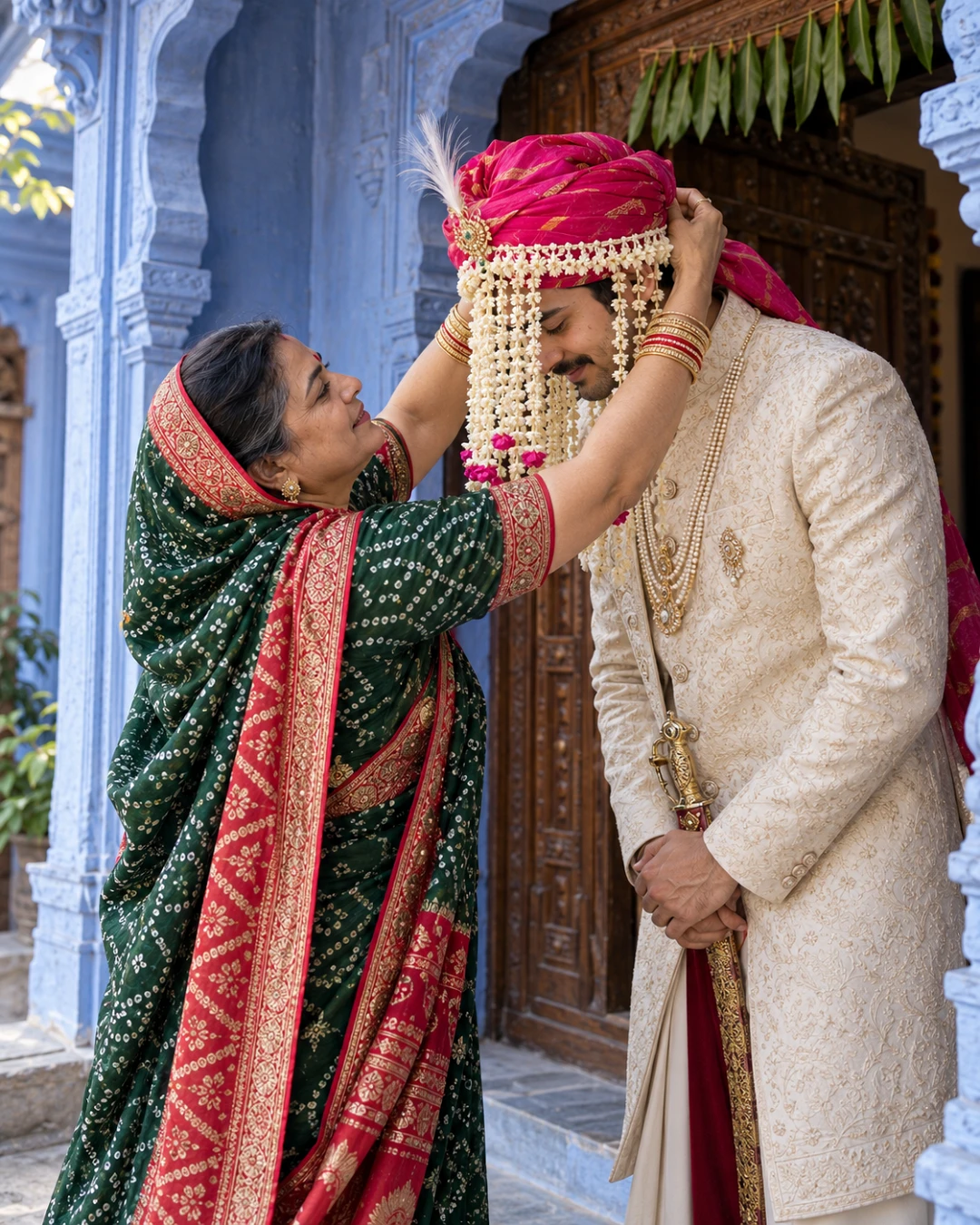
Open this prompt on its own page: Groom's mother tying his sehra at a Jodhpur haveli doorway
5. Baraat groom on a white mare in a Lucknow lane at night
The classic groom look, rebuilt so it does not fall into the usual traps of an orange night sky and a sehra that hides the face. Here the groom pushes the jasmine strands aside and laughs down at his dancing friends, lit by a cool street lamp while the band's light poles stay small points down the lane.
With a photo attached: the person in the photo is the subject. Keep their face exactly as it is, with bone structure, eye shape and spacing, nose, lips, jawline, hairline, skin tone and apparent age all unchanged, and keep their own body: build, height and proportions, shoulders, arms, hands and legs, with the same skin tone on face, neck, arms and hands. Use the photo only for who the person is. Ignore its pose, expression, clothing, hairstyle, background, framing and light, and rebuild all of them exactly as described below, even when the photo shows them standing straight or dressed differently.
The commission: Photograph the groom at the heart of his baraat as it squeezes through a narrow old Lucknow lane at night: him high on a white mare, his friends dancing below, the brass band out of frame.
In frame: He sits astride the mare, back straight, torso turned three quarters to the camera, feet in the stirrups. His left hand holds the reins low at the saddle. His right arm is raised, elbow bent, the hand pushing the sehra strands aside so his face is fully visible. Head tilted down toward his friends, a wide open laugh. Below him two friends dance with arms up, motion soft.
Wardrobe: An ivory raw-silk sherwani to the knee with tonal threadwork, ivory churidar, a pale blush pink safa, a sehra of white jasmine strings and small pearls, ivory juttis. The mare is pale grey-white like fresh chalk, with a red and silver embroidered saddle cloth and a silver head ornament.
The set: A narrow lane of whitewashed walls, blue wooden doors and hanging cables, neighbours watching from a balcony, soft.
The light: Cool blue night ambience from the open sky. The band's handheld light poles are small bright points down the lane and light nothing; a cool white street lamp from the left gives his face clean, even light.
How it is shot: 85mm at f/1.8 from slightly below, three quarter length, the dancers in soft motion. Natural cool colour, true ivory, real skin with pores, fine grain.
Avoid: airbrushed skin, plastic skin, waxy face, changed face, distorted hands, extra fingers, orange cast, warm wash, sehra covering the face, brown horse, fireworks, sharp crowd faces, text, logo, watermark
Aspect ratio 4:5.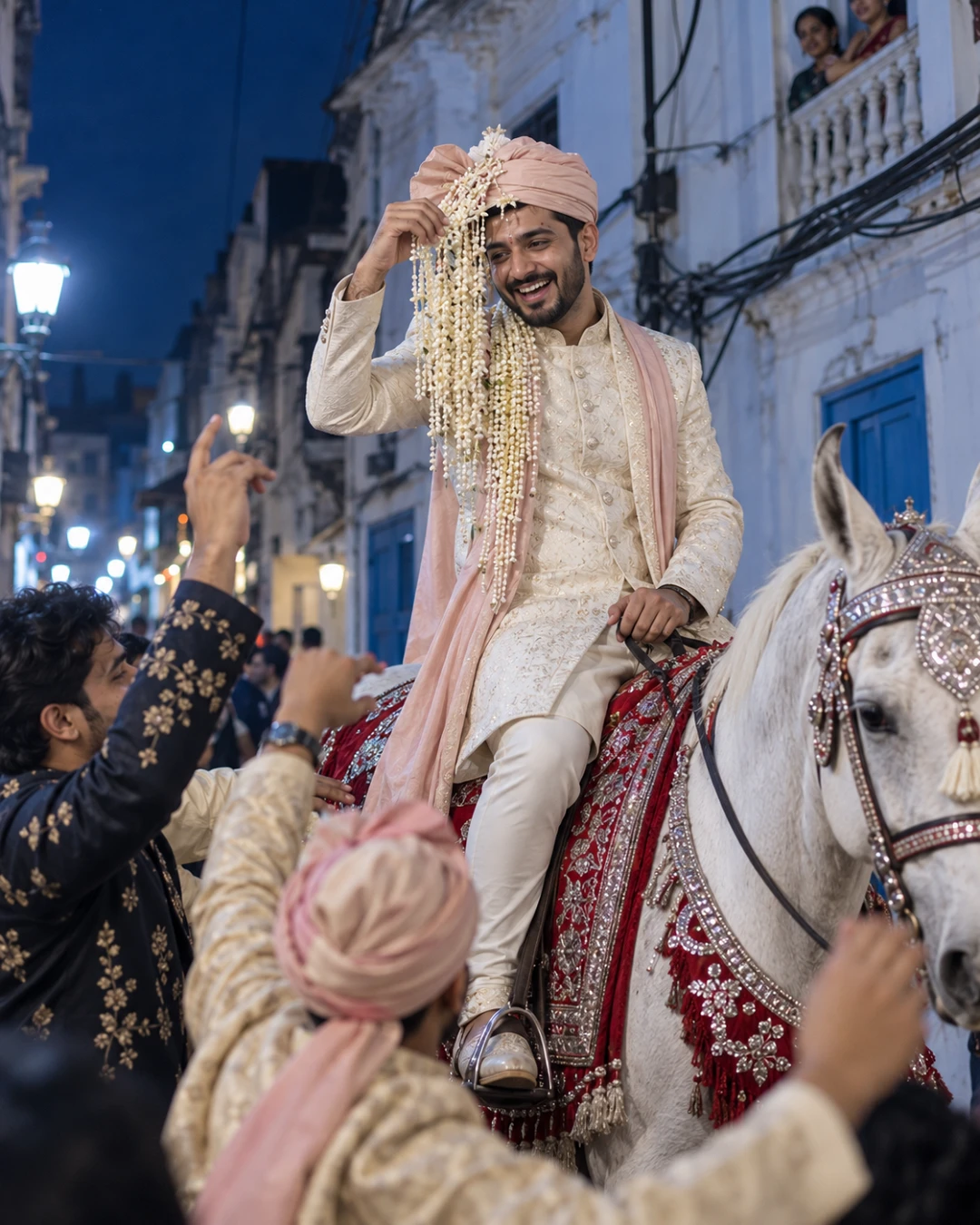
Open this prompt on its own page: Baraat groom on a white mare in a Lucknow lane at night
6. Bride on haveli stairs seen from above through a marigold canopy
The bridal entry under a phoolon ki chadar is the moment every guest films. This editorial version shoots it from a balcony straight above the staircase, so the canopy of marigold and rose strings fills the frame and the bride's face looks up through the one gap in the flowers.
With a photo attached: the person in the photo is the bride. Keep their face exactly as it is, with bone structure, eye shape and spacing, nose, lips, jawline, hairline, skin tone and apparent age all unchanged, and keep their own body: build, height and proportions, shoulders, arms, hands and legs, with the same skin tone on face, neck, arms and hands. Use the photo only for who the person is. Ignore its pose, expression, clothing, hairstyle, background, framing and light, and rebuild all of them exactly as described below, even when the photo shows them standing straight or dressed differently. The four cousins are always created as described below.
Base: Seen from a balcony straight above a haveli staircase, a bride walks down the stone steps under a phoolon ki chadar of marigold and rose strings held at its four corners by four cousins, her face turned up toward the camera through one gap in the flowers.
Add: pose: The bride is mid-step, left foot one step lower, torso upright, head tipped back so her face looks straight up into the lens, eyes bright, a wide open smile. Her right hand lifts the skirt at the knee; her left holds the edge of her dupatta at her chest. Each cousin raises one bamboo pole above head height at a corner, two on the step above her and two below, faces turned up and laughing, partly hidden by flowers.
Add: wardrobe: The bride in a true red Banarasi silk lehenga with silver zari buttis, a red net dupatta pinned over her head, a kundan choker, a nath, a maang tikka, red chooda and kaleeras hanging from her wrists. The cousins in pastel georgette lehengas: mint, powder blue, lilac and blush.
Add: set and light: Worn pink sandstone steps and a carved stone balustrade. The canopy is a square of dense strings of true saffron marigolds and deep red roses. Soft cool daylight from the open courtyard sky above, even and clean on the upturned faces.
Lock: The camera looks straight down. The canopy fills most of the frame, the bride's face visible in one clear gap near the centre. The canopy is flowers on strings, never cloth.
Camera and grade: 35mm at f/4 from directly overhead. Natural cool true colour, real skin with pores, fine grain.
Avoid: airbrushed skin, plastic skin, waxy face, changed face, distorted hands, extra fingers, orange cast, warm wash, cloth canopy, groom, extra people, blurred bride face, text, logo, watermark
Aspect ratio 4:5.
Open this prompt on its own page: Bride on haveli stairs seen from above through a marigold canopy
Prefer the classic eye-level view with her brothers holding the canopy? Use the bride entering under a phoolon ki chadar held by her brothers.
7. Pheras seen from directly above around a ring of white tuberoses
The pheras are the heart of a Hindu wedding, and the overhead view is the most striking way to show them. The bride leads the groom around a havan kund hidden in a heaped ring of white tuberoses and jasmine, their knotted cloth curving between them. The all-white flowers and the white canopy keep the colour clean.
With a photo attached: the two people in the photo are the subjects. Keep each face exactly as it is, with bone structure, eye shape and spacing, nose, lips, jawline, hairline, skin tone and apparent age all unchanged, and keep each person's own body: build, height and proportions, shoulders, arms, hands and legs, with the same skin tone on face, neck, arms and hands. Use the photo only for who they are. Ignore its poses, expressions, clothing, hairstyles, background, framing and light, and rebuild all of them exactly as described below, even when the photo shows them standing straight or dressed differently. If the photo shows only one person, keep that face and create the other as described below.
Logline: The pheras from directly above a white mandap in a Jaipur haveli courtyard: the bride leads the groom around the havan kund, hidden inside a heaped ring of white tuberoses and jasmine.
Subject: Seen from straight above, both mid-step on the curve of the circle. She walks a step ahead, body along the curve, face turned up to the camera. Her right hand holds the edge of her dupatta at her chest; her left arm hangs loose at her side. He follows a step behind, his right hand at his waist holding his ivory stole, its end knotted to the end of her dupatta so the cloth curves between them; his left arm hangs relaxed. Both look up at the lens, she with a shy, bright smile, he grinning.
Wardrobe: She wears a true red raw-silk lehenga with a dense silver zari border, a red elbow-sleeve blouse, a sheer red net dupatta over her head with a scalloped silver edge, a kundan maang tikka, a nath, red and ivory chooda and mehendi on both hands. He wears an ivory raw-silk sherwani to the knee with tonal embroidery, an ivory safa with a small pearl brooch, a pearl string and an ivory stole.
Set: A white marble floor, the circular path marked in loose white rose petals. At the centre a brass havan kund buried in a mound of white tuberoses and jasmine. Four corner posts wound with white flowers, the edge of a white cloth canopy framing the top of the frame, two low wooden stools with ivory cushions and a brass plate of rice to one side.
Light: Cool soft daylight through the white canopy, even and nearly shadowless, the marble clean white.
Lens: 24mm at f/4 from directly overhead, the circle centred, both faces sharp and undistorted.
Grade: Natural cool colour, true red, true ivory, real skin with pores, fine grain.
Avoid: airbrushed skin, plastic skin, waxy faces, changed faces, distorted hands, extra fingers, orange cast, warm wash, marigolds, orange flowers, fisheye distortion, stretched faces, guests, priest, gold cast, text, logo, watermark
Aspect ratio 4:5.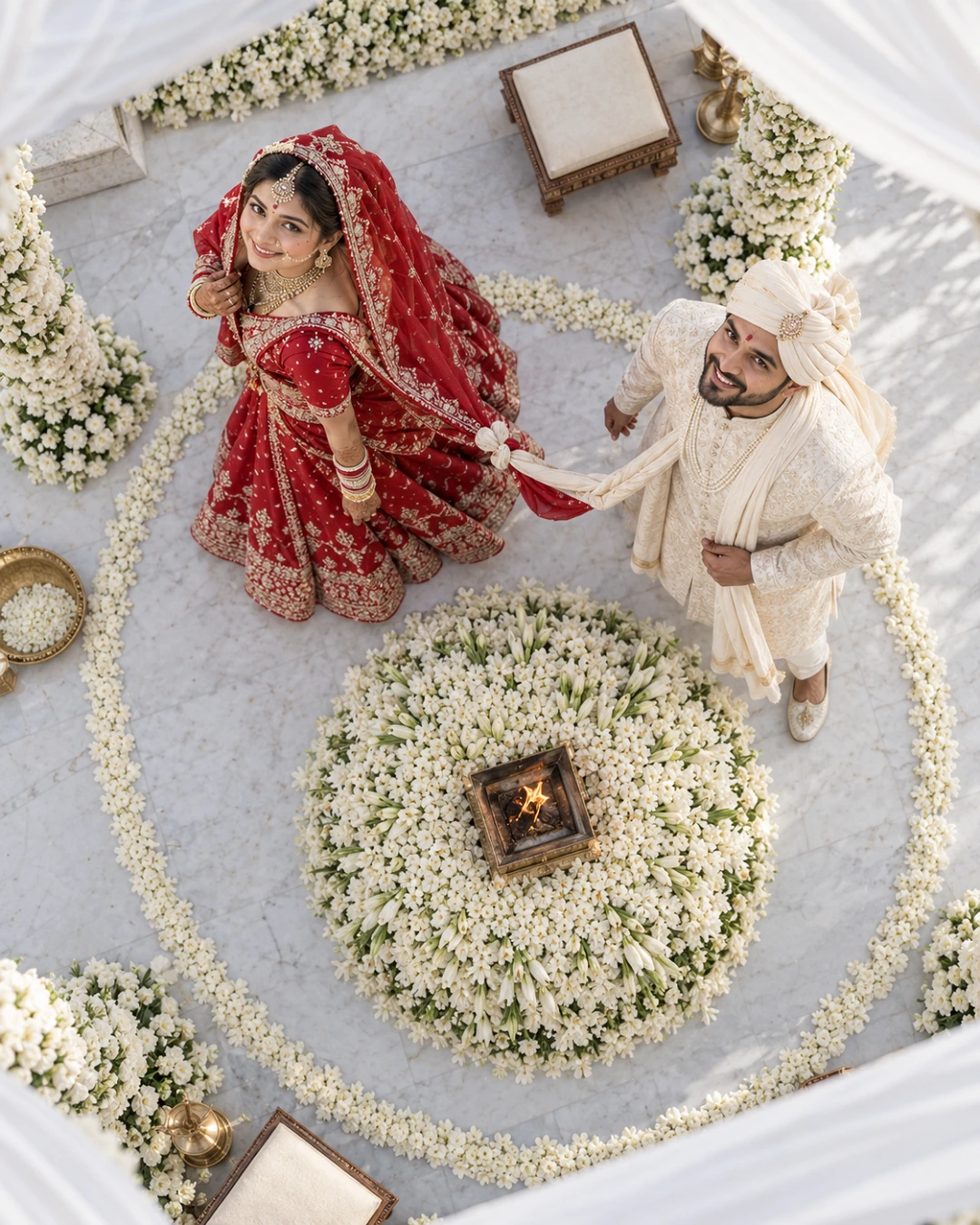
Open this prompt on its own page: Pheras seen from directly above around a ring of white tuberoses
For a Sikh wedding, the Anand Karaj bride holding the groom's palla during the laavan prompt shows the same moment at the gurdwara.
8. Bride and groom first look in a Kerala temple corridor
A couple portrait that feels like a real moment rather than a pose. The groom in a cream mundu turns over his shoulder to see the bride in red Kanjivaram silk for the first time, in a long granite corridor with the brass lamps left unlit so the light stays cool and even.
With a photo attached: the two people in the photo are the subjects. Keep each face exactly as it is, with bone structure, eye shape and spacing, nose, lips, jawline, hairline, skin tone and apparent age all unchanged, and keep each person's own body: build, height and proportions, shoulders, arms, hands and legs, with the same skin tone on face, neck, arms and hands. Use the photo only for who they are. Ignore its poses, expressions, clothing, hairstyles, background, framing and light, and rebuild all of them exactly as described below. If the photo shows only one person, keep that face and create the other as described below.
Base: A wedding first look in a long Kerala temple corridor of carved granite pillars: the groom stands facing away from the camera, and the bride has just stopped two steps behind him as he turns his head to see her for the first time.
Add: pose: He stands in the left third, back half to the camera, torso twisting toward her, head turned over his right shoulder, eyes wide, lips parted in a surprised smile. His right hand rises to his chest; his left hand holds the folded edge of his mundu at the waist. She stands right of centre facing the lens, feet together, weight on her right foot. Her left hand holds a small bunch of white jasmine at her waist; her right hand lifts the front pleats a little off the floor. Head tilted down, eyes raised to him, a shy pressed smile.
Add: wardrobe: Him: a cream cotton mundu with a narrow gold kasavu border, a matching cream half-sleeve shirt, a gold-bordered neriyathu over the left shoulder. Her: a true red Kanjivaram silk saree with a broad gold zari border, an elbow-sleeve red blouse, a gold temple-style necklace, a jasmine string wound around a low bun, a small red bindi, kajal.
Add: set and light: Polished stone floor, rows of unlit brass lamps on carved stands along both sides. Soft cool morning light enters from an open courtyard on the right, shaping both faces; the far corridor falls into shadow.
Lock: Only two people. The lamps stay unlit. Her saree stays true red, not maroon or orange.
Camera and grade: 85mm at f/2, eye level, full figures, the pillars soft behind. Natural cool colour, true gold and true red, real skin with pores, fine grain.
Avoid: airbrushed skin, plastic skin, waxy faces, changed faces, distorted hands, extra fingers, orange cast, warm wash, lit lamps, crowd, priest face, third person, text, logo, watermark
Aspect ratio 4:5.
Open this prompt on its own page: Bride and groom first look in a Kerala temple corridor
9. Kanjivaram bride looking back in the Darasuram temple corridor
A solo bridal portrait for a South Indian bride: an ivory and bottle green Kanjivaram saree, a jasmine braid down to the hip and a look back over the shoulder between carved granite pillars. The 2:3 frame makes it a strong print for the living room wall.
With a photo attached: the person in the photo is the subject. Keep their face exactly as it is, with bone structure, eye shape and spacing, nose, lips, jawline, hairline, skin tone and apparent age all unchanged, and keep their own body: build, height and proportions, shoulders, arms, hands and legs, with the same skin tone on face, neck, arms and hands. Use the photo only for who the person is. Ignore its pose, expression, clothing, hairstyle, background, framing and light, and rebuild all of them exactly as described below, even when the photo shows them standing straight or dressed differently.
Subject: A Tamil bride on her wedding morning walks down the long stone pillared corridor of the Airavatesvara temple at Darasuram and turns to look back over her shoulder at the camera.
Pose: Walking away from the camera, mid-step, back and left shoulder toward the lens. Head turned right over the shoulder, chin lowered a little, eyes straight into the lens, a shy closed smile. Her left arm hangs loosely, fingers lifting the pleats; her right hand rests on a carved pillar beside her. Right foot forward, left heel lifted.
Wardrobe: An ivory Kanjivaram silk saree with a wide bottle green border and fine gold zari checks, a matching green silk blouse with elbow sleeves, a long plait wrapped from crown to hip in white jasmine, a gold temple necklace, jhumkas, a nethi chutti, green and gold bangles.
Setting: Rows of carved granite pillars with small sculpted figures, a smooth stone floor, the corridor receding into soft shade.
Light: Cool daylight falling between the pillars from the open courtyard on the right, soft on her face, clean shadows on the stone.
Camera: 85mm at f/1.8, eye level, full length, the far pillars in soft blur.
Finish: Natural cool colour, true ivory and green, real skin with pores, fine grain.
Avoid: airbrushed skin, plastic skin, waxy face, changed face, distorted hands, extra fingers, orange cast, warm wash, red saree, crowd, second person, broken pillars, text, logo, watermark
Aspect ratio 2:3.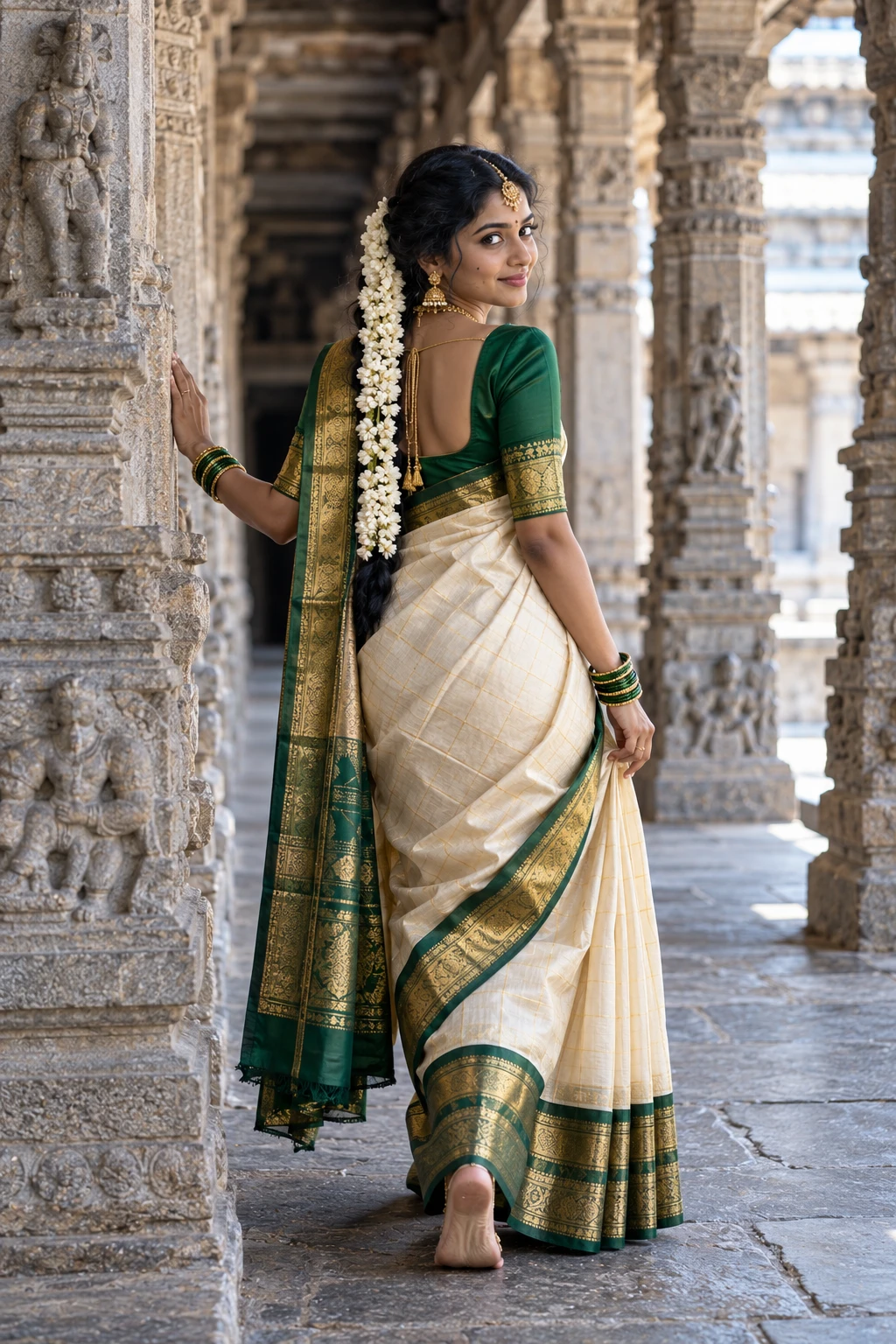
Open this prompt on its own page: Kanjivaram bride looking back in the Darasuram temple corridor
A Bengali bride can swap in the white shola topor hidden behind betel leaves for her own subho drishti picture.
10. Bride throwing rice over her head at her vidaai
The last picture of the wedding, and often the most moving. The bride throws a handful of rice back over her head at her parents' doorway while her mother catches the grains in her open pallu. A fast shutter freezes the rice in mid-air, and cool overcast light keeps the rani pink true.
With a photo attached: the person in the photo is the subject, the bride. Keep their face exactly as it is, with bone structure, eye shape and spacing, nose, lips, jawline, hairline, skin tone and apparent age all unchanged, and keep their own body: build, height and proportions, shoulders, arms, hands and legs, with the same skin tone on face, neck, arms and hands. Use the photo only for who the person is. Ignore its pose, expression, clothing, hairstyle, background, framing and light, and rebuild all of them exactly as described below, even when the photo shows them standing straight or dressed differently. The mother is always created as described below.
Logline: At her vidaai, a bride walking away from her parents' doorway throws a handful of rice back over her head, the grains frozen mid-air above her, her mother catching them in an outstretched pallu.
Subject: The bride faces the camera, walking toward it, torso upright, head tilted back a little. Both arms are thrown up and back over her head, palms open, the rice leaving her fingers; red-and-white chooda on both wrists, gold kaleere hanging from them. Eyes wet, closed tight, a trembling smile. Left foot forward mid-step.
Wardrobe: A rani-pink Banarasi silk lehenga with gold zari buttis, a matching blouse, a sheer pink net dupatta over her head, a gold nath with a pearl chain, maang tikka.
Set: A carved wooden doorway with a mango-leaf toran. The mother stands two steps behind, holding her pale peach saree pallu open with both hands, softly blurred. White rice grains hang in the air between them.
Light: Cool soft overcast daylight from above, even on the bride's face.
Lens: 70mm at f/2.8, fast shutter, the rice crisp, the bride sharp from the knees up.
Grade: Natural cool colour, the lehenga a true rani pink, the rice a true white, real skin and real tears, fine grain.
Avoid: airbrushed skin, plastic skin, waxy face, changed face, distorted hands, extra fingers, extra arms, confetti, petals instead of rice, orange cast, golden light, crowd, text, logo, watermark
Aspect ratio 4:5.
Open this prompt on its own page: Bride throwing rice over her head at her vidaai
Tips for better Indian wedding AI pictures
- Lock the face first. Keep the identity paragraph at the top of every prompt, unchanged. If a face drifts, reply with one line: "Keep the face exactly as in my photo, change nothing else." Do not paste the whole prompt again.
- Name the outfit like a tailor would. "A true red Banarasi silk lehenga with silver zari buttis" gives you real fabric. "A beautiful bridal dress" gives you shiny polyester. Name the fabric, the colour, the border and every piece of jewellery.
- Choose cool light, even for night functions. Words such as "golden hour", "warm glow" and "candlelit" are the main reason wedding pictures come back orange. Ask for open shade, cool daylight or blue evening light, and treat diyas, lamps and band lights as small points that light nothing.
- Put "orange cast" in the Avoid line. Every prompt here does, along with "warm wash". It is the single most useful negative for wedding pictures, because red silk, gold jewellery and marigolds all push the model towards orange.
- Give every hand a job. Hands holding a dupatta edge, a sword, the reins or a pinch of rice come out right far more often than hands left to the model.
- Keep the place specific. A tharavad courtyard near Thrissur or a blue Jodhpur doorway reads as real. "A wedding venue" reads as a banquet hall.
- Change one thing at a time. To match your own outfit, edit only the Wardrobe line and leave the light and lens lines alone.
Guests and family can join in as well. The wedding guest lookbook in a sharara set and an Indo-Western gown shows two looks for one person, and our Gemini saree prompts guide covers draping, borders and blouses in more depth.
Frequently asked questions
What is the best Indian wedding AI photo editing prompt?
The best prompt names one moment of one ritual, describes the outfit in detail and asks for cool natural light. The haldi, pheras and vidaai prompts above are the most reliable, because each has a clear action and a simple, clean colour palette.
Can I use these wedding prompts in Gemini as well as ChatGPT?
Yes. Every prompt works in both ChatGPT and Google Gemini. Attach your photo first, then paste the full prompt. If Gemini softens a face or changes the jewellery, reply asking it to keep the face exactly as in the photo and to follow the Wardrobe line.
Do I need a photo of both the bride and the groom?
No. For the couple prompts, one photo of the two of you together works best, but if you attach only one person, the model keeps that face and creates the other as described. The mehendi close-up needs no photo at all.
Why do my wedding AI pictures look orange or fake?
Warm words such as "golden glow" and "candlelight", plus a frame full of red silk and marigolds, push the whole image towards orange and make skin look waxy. Keep the light cool, put "orange cast" and "airbrushed skin" in the Avoid line and ask for real skin with pores.
When does the 2026 Indian wedding season start?
The main wedding season starts in late November 2026, after Dev Uthani Ekadashi, and continues through December, January and February. Exact auspicious dates vary by region and family, so check them with your family priest or a local panchang.
Related guides
- Couple photo editing prompts for pre-wedding and anniversary pictures
- ChatGPT family photo prompts for the whole family in one frame
- Gemini saree prompts for reception and guest looks
Browse every image prompt in the library. New wedding prompts are added every day through the season.