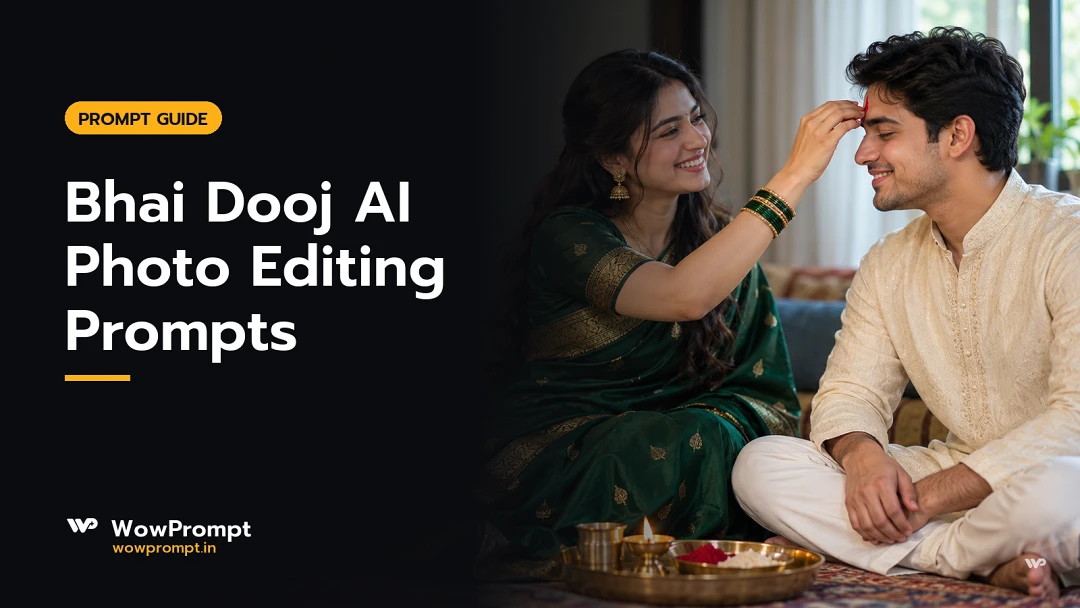
Bhai Dooj AI Photo Editing Prompts 2026 for Gemini and ChatGPT
Copy-ready Bhai Dooj AI photo editing prompts for Gemini and ChatGPT: tilak, gifts, Bhai Tika, twins, cousins, video calls and name posters, faces kept.
A Bhai Dooj AI photo editing prompt works best when it keeps both siblings' faces exactly as they are in your photo, gives each person one clear job in the frame, such as the sister holding the thali and the brother sitting still for the tilak, and asks for soft daylight or a few small lamps instead of "golden glow everywhere". Bhai Dooj falls on 10 November 2026, two days after Diwali. This guide gives you eight fresh, copy-ready prompts for Gemini and ChatGPT: the tilak at home, swapping gifts, a brother who is away on a video call, a Nepali Bhai Tika, twins, a cousins group, a retro sibling photo and a greeting poster with your names. Each one is written so that both faces stay yours.
Most Bhai Dooj edits online are last year's lists of one-line prompts. They give two strangers in matching orange, a background of floating diyas, and faces that drift a little more each time you try. The prompts below are longer on purpose. They name the outfit, the room, the light, the lens and the things to avoid, and each section links to a sample picture on our site so you can see the look before you copy.
What makes a Bhai Dooj AI photo editing prompt work
A sibling picture is harder than a solo portrait because the model has to hold two identities at once. When the prompt is vague, it blends the two faces, makes the brother and sister look like twins when they are not, or invents a third hand around the thali. Five habits fix most of this:
- Two people, two identity lines. Say who is on the left and who is on the right, and ask the model to keep both faces as they are.
- One job per hand. The sister's right hand applies the tilak, her left hand holds the thali; the brother's hands rest on his knees. Hands without a job are where pictures break.
- A named outfit for each sibling. "Traditional clothes" gives a costume. A mustard cotton kurta and a bottle-green silk saree give real fabric with real folds, and they keep the two people visually distinct.
- Small, named warm lights. Bhai Dooj is mostly a morning or afternoon ritual. Daylight through a window plus one diya on the thali looks real. "Warm golden festive light" turns everything orange.
- An explicit Avoid line. Changed faces, merged faces, extra fingers, orange cast and stray text go in every prompt.
Our festival portrait prompts guide explains this structure in depth, and the reference photo guide has stronger identity lines if a face keeps changing.
How to get both faces right
- Use one photo where both siblings are side by side, facing the camera, in daylight. Two separate selfies also work: attach both and say "the person in the first photo is the sister, the person in the second photo is the brother".
- Avoid sunglasses, heavy filters and photos where one face is much smaller than the other.
- Open Gemini or ChatGPT, start a new chat, attach the photo and paste the prompt exactly.
- If one face drifts, reply: "Keep both faces exactly as in the photo; change only the outfits, pose, place and light."
- Keep the aspect ratio in the prompt. Use 4:5 for an Instagram post and 9:16 for a WhatsApp status or story.
Bhai Dooj AI photo editing prompts for brothers and sisters
1. The tilak at home with the aarti thali
The picture every family wants: the sister applying the tilak while the brother sits cross-legged on a low wooden seat. See the sample Bhai Dooj tilak portrait of a brother and sister before you copy.
Use the two people in the attached photo for the faces only: the woman is the sister, the man is the brother. Keep both faces, skin tones, hairlines and builds exactly as they are; take nothing else from the photo.
Scene: Bhai Dooj morning at home; the sister applies a roli and rice tilak to her brother's forehead.
Pose: the brother sits cross-legged on a low wooden patla, hands resting on his knees, eyes lifted toward her, smiling; the sister kneels beside him, right ring finger on his forehead, left hand holding a brass thali with a lit diya, roli, rice and two pieces of mithai.
Outfits: the sister wears a bottle-green Chanderi silk saree with a thin gold border, glass bangles and a small bindi; the brother wears a mustard cotton kurta with white pyjamas.
Place: a family living room with a marigold toran over the door, a fresh rangoli on the floor and a window behind them.
Light: soft morning daylight from the window; the diya flame is the only warm point.
Finish: 50mm, f/2, eye level, real skin texture, natural colour, gentle film grain.
Avoid: changed faces, merged or identical faces, orange cast, plastic skin, extra fingers, a third hand, text, watermark.
Aspect ratio 4:5.
For more family frames like this one, browse the baby and family prompts.
2. Swapping gifts on the sofa
After the tilak comes the best part for most siblings: the gift, and the teasing that goes with it. Compare the sample of Bhai Dooj siblings swapping gifts on a sofa.
Use the two people in the attached photo for the faces only: keep the sister's and the brother's faces, skin tones and hairlines exactly as they are; take nothing else from the photo.
Scene: Bhai Dooj afternoon; the siblings exchange gifts on the living room sofa and laugh as she shakes a wrapped box to guess what is inside.
Pose: seated side by side, turned toward each other; her right hand holds a small box wrapped in red paper with a gold ribbon close to her ear, her left hand rests on a cushion; his right hand holds out a second gift, his left arm rests on the sofa back.
Outfits: she wears a peach cotton anarkali with white chikankari; he wears a navy Nehru jacket over an ivory kurta.
Place: a bright living room, a box of mithai open on the side table, a string of marigold on the window.
Light: soft afternoon daylight, cool and even, no colour cast.
Finish: 35mm, f/2.8, candid, real skin texture, crisp fabric detail.
Avoid: changed faces, merged faces, extra hands, extra gift boxes floating, orange cast, text, watermark.
Aspect ratio 4:5.
If you are still choosing the present itself, the gift picker for someone hard to shop for is a quick daily prompt.
3. Tilak over a video call for a brother far away
Many brothers and sisters spend the day in different cities. This prompt keeps the ritual in one frame: the sister holds the thali up to a phone with her brother on the screen. The same idea works for couples in our long-distance Karwa Chauth video call picture.
Use the two people in the attached photo for the faces only: the sister is in the room, the brother appears on the phone screen. Keep both faces, skin tones and hairlines exactly as they are; take nothing else from the photo.
Scene: Bhai Dooj morning; the sister sits at a window and holds a brass thali toward a phone propped against a vase, where her brother smiles on a video call from his apartment.
Pose: her left hand holds the thali with a lit diya, roli and rice; her right ring finger touches the phone screen near his forehead as if applying the tilak; she smiles at the screen.
Outfits: she wears a maroon silk kurta with gold buttis and a cream dupatta; on screen he wears a grey hoodie, a city skyline behind him.
Place: a sunlit window seat, a marigold string on the frame, the phone screen clearly readable.
Light: morning daylight on her face; the phone screen glows softly; the diya is a small warm point.
Finish: 50mm, f/2, real skin texture, sharp detail on both faces including the face on the screen.
Avoid: changed faces, a blurred face on the screen, orange cast, extra fingers, interface text on the screen, watermark.
Aspect ratio 9:16.
When the picture is ready, pair it with one of the Bhai Dooj messages for a brother or sister living far away, or browse more WhatsApp and chat prompts.
4. Bhai Tika in the Nepali style
In Nepal and Darjeeling, Bhai Tika is the last day of Tihar: the sister places a seven-colour tika on her brother's forehead and garlands him with makhamali flowers, the globe amaranth that holds its colour for days. See the sample Bhai Tika with a seven-colour tika and a makhamali garland.
Use the two people in the attached photo for the faces only. Keep the sister's and the brother's faces, skin tones and hairlines exactly as they are; take nothing else from the photo.
Scene: Bhai Tika during Tihar; the sister places a vertical seven-colour tika on her brother's forehead in a courtyard.
Pose: the brother sits on a low cushion, a makhamali garland of purple and orange globe amaranth around his neck; the sister stands in front, right hand finishing the tika, left hand holding a brass plate of tika powders, walnuts and a small oil lamp.
Outfits: she wears a red gunyu cholo with a gold-thread patuka at the waist; he wears a white daura suruwal with a dark waistcoat and a Dhaka topi.
Place: a brick courtyard with a wooden carved window, marigold strings on the eaves.
Light: soft late-morning daylight, true colours on every tika stripe.
Finish: 50mm, f/2, eye level, real skin texture, fine detail in the flowers.
Avoid: changed faces, a smeared or blended tika, orange cast, extra fingers, text, watermark.
Aspect ratio 4:5.
More rituals like this one live in our festival and devotional prompts.
5. Twins in matching colours
Twins are the one case where you want the model to keep two similar faces apart. Say who is who, and give them colours that match but are not identical.
Use the two people in the attached photo for the faces only: they are twin siblings. Keep each face exactly as it is, including the small differences between them; do not make them more alike; take nothing else from the photo.
Scene: Bhai Dooj evening on a terrace; the twins sit back to back on a wooden bench and both look over a shoulder at the camera.
Pose: the twin on the left holds a small brass thali with a diya in both hands; the twin on the right holds a box of mithai on one knee; both laugh.
Outfits: left, a rust silk kurta set; right, a mustard silk kurta set with the same cream embroidery.
Place: a rooftop terrace with potted tulsi, a string of small bulbs and the city at dusk behind.
Light: cool blue dusk; the bulbs and the diya are the only warm points.
Finish: 50mm, f/1.8, real skin texture, light grain.
Avoid: identical copied faces, changed faces, orange cast, extra fingers, text, watermark.
Aspect ratio 4:5.
Bhai Dooj photo prompts for cousins, family and old photos
6. A cousins group in the courtyard
When all the cousins gather at the grandparents' house, the picture is a group. Keep it to four or five people; models lose faces beyond that. The mehendi picture of a bride laughing with her cousins is a good reference for a relaxed group mood, and the three generations making a Diwali rangoli shows the courtyard light.
Use the people in the attached photo for the faces only. Keep every face, skin tone and hairline exactly as it is; take nothing else from the photo; do not add or remove people.
Scene: Bhai Dooj afternoon at the grandparents' house; the cousins sit on the courtyard steps after the tilak, eating mithai and laughing at a shared joke.
Pose: two sisters on the top step, one holding the thali, one holding a plate of kaju katli; the brothers and cousins on the steps below, turned toward each other, each with a fresh tilak.
Outfits: simple festive cotton in different colours: indigo, rust, cream, olive and pink, so every person stays distinct.
Place: an old courtyard with a tulsi planter, marigold strings on a wooden door and a rangoli on the floor.
Light: soft afternoon daylight from above, no colour cast.
Finish: 35mm, f/4, eye level, every face sharp, candid feel.
Avoid: changed faces, merged faces, extra people, extra fingers, orange cast, text, watermark.
Aspect ratio 4:5.
For the sweets in the frame, see the open brass box of kaju katli and motichoor.
7. A retro sibling photo from the 1980s
A grainy film look turns this year's photo into something that feels like it came out of a family album. Compare the two friends in 1970s bell-bottoms, browse the vintage and retro prompts, or, if you have a real old picture, start with restoring a faded 1980s Diwali family photo.
Use the two people in the attached photo for the faces only. Keep both faces, skin tones and hairlines exactly as they are; take nothing else from the photo.
Scene: a Bhai Dooj photo taken in the late 1980s on a family camera; the sister and brother stand in front of a painted green door after the tilak.
Pose: standing shoulder to shoulder, his arm around her shoulders, her hands holding a steel thali with a diya; both squint a little in the sun and smile.
Outfits: she wears a printed chiffon saree in orange and white florals with a high-neck blouse; he wears a cream safari suit.
Place: a government-colony doorway with a nameplate, a scooter parked to one side, a marigold string on the door frame.
Light: hard midday sun, real shadows.
Finish: 35mm film look, faded warm colour, visible grain, slight vignette, soft focus at the edges.
Avoid: changed faces, modern phones or logos, plastic skin, extra fingers, text, watermark.
Aspect ratio 4:5.
8. A Bhai Dooj poster with your names
For a status or a printed card, a poster with both names is the most shared format. Replace the two names in brackets. The Diwali greeting poster with a lamp-lit portrait shows the layout style.
Use the two people in the attached photo for the faces only. Keep both faces, skin tones and hairlines exactly as they are; take nothing else from the photo.
Design: a vertical Bhai Dooj greeting poster; the siblings stand in the lower two thirds, the sister's hand resting on her brother's shoulder; he holds a brass thali with a diya.
Outfits: she wears a deep pink silk saree with a gold border; he wears an ivory sherwani-style kurta.
Background: a plain deep maroon wall with a row of clay diyas along the bottom edge and a marigold toran across the top.
Text: in the top third, "Happy Bhai Dooj" in a clean serif, and below it "[Sister's name] and [Brother's name]" in a smaller matching serif, both in warm cream, spelled exactly as given.
Light: soft studio light on the faces; the diyas are small warm points.
Finish: high detail, real skin texture, clean print-ready layout with margins.
Avoid: changed faces, misspelled names, any other text, logos, orange cast, extra fingers, watermark.
Aspect ratio 9:16.
New Bhai Dooj prompts for 2026
Bhai Dooj 2026 falls on Tuesday, 10 November. These three prompts were added this week, each with the picture it made.
9. Tilak on a station platform as he arrives
For the brother who comes home by train for the festival: his sister puts the roli tilak on his forehead right on the platform, the overnight carriage still behind him and his trolley bag at his feet. It answers the most common Bhai Dooj story of all, the trip home.
With a photo attached: the two people in the photo are the subjects. Keep each face exactly as it is, with bone structure, eye shape and spacing, nose, lips, jawline, hairline, skin tone and apparent age all unchanged, and keep each person's own body: build, height and proportions, shoulders, arms, hands and legs, with the same skin tone on face, neck, arms and hands. Use the photo only for who they are. Ignore its poses, expressions, clothing, hairstyles, background, framing and light, and rebuild all of them exactly as described below, even when the photo shows them standing straight or dressed differently. If the photo shows only one person, keep that face and create the other as described below.
Subject: On Bhai Dooj morning a young woman applies a roli tilak to her younger brother's forehead on a platform of Lucknow's Charbagh station, moments after he steps off an overnight train.
Pose: She stands facing him, torso three quarters to the camera. Her right arm is raised, elbow bent, ring finger pressing the tilak between his brows; her left hand holds a small steel thali of roli, rice and sweets at her waist. Eyes on his forehead, a tender smile. He leans forward, head lowered to her, eyes closed, a sheepish grin. His right hand holds out a small box in sage green paper with a white ribbon; his left hand grips the strap of a grey backpack on his shoulder, a small trolley bag at his right foot.
Wardrobe: She wears a powder pink cotton chikankari kurta with white embroidery, straight white trousers, a white mulmul dupatta over one shoulder, silver jhumkas and a small red bindi. He wears a navy hoodie over a white tee, black joggers, white sneakers and a red thread on his wrist.
Setting: A long platform, a blue and cream carriage behind them with its door open, iron pillars, a high arched roof.
Light: Cool morning daylight from the open platform end and the roof skylights, soft and even on both faces.
Camera: 85mm at f/1.8, eye level, waist up, the carriage in soft bokeh.
Finish: Natural cool colour, true red roli, true sage green, real skin with pores, fine grain.
Avoid: airbrushed skin, plastic skin, waxy faces, changed faces, distorted hands, extra fingers, orange cast, warm wash, readable station boards, legible signs, sharp faces in the crowd, text, logo, watermark
Aspect ratio 4:5.
Open this prompt on its own page: Bhai Dooj tilak on a Lucknow station platform as he arrives
10. A Bhai Dooj gift post for a shop
A ready Instagram post for a gift shop: a sister opens a gift box on old pol house steps while her brother leans in laughing, with the shop's headline set calmly above. Change GIFT GALI to your own shop name.
With a photo attached: the two people in the photo are the subjects. Keep each face exactly as it is, with bone structure, eye shape and spacing, nose, lips, jawline, hairline, skin tone and apparent age all unchanged, and keep each person's own body: build, height and proportions, shoulders, arms, hands and legs, with the same skin tone on face, neck, arms and hands. Use the photo only for who they are. Ignore its poses, expressions, clothing, hairstyles, background, framing and light, and rebuild all of them exactly as described below, even when the photo shows them standing straight or dressed differently. If the photo shows one person, keep that face and create the other as described below.
The commission: You are shooting a gift store's Bhai Dooj post. Catch the second when a sister opens the box and her brother leans in, both laughing for real. It should feel like a family photo, with the store's words placed calmly above.
Text: "GIFTS FOR YOUR SIBLING" "[Brand]" (sample: GIFT GALI) Nothing else is written anywhere. Spell each line exactly. The gift box carries no words.
In frame: Both sit side by side on the second step, framed from the knees up, the sister on the left. Sister: torso three-quarters to the camera, the box on her knees; her left hand steadies the box, her right hand lifts the lid halfway; head thrown back in a laugh. Brother: leaning in from the right, torso toward her; his right hand on her shoulder, his left hand pointing into the box; eyes on the box, laughing with an open mouth.
Wardrobe: Sister: a dusty rose cotton kurta with white thread embroidery at the neck and three-quarter sleeves, white cotton palazzos, small silver jhumkas, hair open. Brother: a pale sky-blue cotton kurta with sleeves pushed up, off-white trousers, a steel watch. The gift box is wrapped in indigo paper with a white satin ribbon.
The set: Worn grey stone steps, a carved wooden door painted faded teal behind them, a pot of green tulsi on the top step. The upper third stays plain lime-washed wall for the type.
How it is shot: Cool morning daylight from the lane on the left, a white bounce from the right, no warm cast. 50mm at f/2.8, eye level, both faces sharp. Natural true-to-life colour, real skin with pores. "GIFTS FOR YOUR SIBLING" in heavy deep indigo condensed capitals across the top, "[Brand]" in small spaced indigo capitals at the bottom left.
Avoid: misspelled text, extra words, words on the box, prices, stiff posed smiles, extra people, text over faces, orange cast, warm grade, yellow tint, airbrushed skin, plastic skin, waxy face, changed face, distorted hands, extra fingers, watermark
Aspect ratio 4:5.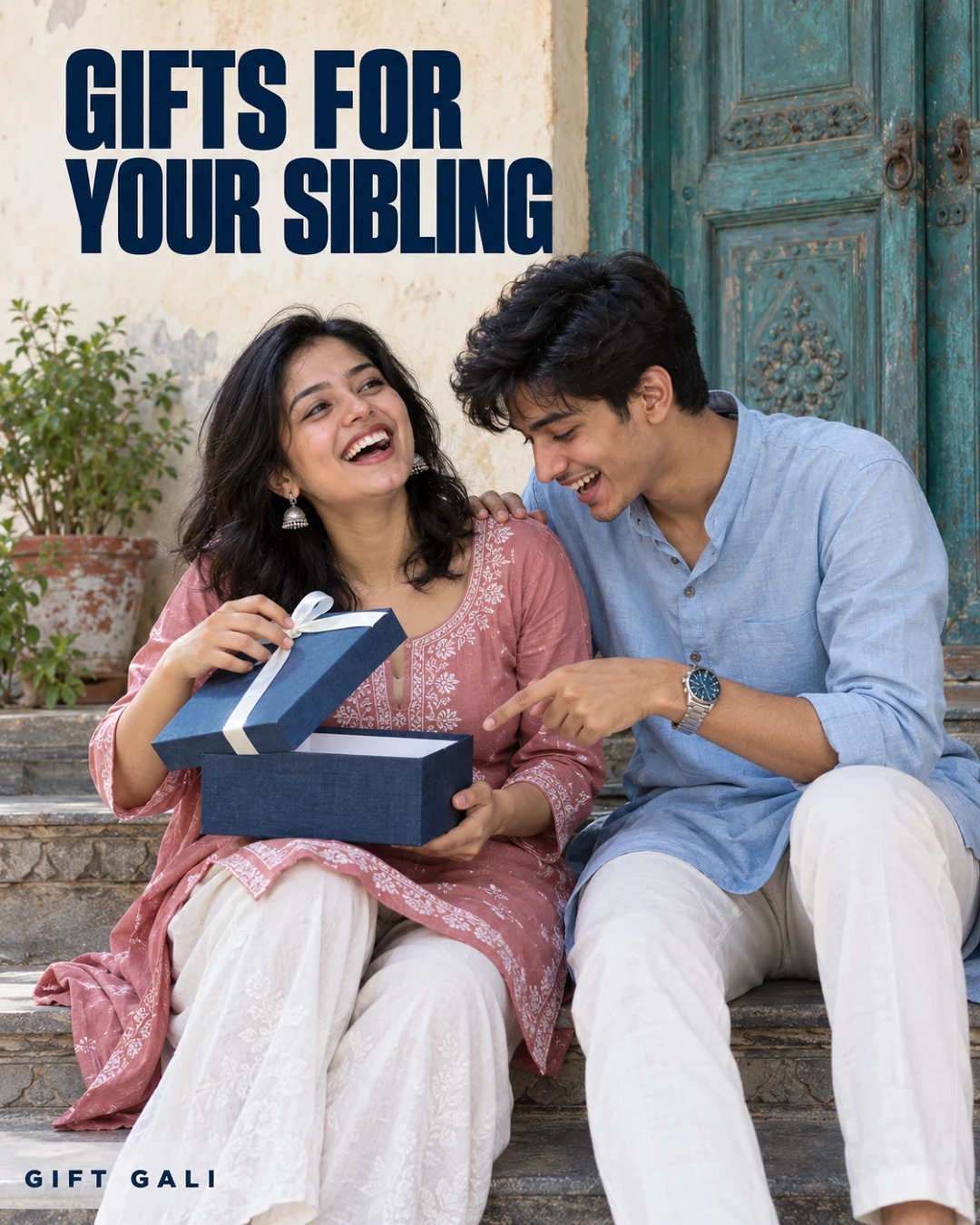
Open this prompt on its own page: Bhai Dooj gift post with siblings laughing on old pol house steps
11. A Bhai Dooj gift ideas thumbnail
A clean 16:9 thumbnail for a blog post or a YouTube video on gift ideas: a knolled flatlay of a watch, a wallet, a kurta, a book, kaju katli and a tilak thali on sage linen, with the title on a deep indigo band.
Must hold: A product flatlay with no people and no hands, seen from straight above. Each gift appears once in its own space, knolled with even gaps, nothing overlapping. Nothing carries a logo, label or readable word. Exactly the lines below and nothing else.
Text: "BHAI DOOJ GIFT IDEAS" "For brothers and sisters" Spell each line exactly.
The picture: The right two thirds is a pale sage-green linen cloth with a fine weave. On it, in a loose grid: a square gift box wrapped in deep indigo paper with a white cotton ribbon at the centre; a steel analogue watch with a plain white dial and no markings above it; a slim navy leather bifold wallet to the right; a folded dusty-blue cotton kurta with white buttons at the top left; a plain paperback with a blank cream cover; a small open box of white diamond-shaped kaju katli with fine silver leaf; and a small round steel thali holding a red roli dot, a few rice grains and a single white jasmine flower in the bottom row. The left third is a clean deep indigo band with "BHAI DOOJ GIFT IDEAS" in heavy white condensed capitals on two lines and "For brothers and sisters" in small pale sage sans serif below.
Technical: Soft cool daylight from the top of the frame, short gentle shadows, the room neutral. 50mm at f/8 from directly above, every item sharp. Natural true-to-life colour: the indigo deep, the kurta a true dusty blue, the kaju katli white with silver, the steel cool.
Avoid: person, hands, face, logos, labels, readable words, price tags, numbered list, cluttered pile, overlapping items, misspelled text, extra words, orange cast, warm grade, yellow tint, airbrushed skin, plastic skin, waxy face, changed face, distorted hands, extra fingers, watermark
Aspect ratio 16:9.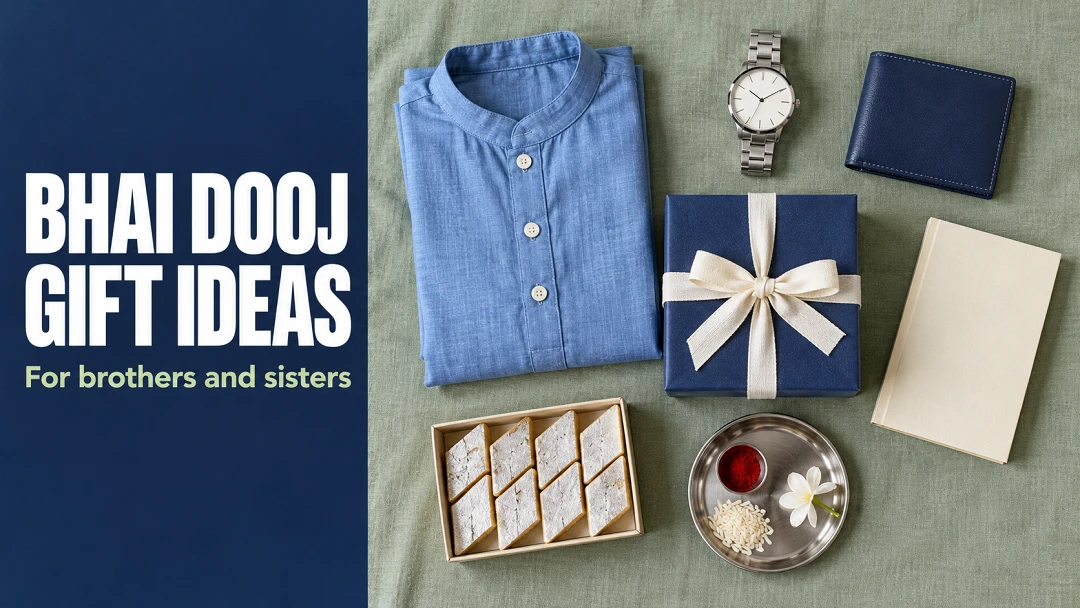
Open this prompt on its own page: Bhai Dooj gift ideas blog thumbnail with a top-down gift flatlay
12. Bhai Dooj tilak for a nurse brother in a hospital corridor at night
Not every brother can come home for Bhai Dooj. This prompt takes the tilak to him instead: a sister in a quiet hospital corridor at night, marking the forehead of her brother, a nurse on a night shift, between rounds. It suits anyone whose brother works in a hospital, the police, the army or any job that does not stop for the festival.
Identity: With a photo attached: the two people in the photo are the subjects. Keep each face exactly as it is, with bone structure, eye shape and spacing, nose, lips, jawline, hairline, skin tone and apparent age all unchanged, and keep each person's own body: build, height and proportions, shoulders, arms, hands and legs, with the same skin tone on face, neck, arms and hands. Use the photo only for who they are. Ignore its poses, expressions, clothing, hairstyles, background, framing and light, and rebuild all of them exactly as described below, even when the photo shows them standing straight or dressed differently. If the photo shows only one person, keep that face and create the other as described below.
The commission: Photograph Bhai Dooj where he actually is: his sister has carried the tilak thali to the hospital where her brother, a nurse, is on night shift, and she gives him the tilak in an empty corridor between rounds.
In frame: Both stand facing each other in profile to the camera, close. She leans in, her left hand holding a small steel thali at waist height, her right ring finger pressing a red tilak between his brows, elbow raised. He stands straight, head bowed slightly toward her, both arms relaxed, his right hand holding a folded surgical cap. His eyes are closed; she is grinning.
Wardrobe: She wears a lilac cotton straight kurta to the knee with a round neck and three-quarter sleeves, white churidar, a white dupatta over one shoulder and silver jhumkas. He wears plain navy scrubs, a short-sleeve V-neck top and straight trousers, a black stethoscope round his neck, a steel watch and an ID card turned backwards on a blue lanyard.
The set: A long, clean corridor with pale grey vinyl floor and white walls, a steel handrail, a wheelchair parked far behind. The thali holds roli, rice, a small diya and two pieces of mithai.
The light: Cool white overhead panels; a blue-white glow from a ward window. The diya is a tiny warm point.
How it is shot: 85mm at f/2, chest height, both from the waist up, corridor in soft depth. Natural cool colour, real skin with pores, fine grain.
Avoid: airbrushed skin, plastic skin, waxy face, changed face, distorted hands, extra fingers, orange cast, warm wash, patients, blood, readable signs, hospital name, extra people, logo, watermark
Aspect ratio 3:4.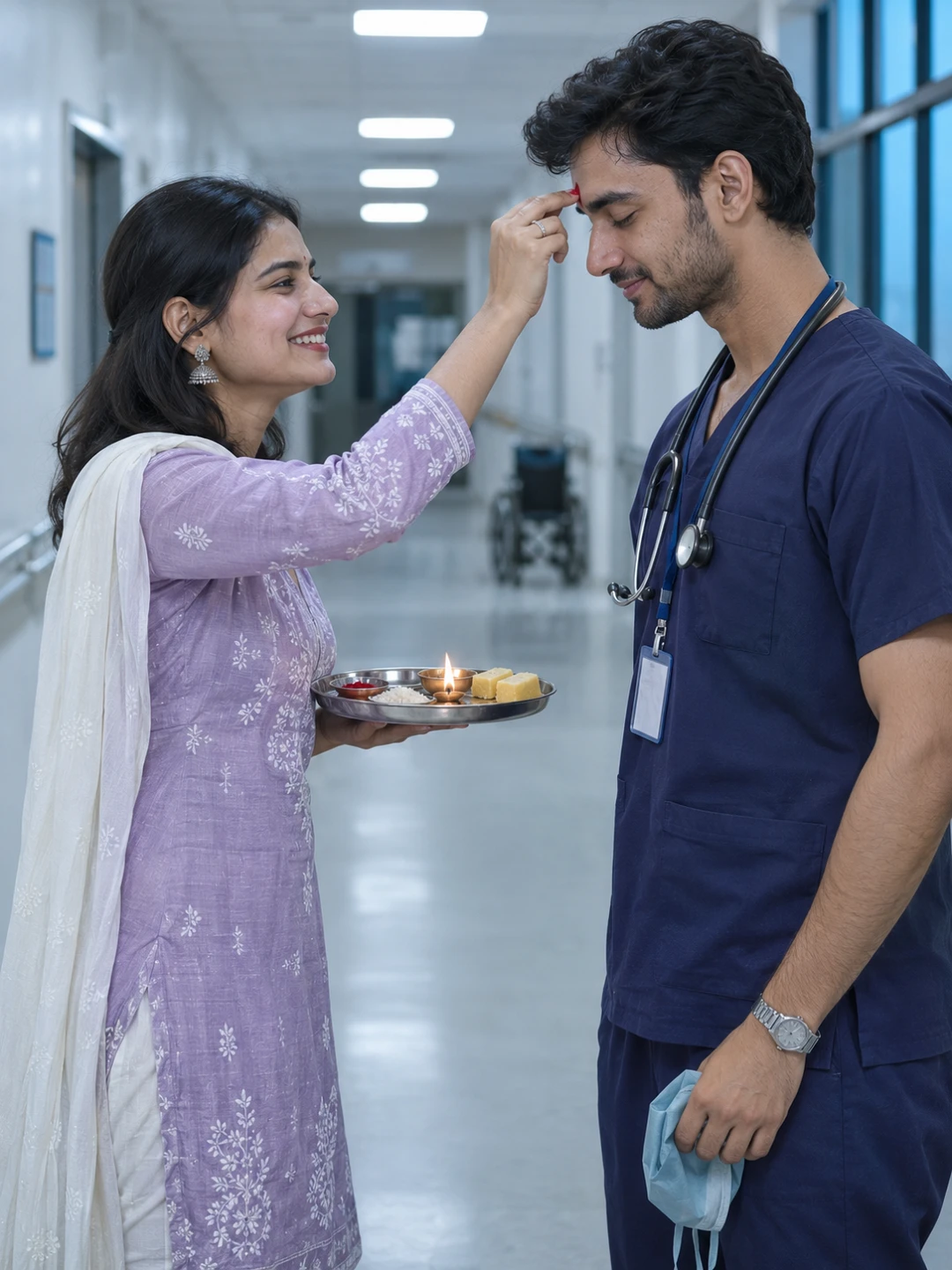
Open this prompt on its own page: Bhai Dooj tilak for a nurse brother in a hospital corridor at night
Common mistakes and how to fix them
- Both siblings get the same face. Name who is who, give each a different outfit colour, and add "merged or identical faces" to the Avoid line.
- The whole picture turns orange. Remove "golden" and "glowing". Ask for daylight or dusk and name the diya as the only warm point.
- A third hand appears near the thali. Say what each hand does, and keep "extra fingers" and "a third hand" in the Avoid line.
- The names come out misspelled. Keep names short, put them in quotes and ask for them "spelled exactly as given". If one letter is still wrong, ask the model to fix only that word.
Bhai Dooj prompts for shops and creators
If you sell gifts rather than pose for them, the Bhai Dooj gift hamper Instagram post with an offer line writes the post for you, and the Bhai Dooj gift guide email for an online store covers the newsletter. More are in our social media prompts. For the days before, the Diwali AI photo editing prompts cover the doorway, the rangoli and the sparklers.
Frequently asked questions
Which app is best for a Bhai Dooj AI photo edit, Gemini or ChatGPT?
Both handle these prompts. Gemini is quick with a single photo of two people. ChatGPT tends to follow long outfit and place descriptions more closely and is better at names on a poster. Try the same prompt in both and keep the better picture.
Can I make a Bhai Dooj photo if my brother is in another city?
Yes. Attach one photo of each sibling and say which is which, or use the video call prompt above, which puts your brother on the phone screen while you hold the thali.
How do I stop the AI from changing our faces?
Put the identity line first, name both people, and leave out beauty words such as "flawless". Use a clear daylight photo, and if a face drifts, ask the model to change only the outfits, pose, place and light.
Is Bhai Tika the same as Bhai Dooj?
They celebrate the same bond on the same festival days. Bhai Tika is the Nepali form, with a seven-colour tika and a makhamali garland; Bhai Dooj in India usually uses a roli and rice tilak. Prompt 4 is written for Bhai Tika.
What aspect ratio should I use for a Bhai Dooj post?
Use 4:5 for an Instagram feed post and 9:16 for a WhatsApp status, story or printed vertical card. Keep the ratio inside the prompt so the model composes for that shape.
Where to find more
Browse all festival and devotional prompts, traditional wear prompts and old photo restoration prompts, or open the full image prompt library. For a solo picture on the evening before, the Diwali doorway portrait with oil lamps is a good next stop.
Related guides
- Govardhan Puja AI photo editing prompts: the earthen hill, annakut, parikrama and cow puja, the day after Diwali
- Children's Day AI photo editing prompts: parent and child photos, a childhood throwback and a school post for 14 November.