Black and White AI Photo Prompts for Gemini and ChatGPT
Copy-ready black and white AI photo prompts for Gemini and ChatGPT: one directional light, a rim, deep blacks, real grain and your own face kept exactly.
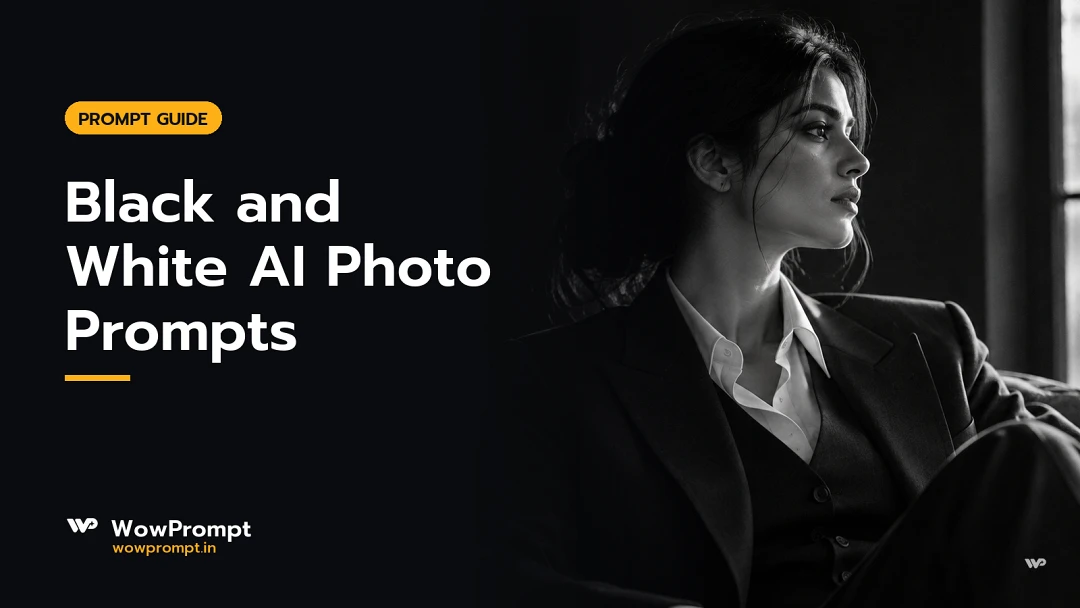
A black and white AI photo prompt works when it describes the light before anything else: one directional source, a thin rim that separates you from the background, deep blacks that are allowed to stay black, and textures the model can render in grey. Ask only for "a black and white photo, 8K" and most models give you a colour picture with the saturation turned down: flat grey skin, a muddy background and no shape. Describe the light, the tones and the surfaces on their own lines, say "no colour at all", and you get the look that is filling prompt galleries this week, from the woman in a dark suit to the close-up male profile.
This guide explains what makes a true monochrome portrait, how to keep your own face, and how to write rim light, window light, rain and film grain. It then gives seven fresh, copy-ready prompts for Gemini and ChatGPT, each linked to a sample picture on our site.
What makes a true black and white AI photo prompt
A real black and white photograph is not a colour photo with the colour removed. Photographers who shoot monochrome plan for it: they choose light that carves shape, clothes that read as clear tones, and backgrounds that fall to black or glow to white. A model needs the same plan written down. Five things separate a gallery-quality result from a flat grey one.
- One directional light. A single source from the side or from above and to the side gives a bright side, a shadow side and a gradient between them. Soft light from everywhere gives a grey face with no form. Name the source and its direction: "a tall window on the left", "one hard strip light above and in front".
- A rim. A thin line of light along the hair, jaw or shoulder separates a dark figure from a dark background. Without it, black hair against black merges into one shape.
- Deep blacks and clean whites. Say "true blacks in the shadows" and "the white shirt is the brightest thing in the frame". Models drift toward the middle grey unless told that the ends of the scale are allowed.
- Named textures. Monochrome has no colour to carry interest, so texture does the work: wool, linen weave, skin pores, wet tarmac, polished wood, chalk on cloth. Name two or three and the picture gains depth.
- No colour at all. Write it in the first line and again in the avoid line, with "sepia, warm tint, cool blue tint, colour cast" as failures. Many models add a faint brown or blue to "make it vintage" unless told not to.
Our guide on how to write AI image prompts covers the one-idea-per-line structure these prompts use. The black and white prompt library shows what each of these elements looks like when it lands.
How to keep your own face in a black and white portrait
Faces drift more in monochrome than in colour, because heavy shadow hides features and the model fills the gaps with a generic face. Three habits keep you recognisable.
- Identity line first. Every prompt below opens by keeping your face, skin tone and body from your photo and taking nothing else from it. Our reference photo guide explains why this order matters.
- Keep the key light on the eyes. Even in a dramatic low-key portrait, ask for "both eyes lit" or "light across the eyes". A face in total shadow is no longer your face.
- Attach a sharp colour photo. Do not convert your photo to black and white first. The model reads skin tone and features better in colour, and the prompt does the conversion.
Keep skin honest too. "Real skin texture with pores" in the finish line stops the plastic smoothing that makes monochrome portraits look like waxwork.
Rim light, window light, rain and film grain
These four tools carry most of the black and white looks that people copy.
Rim light. Place it behind the subject and to one side: "a thin silver rim of light from behind on the left, outlining the hair, jaw and shoulder". Keep the background "near black". Prompt 2 below shows how little light a strong portrait needs.
Window light. The classic, forgiving source. Say where the window is, how large it is and whether the light is soft or direct. A tall north-facing window gives soft, even modelling; low sun through blinds gives stripes. See the window light portrait in an old library.
Rain. Water is a gift in monochrome, because wet surfaces turn into mirrors and every street lamp doubles. Ask for "wet tarmac reflecting the lamps", "fine rain visible against the backlight" and a source behind the falling drops, or the rain disappears. The noir poster laughing under a clear umbrella and the rainy street portrait under a shop awning both use this.
Film grain. Grain makes digital grey feel like a print. Ask for "fine, even film grain like ISO 400 black and white film" and avoid "heavy noise", which smears the face. The monochrome film still in a lamp-lit vintage cafe is a good reference for the right amount.
Black and white AI photo prompts you can copy
1. Woman in a dark suit against a black wall
The look that gathered the most copies this week. Sample: black and white rooftop portrait in a wide-leg linen suit; a studio version is the oversized blazer portrait on a studio stool.
Use the person in my photo as the subject. Keep their face, skin tone and body exactly as they are; rebuild the pose, clothes, background and light from this prompt.
Style: a true black and white photograph with no colour at all.
Pose: standing at three-quarter view, chin slightly lowered, eyes on the lens; right hand in the trouser pocket, left hand resting on the jacket lapel.
Outfit: a charcoal wool suit with a single-button jacket and wide-leg trousers, a plain white cotton shirt open at the collar, no tie.
Place: a studio with a matte black wall, nothing else in the frame.
Light: one large soft source from the left at 45 degrees; a thin silver rim from behind on the right along the hair, jaw and shoulder; both eyes lit.
Lens: 85mm portrait lens, waist-up framing, background falling to near black.
Finish: true blacks in the shadows, the shirt collar the brightest tone, wool texture visible, real skin texture with pores, fine film grain.
Avoid: colour, sepia, warm or blue tint, flat grey skin, washed-out blacks, plastic skin, extra fingers, text, watermark.
Aspect ratio 4:5.
2. Man in profile, close-up under one hard light
The male close-up that keeps rising in the galleries. Sample: extreme close-up profile under a single strip light.
Use the person in my photo as the subject. Keep their face, skin tone and body exactly as they are; rebuild the pose, clothes, background and light from this prompt.
Style: a true black and white photograph with no colour at all.
Pose: strict side profile facing left, the face filling most of the frame; right hand raised, fingertips resting along the jaw; left hand out of frame.
Outfit: a black ribbed wool turtleneck, the collar just visible.
Place: a dark studio, the background pure black.
Light: one narrow band of hard light from the front-left falling across the eyes and cheekbone; the back of the head fading into shadow; a faint rim along the nose and lips.
Lens: 100mm macro-style portrait lens, very close framing.
Finish: deep blacks, skin pores and stubble in sharp detail, eyelashes clear, fine grain.
Avoid: colour, sepia, warm tint, the face in total shadow, plastic skin, distorted fingers, text, watermark.
Aspect ratio 4:5.
3. Black and white couple photo prompt in studio haze
Two faces, one light, a little haze to make the beam visible. Sample: black and white couple portrait in studio haze against plaster. More pairs are in the couple prompt library.
Use the two people in my photo as the subjects. Keep both faces, skin tones and bodies exactly as they are; rebuild the pose, clothes, background and light from this prompt. If only one person is in the photo, keep that person and create a partner.
Style: a true black and white photograph with no colour at all.
Pose: she stands slightly in front, her right hand resting on his forearm, her left hand at her side; he stands behind her shoulder, his left hand in his trouser pocket, his right hand on her waist; both looking past the camera.
Outfits: she wears a white silk shirt and black high-waisted trousers; he wears a black linen shirt with the sleeves rolled.
Place: a studio with a rough off-white plaster wall, light haze in the air.
Light: one hard source high on the right cutting a visible beam through the haze; a soft rim on both profiles.
Lens: 50mm, waist-up framing of both.
Finish: true blacks, glowing whites in the silk, plaster texture visible, fine grain.
Avoid: colour, sepia, faces merging, one face much larger than the other, flat grey light, extra hands, text, watermark.
Aspect ratio 4:5.
4. Pianist at an upright piano
Hands are the hardest part of this picture, so they get their own line. Sample: black and white portrait of a young man at an upright piano.
Use the person in my photo as the subject. Keep their face, skin tone and body exactly as they are; rebuild the pose, clothes, background and light from this prompt.
Style: a true black and white photograph with no colour at all.
Pose: seated at an upright piano, body turned three-quarters to the camera, head tilted toward the keys, eyes half closed; both hands on the keys, ten fingers clearly formed, the right hand higher up the keyboard than the left.
Outfit: a white cotton shirt with the sleeves rolled to the elbow, dark wool trousers.
Place: a small room with a dark wooden upright piano, sheet music on the stand, a bare wall.
Light: soft window light from the left falling on the face and the keys; the far side of the room in deep shadow.
Lens: 35mm, the keys and face both in focus.
Finish: polished wood reflections, ivory and black keys crisp, fine grain.
Avoid: colour, sepia, brand names or lettering on the piano, extra or merged fingers, warped keys, text, watermark.
Aspect ratio 4:5.
5. White shirt in a tailoring workshop
A portrait built on texture: chalk, cloth and a measuring tape. Sample: black and white portrait in a white shirt in a tailoring studio.
Use the person in my photo as the subject. Keep their face, skin tone and body exactly as they are; rebuild the pose, clothes, background and light from this prompt.
Style: a true black and white photograph with no colour at all.
Pose: standing at a cutting table, looking at the lens over the left shoulder; right hand holding a tailor's chalk on a length of dark cloth, a measuring tape draped around the neck, left hand flat on the table.
Outfit: a crisp white cotton shirt with the sleeves rolled, dark grey trousers, a leather watch.
Place: a tailoring workshop, bolts of wool on shelves, a dressmaker's form in the background, paper patterns pinned to the wall.
Light: a tall window on the right; a thin rim of light along the profile and shoulder; the far shelves falling to near black.
Lens: 50mm, waist-up framing.
Finish: the white shirt the brightest tone, chalk lines visible on the cloth, wool weave sharp, real skin texture, fine grain.
Avoid: colour, sepia, flat grey light, readable labels, extra fingers, text, watermark.
Aspect ratio 4:5.
6. Street scene in the rain at night
Wet tarmac, a single lamp and a figure walking through it. Sample: noir poster laughing under a clear umbrella; for a softer evening, the full-length of two friends on a promenade at dusk.
Use the person in my photo as the subject. Keep their face, skin tone and body exactly as they are; rebuild the pose, clothes, background and light from this prompt.
Style: a true black and white photograph with no colour at all, cinematic street style.
Pose: walking toward the camera, mid-stride; right hand holding a clear umbrella above the head, left hand in the coat pocket; a slight smile, eyes on the lens.
Outfit: a long dark wool overcoat, a pale knit scarf, leather boots.
Place: an old city street at night, shuttered shopfronts, wet tarmac and puddles.
Light: one street lamp behind and to the right, rain falling visibly through its glow, a rim on the umbrella edge and the shoulders; the face lit softly by a shop window on the left.
Lens: 35mm, full-length framing, the street receding behind.
Finish: deep blacks, lamp reflections doubled in the puddles, raindrops sharp, fine grain like ISO 400 film.
Avoid: colour, sepia, blue tint, the face in shadow, blurred raindrops covering the face, readable signs, text, watermark.
Aspect ratio 9:16.
7. Selective colour: one red detail
The one exception to "no colour at all": a single coloured detail in a monochrome frame. Sample: monochrome magazine cover with a red rim light and sunglasses.
Use the person in my photo as the subject. Keep their face, skin tone and body exactly as they are; rebuild the pose, clothes, background and light from this prompt.
Style: a black and white photograph in which only the dupatta is red; skin, hair, clothes and background are all strictly monochrome.
Pose: three-quarter view, chin lifted slightly; right hand holding the dupatta across the shoulder so it falls in a long line, left hand at the side.
Outfit: an ivory cotton kurta with fine chikankari, a deep red georgette dupatta, small silver jhumkas.
Place: a plain grey plaster wall.
Light: one soft source from the left at 45 degrees, a thin rim from behind on the right.
Lens: 85mm, waist-up framing.
Finish: rich blacks, the red saturated but natural, fabric texture visible, real skin texture, fine grain.
Avoid: red spilling onto skin or lips, any second colour, sepia, warm tint on the skin, flat grey light, text, watermark.
Aspect ratio 4:5.
Selective colour fails when the colour word appears twice. Name the coloured object once, and say that skin stays monochrome.
Black and white photo editing prompt for Gemini and ChatGPT: how to use it
- Open Gemini or ChatGPT and start a new chat.
- Attach one sharp, evenly lit colour photo of your face. For the couple prompt, attach a photo with both people.
- Paste the prompt as written and send. Keep the avoid line; it removes the sepia and the grey wash.
- If the result is still grey, reply: "Deepen the blacks, keep the brightest tone on the shirt, and make the light come only from the left. Keep my face the same."
- If a tint appears, reply: "Remove all colour, including warm or blue tints. Pure black and white."
A ChatGPT black and white portrait prompt uses the same wording as a Gemini one. Gemini often holds the face closer on the first try; ChatGPT tends to follow the lighting lines more strictly, which suits the rim light prompts. For tall frames and feed posts, our aspect ratio guide explains the choices, and our prompts for Gemini collect more ideas for that model.
Common failures and how to fix them
- Flat grey result. The light is not directional. Name one source and its side, and ask for true blacks.
- Sepia or a blue cast. Put "no colour at all" in the style line and "sepia, warm tint, blue tint" in the avoid line.
- Black hair vanishing into the background. Add a rim from behind, or lighten the background to a dark grey.
- Waxy skin. Remove beauty words such as "flawless" and ask for pores and fine grain.
- "8K" with no effect. Resolution words add nothing to tone. Spend the words on light and texture instead.
Frequently asked questions
What is a black and white AI photo prompt?
It is a prompt that asks an AI model to rebuild your photo as a true monochrome photograph. A good one names one directional light, a rim, deep blacks, specific textures and "no colour at all", and lists sepia and tints as failures.
Does the same prompt work in Gemini and ChatGPT?
Yes. Every prompt here works in both. Run it in each and keep the better result.
Why does my black and white AI photo look flat and grey?
Usually the prompt never said where the light comes from. Name a single source, add a rim, and ask for true blacks and a brightest tone.
How do I make a b&w cinematic portrait prompt?
Use a hard side light or a street lamp behind the subject, a 35mm or 85mm lens, deep blacks and fine film grain. Rain and haze make the light visible and add a film-still feel, as in prompts 3 and 6.
Can I keep one colour in a black and white photo?
Yes. Name one object in colour, say that skin and everything else stay monochrome, and list "colour spilling onto skin" in the avoid line, as in prompt 7.
Where to find more
Browse the full black and white prompt library, portrait prompts, editorial and fashion prompts, vintage and retro prompts and the complete image prompt library. Other monochrome looks worth trying are the candid laugh in a tuxedo in a hotel corridor, the cover portrait on a cloudy mountain road and the double exposure with a misty pine forest. For layered silhouettes, read our double exposure AI photo prompts.
Related guides
- Contact sheet AI photo prompts: nine poses of one face in a 3x3 grid
- Winter Arc photo prompts for day 1 to day 90: ten fitness and discipline pictures for the 90-day winter challenge, each with its result.