Karwa Chauth AI Photo Editing Prompts for Gemini and ChatGPT
Copy-ready Karwa Chauth AI photo editing prompts for solo and couple pictures: moon and thali, mehendi, red Bandhani saree, with your own face kept.
Karwa Chauth AI photo editing prompts work best when they name the ritual, the fabric and the light instead of asking for "a festive look". Karwa Chauth falls on 29 October 2026, and this guide gives you six copy-ready prompts for Gemini and ChatGPT, for a solo portrait or a couple picture, each one written so the face in your photo stays exactly yours.
Most Karwa Chauth edits you see on social media have the same three problems: an orange glow over everything, a face that no longer looks like the person, and a sieve pasted into the frame at a strange angle. The prompts below fix all three. Every one of them also has a matching sample on our site, so you can see the result before you copy.
What makes a Karwa Chauth AI photo look real
A good Karwa Chauth picture is an evening picture. The fast ends when the moon rises, so the honest light is blue hour and moonlight, with one small lamp or diya on the face. That is the single biggest change you can make: ask for cool evening light and name one warm source, and the picture stops looking like a filter.
Four details do the rest of the work:
- The ritual object, named. A brass karwa, a puja thali with a diya, a channi (sieve) or, for a fresher look, the moon reflected in a thali of water. Pick one. Two or three props in the same frame look staged.
- The fabric, not "traditional outfit". Red Bandhani georgette, a Banarasi silk saree, a bottle-green silk with a red border or a gota-patti dupatta each draw a different picture. The model only gets the weave right when you name it.
- Mehendi as fine lines. Say "deep brown mehendi to the wrists, the pattern reading as fine lines". Without it, hands come out smudged.
- The identity rule, once. If you attach your photo, one clear line keeps your face unchanged. Repeating it three times does not help. Our guide to identity lock prompts for a reference photo explains the wording in detail.
If you want to browse finished pictures first, the festival and devotional prompts and couple prompts libraries hold every festive picture we have published.
How to use these prompts with your own photo
The steps are the same in both tools:
- Open ChatGPT or Google Gemini and start a new chat.
- Attach one clear, front-facing photo in daylight. For a couple picture, attach a photo with both faces visible.
- Paste the prompt and send it. Ask for one change at a time if you want to adjust it, for example "same picture, saree in maroon instead of red".
Two tips save most failed attempts. First, do not upload a heavily filtered selfie: the model copies the filter along with the face. Second, keep the aspect ratio at 4:5 or 3:4 for a portrait, which fits an Instagram post without cropping. Our aspect ratio guide covers the other sizes.
Karwa Chauth AI photo editing prompts for a solo portrait
Prompt 1: Mehendi hands and a brass karwa on the terrace
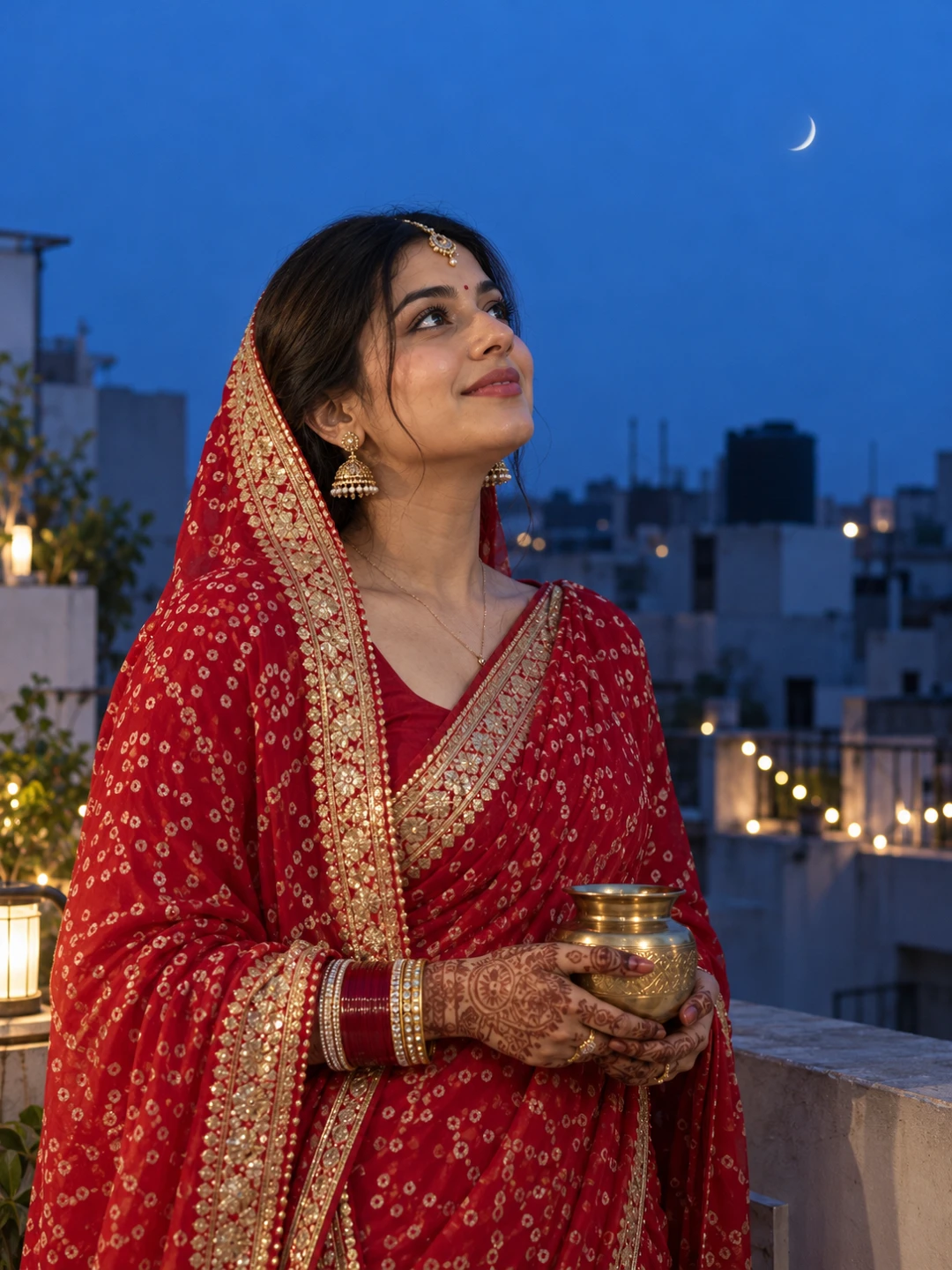
This is the classic waiting-for-the-moon picture, done in cool evening light so the red stays a true red. The full version with its sample is on the Karwa Chauth mehendi hands on a terrace prompt page.
Keep the face in the attached photo exactly as it is: bone structure, eyes, nose, lips, jawline, hairline, skin tone and age unchanged.
A young woman stands at a terrace parapet at blue hour on Karwa Chauth, a small brass karwa held at her waist in hennaed hands, looking up at the sky.
She wears a true-red Bandhani georgette saree with a gold gota border over her head, a thin gold maang tikka, red and gold chooda, and deep brown mehendi to the wrists, the pattern reading as fine lines.
Rooftops fade into a deep blue sky with one pale crescent moon. Cool skylight as the main light, a small soft lamp lifting her face.
85mm lens at f/2, waist up. Natural skin with visible texture, the saree a true red, never orange.
Avoid: airbrushed skin, changed face, orange cast, smudged mehendi, extra fingers, text, watermark.
Aspect ratio 3:4.
Prompt 2: The moonrise with a channi
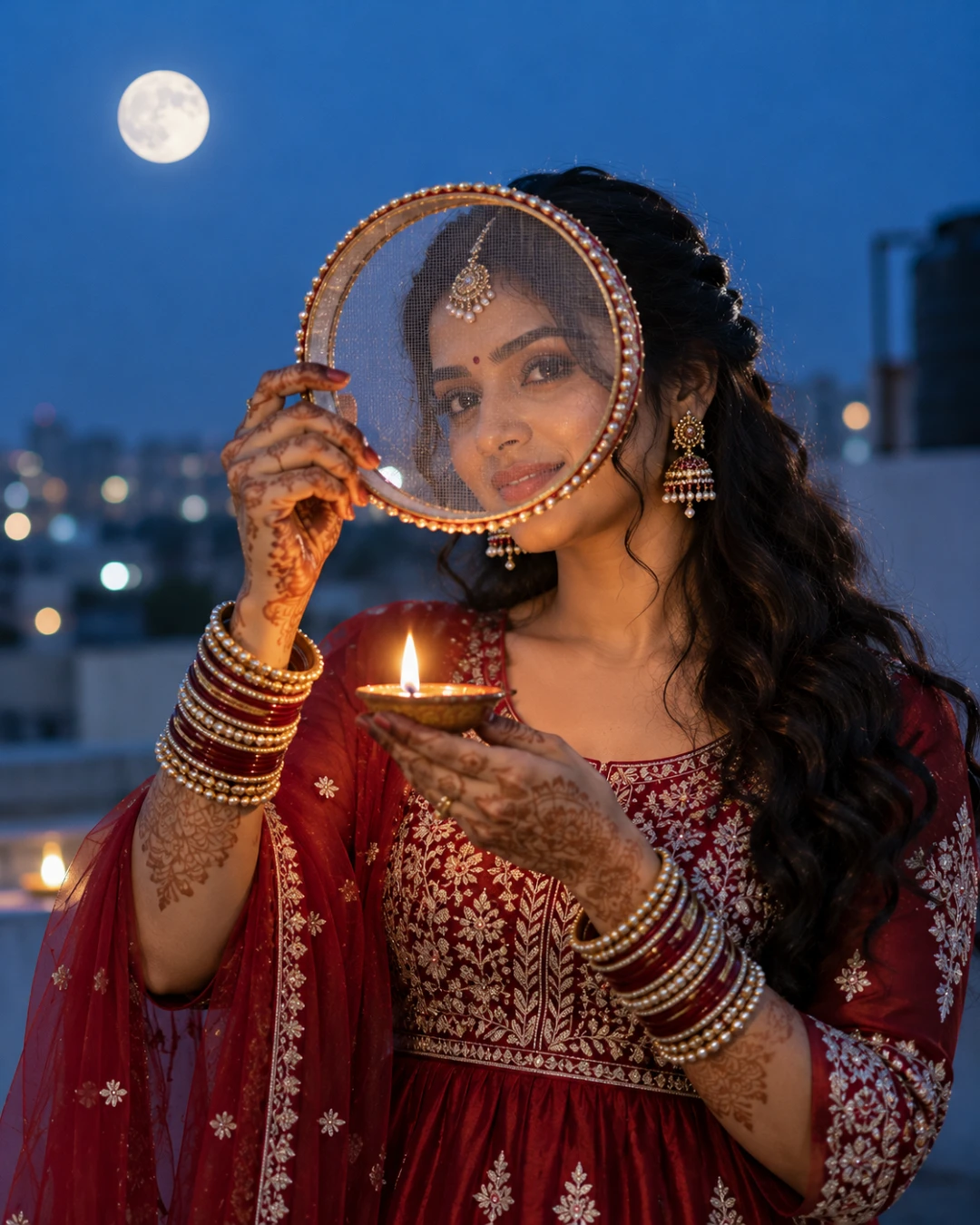
If you want the traditional sieve shot, keep the channi in front of the face but not covering the eyes. See the Karwa Chauth moonrise portrait with a sieve for our published version.
Keep the face in the attached photo exactly as it is; only the clothing, pose, setting and light change.
On a rooftop on Karwa Chauth night, a young woman raises a steel channi (sieve) beside her face, looking through it at a full moon low in the sky, a lit diya in a puja thali in her other hand.
She wears a red and ivory chanderi suit with a sheer red dupatta, small gold jhumkas and a red bindi.
Deep navy night sky, the moon sharp and round. The diya gives a small warm light on her cheek; everything else stays cool.
85mm at f/1.8, chest up, the sieve mesh crisp, both eyes visible.
Avoid: sieve covering the eyes, orange sky, plastic skin, changed face, fireworks, watermark.
Aspect ratio 4:5.
Prompt 3: Silk saree portrait in a courtyard before the puja
A daytime option for the morning sargi or the evening katha, when the light is still soft. The styling follows our Banarasi lehenga bridal portrait and the Kanjivaram silk in a Chettinad mansion courtyard prompts, which are good starting points if you prefer a south Indian silk.
Keep the face in the attached photo exactly as it is.
A married woman sits on the steps of an old courtyard before the Karwa Chauth katha, a puja thali with roli, rice and a small unlit diya on her lap, smiling softly at someone off frame.
She wears a maroon Banarasi silk saree with a wide gold zari border, a red blouse, sindoor in the parting and stacked red and gold bangles.
Soft open shade, lime-plaster walls, a tulsi pot and a brass bell behind her.
50mm at f/2, three-quarter length. Natural true colour, real skin texture, fine silk sheen.
Avoid: orange grade, airbrushed skin, changed face, synthetic shiny fabric, watermark.
Aspect ratio 4:5.
Karwa Chauth couple photo prompts
Couple pictures are where most edits go wrong, because the model has two faces to keep. Attach a photo with both of you looking roughly at the camera, and say what to do if only one face is visible. The couple photo editing prompts guide covers this in more depth.
Prompt 4: The moon in a brass thali
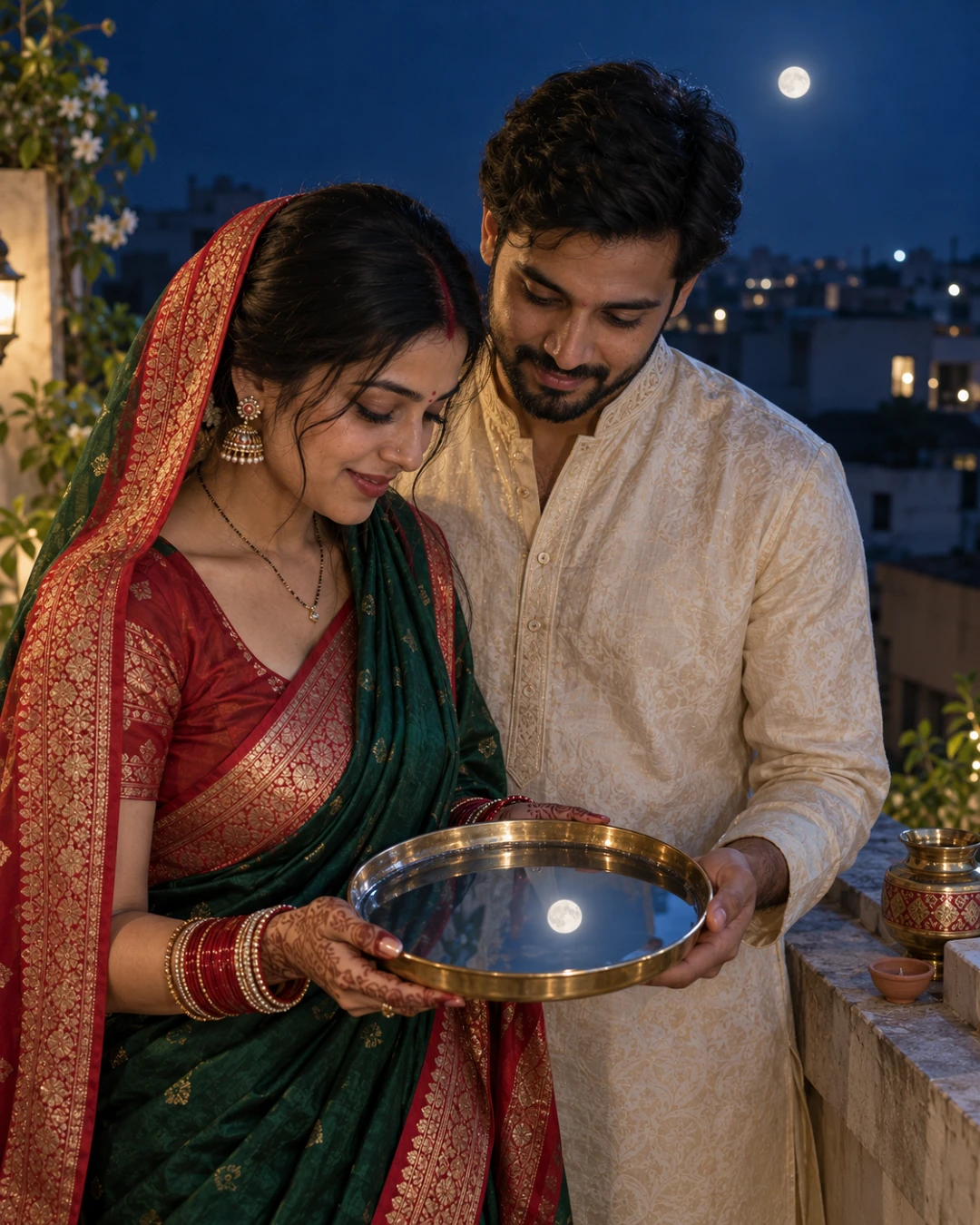
This is our favourite fresh take: instead of the sieve, the couple look down at the moon reflected in a thali of water. The tested version is the Karwa Chauth couple with the moon in a brass thali prompt.
Keep both faces in the attached photo exactly as they are. If only one person is in the photo, keep that face and create the other.
A couple stands close on a terrace on Karwa Chauth night, heads bent toward a wide brass thali of still water she holds; the round moon shines in the water. His hand rests under hers to steady the plate.
She wears a bottle-green silk saree with a red border and red bangles; he wears a cream silk kurta.
Cool moonlight from above, a soft lamp from the side on their faces, a small unlit diya and a karwa on the parapet.
85mm at f/2, slightly high angle so the reflection shows.
Avoid: sieve, orange grade, fireworks, blurred reflection, changed faces, extra fingers, watermark.
Aspect ratio 4:5.
Prompt 5: Breaking the fast together
The moment after the moon is sighted, when he offers the first sip of water. Keep the gesture simple; long hand-to-mouth descriptions are where hands distort.
Keep both faces in the attached photo exactly as they are.
On a rooftop under the moon, a husband holds a small brass glass of water to his wife's lips as she breaks the Karwa Chauth fast, both smiling with their eyes.
She wears a red Banarasi saree with the pallu over her head and fresh mehendi; he wears an ivory kurta with a maroon stole.
A puja thali with a lit diya on the ledge, the city lights soft and blue behind them.
50mm at f/1.8, waist up, one warm diya light on their faces, cool night everywhere else.
Avoid: distorted hands, extra fingers, changed faces, orange cast, plastic skin, watermark.
Aspect ratio 4:5.
Prompt 6: Newlyweds' first Karwa Chauth in a palace window

For a first Karwa Chauth, a richer setting works. The look borrows from our newlyweds in a jharokha window with a Bandhani odhni prompt.
Keep both faces in the attached photo exactly as they are.
A newly married couple stands in a carved sandstone jharokha window on their first Karwa Chauth evening, she holding a puja thali with a diya, he looking at her rather than the camera.
She wears a red Bandhani odhni over a heavy red lehenga with gota-patti work and a fresh chooda; he wears a cream bandhgala.
Blue hour sky through the arch, the stone carving sharp, a small diya light on their faces.
85mm at f/2, three-quarter length.
Avoid: orange sky, changed faces, plastic skin, crowds, watermark.
Aspect ratio 3:4.
Common mistakes and how to fix them
- Everything turns orange. Delete "golden hour", "warm glow" and "sunset" from the prompt. Ask for blue hour or moonlight and one small warm lamp. Then add "no orange cast".
- The face changes. Use one identity line at the top and say "only the clothing, pose, setting and light change". Attach a sharper photo with even light.
- The sieve looks pasted on. Describe where it is held (beside the face, eyes visible) and what it is made of (steel mesh).
- Mehendi smudges. Add "the pattern reading as fine lines" and keep the hands in a simple pose.
- Text or names appear. End every prompt with "no text, no watermark", or use a poster prompt on purpose, like our anniversary poster at a lighthouse at blue hour, where the words are set exactly.
More festive prompts for the season
Karwa Chauth sits between Dussehra and Diwali, so the same week is full of festive picture ideas. Try the sindoor khela portrait of two friends for Vijaya Dashami, the painting clay diyas on a balcony before Diwali prompt for the run-up to Diwali, or the rooftop sparkler couple before Diwali night for a couple post. For a wedding-season look, the mehendi ceremony bride laughing with her cousins is one of our most natural candids.
You will find all the sarees and lehengas in the traditional wear prompts library and the anniversary cards and posters in the anniversary prompts library. If you are new to festival prompts in general, the festival portrait prompts guide and the Gemini saree prompts post are good next reads.
Frequently asked questions
Which is better for Karwa Chauth photos, Gemini or ChatGPT?
Both keep a face well when the photo is clear. ChatGPT tends to follow long prompts and exact text more closely, so it is better for posters with names. Gemini is quick and good at natural skin. Try the same prompt in both and keep the one that looks more like you.
Can I use these prompts without my own photo?
Yes. Without a photo, both tools create an original person who matches the description in the prompt. Add a short line such as "a Punjabi woman of about twenty-seven with a low bun" so the result fits the story you want.
How do I keep my husband's face the same in a couple edit?
Attach one photo where both faces are clear and similar in size, and use the couple identity line from Prompt 4. If the tool still changes one face, regenerate rather than editing the same picture again; repeated edits drift further from the original.
Why does my Karwa Chauth picture look orange?
Warm words in the prompt, such as golden hour or warm glow, push the whole frame orange. Use blue hour or moonlight as the main light, one small diya or lamp on the face, and add "no orange cast" at the end.
What aspect ratio should I use for an Instagram post or status?
Use 4:5 for an Instagram feed post and 9:16 for a story, reel cover or WhatsApp status. 3:4 is a good middle ground for a printed photo.
Where to find more
Every prompt above links to a page with a tested sample picture, the full prompt and its negative list. For more ideas this festive season, browse the festival and devotional, couple and traditional wear libraries, or start from the full image prompt library.
Related guides
- Diwali AI photo editing prompts: seven copy-ready prompts for diyas, rangoli, sparklers and family pictures in Diwali week.
- Sharad Purnima AI photo editing prompts for moonlit photos
- Dhanteras AI photo editing prompts for Gemini and ChatGPT