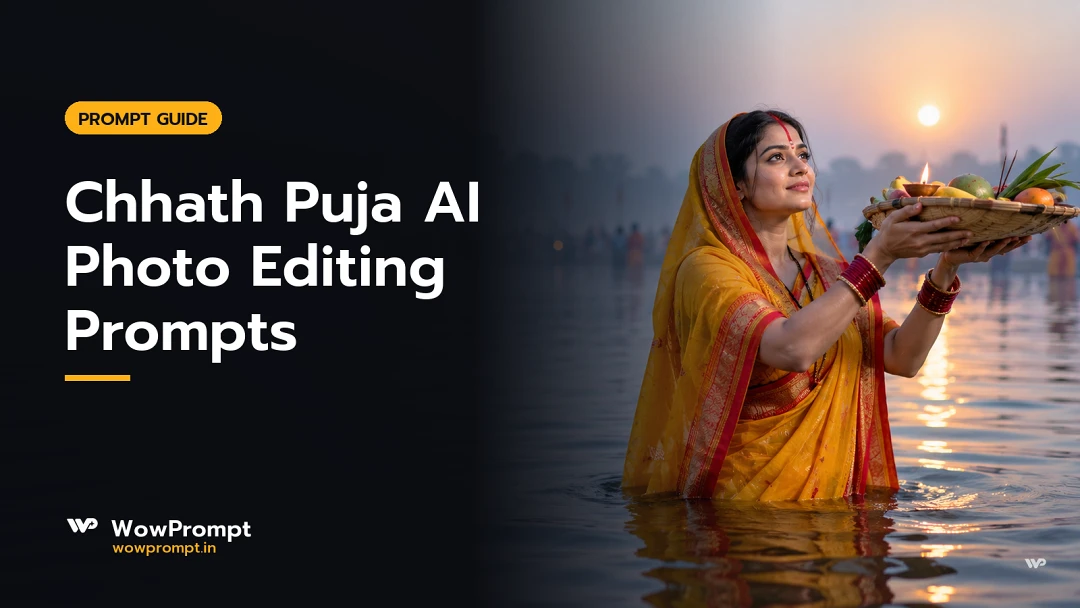
Chhath Puja AI Photo Editing Prompts 2026 for Gemini and ChatGPT
Copy-ready Chhath Puja AI photo editing prompts: river arghya with a soop, the daura, ghat evenings, thekua and a greeting poster, with your face kept.
A Chhath Puja AI photo editing prompt works best when it places you in one real moment of the four days, such as standing in the river at sunrise with a bamboo soop, and asks for cool natural water light instead of "golden divine glow with the sun god behind me". Chhath Puja 2026 falls from 13 to 16 November, about a week after Diwali, and the ghats of Bihar, Jharkhand, eastern Uttar Pradesh and the Nepal Terai fill with families for the evening and dawn offerings. This guide gives you eight copy-ready prompts for Gemini and ChatGPT: the dawn arghya, carrying the daura, a couple at the ghat at dusk, a family on the steps with diyas, a close-up of hands on the soop, making thekua, a greeting poster with your name, and a misty black and white variant. Each one keeps the face in your photo as yours.
Most Chhath edits online look the same: the whole frame turns orange, the river becomes molten gold, and a giant sun or a painted face of Chhathi Maiya fills the sky. The festival itself is quieter than that. It is about patience, cold water, bare feet on wet steps and a family that has waited all day. The prompts below aim for that feeling, and each section links to a sample picture on our site so you can see the look before you copy.
What makes a Chhath Puja AI photo editing prompt work
Chhath light is unusual. The evening offering happens as the sun sets over the water, and the dawn offering happens before and just as it rises, often in November mist. Both are blue, grey and soft, with the sun as one small warm disc. When a prompt says "warm golden festival light", the model paints the river orange and loses the water, the cotton and the skin. When it says "cool dawn, low mist, the sun a small pale disc on the horizon", you get depth and a picture that looks like the ghat you remember.
Five habits make the difference:
- One real moment. Standing waist-deep for the arghya, walking to the ghat with the daura, lighting diyas on the steps, pressing thekua dough. A moment gives every hand a job.
- A named outfit. "Traditional Bihari dress" gives a costume. A yellow cotton saree with a red border, worn wet at the hem, or a plain white dhoti and a cotton vest gives a real garment.
- Real offerings. Name what is on the soop: thekua, a coconut, bananas, sugarcane, a small clay diya. Generic "fruits" produces a supermarket basket.
- An explicit Avoid line. Orange cast, golden river, plastic skin, changed face, extra fingers and text all go in the negative line, every time.
- No deity as the subject. The sun is nature and can sit on the horizon, but the prompt never asks the model to draw Chhathi Maiya or a god in the sky. Image models draw sacred figures badly, and a respectful picture is one the whole family can forward.
Our festival portrait prompts guide explains this structure in full, and every prompt below follows it.
How to use these prompts with your own photo
- Open Gemini or ChatGPT and start a new chat.
- Attach one clear, front-facing photo taken in daylight. Avoid sunglasses, beauty filters and group shots for the solo prompts.
- Paste the prompt exactly as written and send.
- If the face drifts, reply: "Keep my face exactly as in the photo; change only the outfit, pose, place and light." Our reference photo guide has stronger identity lines if you need them.
- Keep the aspect ratio inside the prompt. Use 4:5 for an Instagram feed post and 9:16 for stories and WhatsApp status, so the model composes for that shape rather than cropping a square later.
Chhath Puja AI photo prompts for Gemini and ChatGPT
1. Dawn arghya standing in the river with a soop
The picture that means Chhath to most people: the vratin standing in the water at sunrise, the soop raised toward the first light. See the sample Chhath dawn arghya standing in the river with a bamboo soop.
Use the person in my photo as the subject. Keep their face, skin tone, hairline and body exactly as they are; take nothing else from the photo.
Scene: the dawn arghya of Chhath Puja; they stand waist-deep in a calm river and offer the soop toward the rising sun.
Pose: facing the horizon in three-quarter view, both hands lift a bamboo soop at chest height, eyes lowered, lips moving in prayer; the saree pallu wet against the arm.
Outfit: a yellow cotton saree with a thin red border, a red blouse, glass bangles, orange-red sindoor drawn from the parting down toward the nose, a small nose pin.
Soop: thekua, a whole coconut, two bananas, a short piece of sugarcane and a small lit clay diya.
Place: a wide river ghat at first light, other devotees standing in the water far behind, soft and small.
Light: cool blue-grey dawn with low mist on the water; the sun is a small pale disc just above the horizon; ripples carry a faint reflection.
Finish: 50mm, f/2, eye level from the water, real skin texture, wet cotton detail.
Avoid: deity in the sky, orange or golden cast, molten gold water, plastic skin, changed face, extra fingers, text, watermark.
Aspect ratio 9:16.
2. Carrying the daura to the ghat before dawn
In many families the men carry the daura, the large bamboo basket of offerings, on the head to the ghat in the dark hours before the dawn arghya. See the sample carrying a bamboo daura to the Chhath ghat before dawn.
Use the person in my photo as the subject. Keep their face, skin tone, hairline and body exactly as they are; take nothing else from the photo.
Scene: the walk to the Chhath ghat before dawn; they carry the daura through a narrow lane with other families walking ahead.
Pose: walking toward the camera, barefoot; both hands steady a bamboo daura balanced on the head over a folded cloth; a calm, focused face.
Outfit: a plain white cotton dhoti and a white cotton kurta, a red-checked gamcha over one shoulder.
Daura: wrapped in a yellow cloth, sugarcane stalks rising from the back, bananas and a coconut visible at the rim.
Place: a mud lane leading down to the river, small clay lamps along the edge, the ghat glow faint ahead.
Light: deep blue pre-dawn; the lamps are the only warm points; a soft fill keeps the face true.
Finish: 35mm, f/2, slight low angle, real skin texture, fine bamboo weave.
Avoid: deity in the sky, orange cast, crowd covering the face, plastic skin, changed face, extra fingers, text, watermark.
Aspect ratio 4:5.
3. A couple at the ghat at dusk for Sandhya arghya
The evening offering is the softer, slower picture, with the water already dark and the sky still light. Compare the anniversary portrait on the ghats at dusk with lamps on the water and the two friends at a ghat railing as floating lamps drift past.
Use the two people in my photo as the subjects. Keep both faces, skin tones and bodies exactly as they are; take nothing else from the photo. If only one person is in the photo, keep that person and create a partner.
Scene: the evening arghya of Chhath Puja; a married couple stands on the lowest ghat step at the water's edge as the sun sets.
Pose: she holds a soop with both hands at the waist; his right hand cups a small clay diya, his left hand rests at her back; both look at each other, a quiet smile.
Outfits: she wears a deep green cotton saree with a red border and orange-red sindoor down the parting; he wears an off-white kurta and dhoti with a maroon shawl.
Place: wet stone steps, other families in small groups along the bank, soft and out of focus.
Light: cool dusk, lavender and grey sky; the low sun is a small warm disc; the diya is the only warm point on their faces.
Finish: 50mm, f/1.8, eye level, real skin texture, light film grain.
Avoid: deity in the sky, orange or golden cast, changed faces, extra fingers, a third hand, text, watermark.
Aspect ratio 4:5.
For more two-person ideas, see the full set of couple prompts.
4. A family on the ghat steps with diyas
A family picture on the steps, everyone together after the offering. This prompt keeps everyone an adult, so the model never invents a child from your photo. See also the family of four in indigo khadi on a misty lake jetty at dawn for the same cool light.
Use the people in my photo as the subjects. Keep every face, skin tone and body exactly as they are; take nothing else from the photo. All subjects are adults; if fewer than four people are in the photo, create adult relatives to make four.
Scene: after the evening arghya of Chhath Puja; the family sits together on the ghat steps lighting a row of clay diyas.
Pose: two sit on a lower step, two on the step above; the front pair shield diya flames with cupped hands, the back pair rest a hand on their shoulders; everyone looks at the camera, relaxed.
Outfits: women in cotton sarees in yellow and pale pink with red borders; men in white kurtas, one with a mustard shawl.
Place: broad stone steps down to a dark river, sugarcane bundles and soops resting beside them.
Light: cool blue dusk; the diya row is a line of small warm points; true colours on fabric.
Finish: 35mm, f/2.8, eye level, real skin texture on every face, sharp from front to back.
Avoid: children, deity in the sky, orange cast, merged faces, changed faces, extra fingers, text, watermark.
Aspect ratio 4:5.
5. Close-up of hands holding the soop
A detail picture works well as a status update or a carousel opener, and it needs no face at all. The Ashtami anjali portrait with flowers in folded hands shows how a hands-first frame can carry a festival.
Use the hands and skin tone of the person in my photo; take nothing else from the photo.
Scene: a close-up during the Chhath arghya; two hands hold a bamboo soop just above the river surface.
Hands: both hands grip the soop rim from below, fingers relaxed, glass bangles in red and green on both wrists, alta on the fingertips, water drops on the skin.
Soop: thekua with its carved pattern, a whole coconut, a lit clay diya, a few bananas and a short sugarcane piece.
Light: cool blue-grey dawn; the diya flame is the only warm point; the water behind falls into soft mist.
Finish: 85mm, f/2.8, shallow depth, focus on the thekua and fingertips, real skin texture.
Avoid: extra fingers, fused fingers, orange cast, plastic skin, text, watermark.
Aspect ratio 4:5.
6. Making thekua at home
Kharna and the day before the evening arghya are spent in the kitchen, pressing dough into wooden moulds. See the grandmother and granddaughter shaping thekua for Chhath, and browse more food and drink prompts.
Use the person in my photo as the subject. Keep their face, skin tone, hairline and body exactly as they are; take nothing else from the photo.
Scene: making thekua for Chhath Puja in a home kitchen in the afternoon.
Pose: seated on a low wooden stool; the right hand presses a ball of wheat and jaggery dough into a carved wooden mould, the left hand holds the mould steady; looking down, a small smile.
Outfit: a cream cotton saree with a maroon border, sleeves pushed up, hair tied in a low bun.
Place: a clean kitchen floor with a brass plate of finished thekua, a bowl of dough and an iron kadhai on a clay chulha behind.
Light: soft window daylight from the left, cool and even; the chulha glow is a small warm point.
Finish: 50mm, f/2, eye level, real skin texture, flour on the fingertips.
Avoid: orange cast, extra fingers, changed face, plastic skin, text, watermark.
Aspect ratio 4:5.
7. Chhath greeting poster with your name
A poster to forward to family groups. Write your name exactly where it says so, and keep the text short, because models spell short lines more reliably. Compare the Diwali greeting poster with a lamp-lit portrait.
Use the person in my photo as the subject. Keep their face, skin tone, hairline and body exactly as they are; take nothing else from the photo.
Scene: a Chhath Puja greeting poster; they stand on a river ghat at dawn holding a lit clay diya in both hands.
Outfit: a yellow cotton saree with a red border (or a white kurta with a mustard shawl).
Layout: the subject on the right third; clear sky on the left for text.
Text: at the top left, "Happy Chhath Puja" in a clean serif; below it, smaller, "With warm wishes from [YOUR NAME]". Spell every word exactly, no other text.
Light: cool blue dawn with mist on the water, the sun a small pale disc low on the horizon.
Finish: 50mm, f/2, real skin texture, crisp typography.
Avoid: deity in the sky, orange or golden cast, misspelled text, extra words, changed face, extra fingers, watermark.
Aspect ratio 4:5.
For more festival portraits built as posters, our Diwali AI photo editing prompts use the same layout rules.
8. Black and white Chhath in dawn mist
A monochrome version removes the colour problem entirely and keeps the mood. See the selective colour sindoor khela close-up for a single-colour twist, and browse the black and white prompts.
Use the person in my photo as the subject. Keep their face, skin tone, hairline and body exactly as they are; take nothing else from the photo.
Scene: the dawn arghya of Chhath Puja in thick river mist, shown in black and white.
Pose: standing knee-deep in still water, side profile, both hands holding a soop with a small lit diya, head slightly bowed.
Outfit: a cotton saree with a broad dark border, the pallu over the head.
Place: a misty river, a faint row of devotees in the water far behind, a boat as a soft shape.
Light: diffused grey dawn, the sun hidden by mist; the diya is the brightest point in the frame.
Finish: black and white, rich mid-greys, fine grain, 85mm, f/2, real skin texture.
Avoid: colour, crushed blacks, deity in the sky, plastic skin, changed face, extra fingers, text, watermark.
Aspect ratio 9:16.
9. Chhath Kharna: rasiya kheer on a mud chulha
Kharna, the second evening of Chhath, is when the vrati cooks rasiya kheer on a clay chulha before the 36-hour fast. This prompt keeps the courtyard in cool dusk light and the fire as one small warm patch, so the green saree and real skin stay true instead of turning orange. Find more in our festival and devotional prompts.
Identity: With a photo attached: the person in the photo is the subject. Keep their face exactly as it is, with bone structure, eye shape and spacing, nose, lips, jawline, hairline, skin tone and apparent age all unchanged, and keep their own body: build, height and proportions, shoulders, arms, hands and legs, with the same skin tone on face, neck, arms and hands. Use the photo only for who the person is. Ignore its pose, expression, clothing, hairstyle, background, framing and light, and rebuild all of them exactly as described below, even when the photo shows them standing straight or dressed differently.
Subject: On the evening of Kharna, the second day of Chhath, a young woman stirs rasiya kheer for the offering on a mud chulha in the courtyard of her family's home in a village near Gaya.
Pose: She kneels on a jute mat before the chulha, torso three quarters to the camera, leaning slightly toward the pot. Her right hand grips a long wooden ladle, elbow out, drawing it through the kheer; her left hand holds the rim of the handi with a folded cotton cloth. Head tilted down, eyes on the pot, a calm, devoted face.
Wardrobe: A deep green cotton saree with a thin red border, the opaque pallu over her head and across the waist, a red elbow-sleeve blouse, red and white glass bangles, a thin line of red sindoor, a small nose pin.
Setting: A smooth mud chulha plastered with cow dung, mango wood glowing inside its mouth. The clay handi holds pale caramel-brown kheer with soft rice grains. Banana leaves, a brass lota and a stack of wheat rotis beside her; a mud wall painted with white rice-paste dots behind.
Light: Clean cool blue dusk from the open sky lights her face. The fire is a small warm patch inside the chulha mouth and does not light the courtyard.
Camera: 50mm at f/2, slightly above eye level, knees up, the wall in soft focus.
Finish: Natural cool colour, true green saree, real skin with pores, faint steam, fine grain.
Avoid: airbrushed skin, plastic skin, waxy face, changed face, distorted hands, extra fingers, orange cast, orange glow on face, warm wash, sunset, gas stove, steel pot, readable text, logo, watermark.
Aspect ratio 4:5.
Open this prompt on its own page: Stirring rasiya kheer on a mud chulha for Chhath Kharna in Bihar
10. Chhath naak-se-maang sindoor drawn at a Patna ghat at cool dusk
The naak-se-maang sindoor is one of the most recognisable details of Chhath: one unbroken line of orange sindoor from the tip of the nose up into the parting. This prompt builds the whole picture around that single gesture, on the steps of a Patna ghat at cool dusk before the sandhya arghya, with a full soop beside her.
Identity: With a photo attached: the person in the photo is the subject. Keep their face exactly as it is, with bone structure, eye shape and spacing, nose, lips, jawline, hairline, skin tone and apparent age all unchanged, and keep their own body: build, height and proportions, shoulders, arms, hands and legs, with the same skin tone on face, neck, arms and hands. Use the photo only for who the person is. Ignore its pose, expression, clothing, hairstyle, background, framing and light, and rebuild all of them exactly as described below, even when the photo shows them standing straight or dressed differently.
Subject: On the evening of Chhath, before the sandhya arghya, a young married woman sits on the stone steps of a ghat on the Ganga in Patna and draws the naak-se-maang sindoor, one unbroken orange-red line running from the tip of her nose up her forehead and into her hair parting.
Scene: She sits sideways on a step with her knees together and folded to the left, torso turned three quarters toward the camera, chin lifted a little. Her right hand holds a small round hand mirror at face height, elbow tucked to her side. Her left ring finger, tipped with orange sindoor, is halfway up her forehead, completing the line. Her eyes are on the mirror, her expression calm and focused. She wears a turmeric-yellow cotton saree with a narrow red border, the opaque pallu draped over her head, a red elbow-sleeve blouse, red lac bangles and a nose pin. Beside her on the step rests a bamboo soop holding bananas, a coconut, sugarcane pieces, a citron and thekua. The river behind her is cool blue-grey at dusk, the far bank a soft line, the sky pale slate. A small diya on the step is a tiny warm point. Shot at 85mm at f/1.8 from her eye level, the ghat in soft bokeh. Natural cool colour, true orange sindoor, real skin with pores, fine grain.
Avoid: airbrushed skin, plastic skin, waxy face, changed face, distorted hands, extra fingers, orange cast, warm wash, red sky, broken sindoor line, crowds in focus, readable text, logo, watermark
Aspect ratio 2:3.
Open this prompt on its own page: Chhath naak-se-maang sindoor drawn at a Patna ghat at cool dusk
11. Usha arghya at Munger with the soop raised high
The most asked-for Chhath Puja AI photo editing prompt this year is the dawn arghya itself, shot from just above the water so the soop rises against a cool sky and the sun stays a small pale disc instead of an orange flood. The yellow saree and the red border keep their true colour.
With a photo attached: the person in the photo is the subject. Keep their face exactly as it is, with bone structure, eye shape and spacing, nose, lips, jawline, hairline, skin tone and apparent age all unchanged, and keep their own body: build, height and proportions, shoulders, arms, hands and legs, with the same skin tone on face, neck, arms and hands. Use the photo only for who the person is. Ignore its pose, expression, clothing, hairstyle, background, framing and light, and rebuild all of them exactly as described below, even when the photo shows them standing straight or dressed differently.
Logline: Usha arghya at Kashtaharni Ghat, Munger. A young vrati stands waist-deep in the Ganga and raises her soop high above her head to the first sun, seen from just above the water.
Subject: She stands facing the sun, body in three-quarter profile to the right, the water at her waist. Both arms reach straight up, elbows soft, both hands gripping the soop's rim above her head. Her head tilts back, eyes half closed toward the sun, lips moving in prayer.
Wardrobe: A bright yellow handloom cotton saree with a thick red border, wet and clinging at the waist, the pallu wrapped across the front and over her left shoulder, with a long-line full-sleeve red blouse meeting the saree so the waist stays covered with her arms raised. Thick sindoor from her nose to her hairline, red and white glass bangles, a small gold nose pin.
Set: A round bamboo soop holding thekua, a short length of sugarcane, bananas, a coconut and a single lit diya. Other devotees soft far behind, temple steps of the ghat to the left.
Light: Cool blue dawn mist, the sun a small pale disc low on the horizon, the diya the only warm point. Water droplets falling from the soop's rim.
Lens: 35mm at f/2.8, low just above the water, looking up at her.
Grade: Natural cool colour, true yellow and red, real skin with pores, fine grain.
Avoid: airbrushed skin, plastic skin, waxy face, changed face, distorted hands, extra fingers, orange cast, golden sky, big sun, sunset glow, underwater split view, extra limbs, readable text, logo, watermark
Aspect ratio 4:5.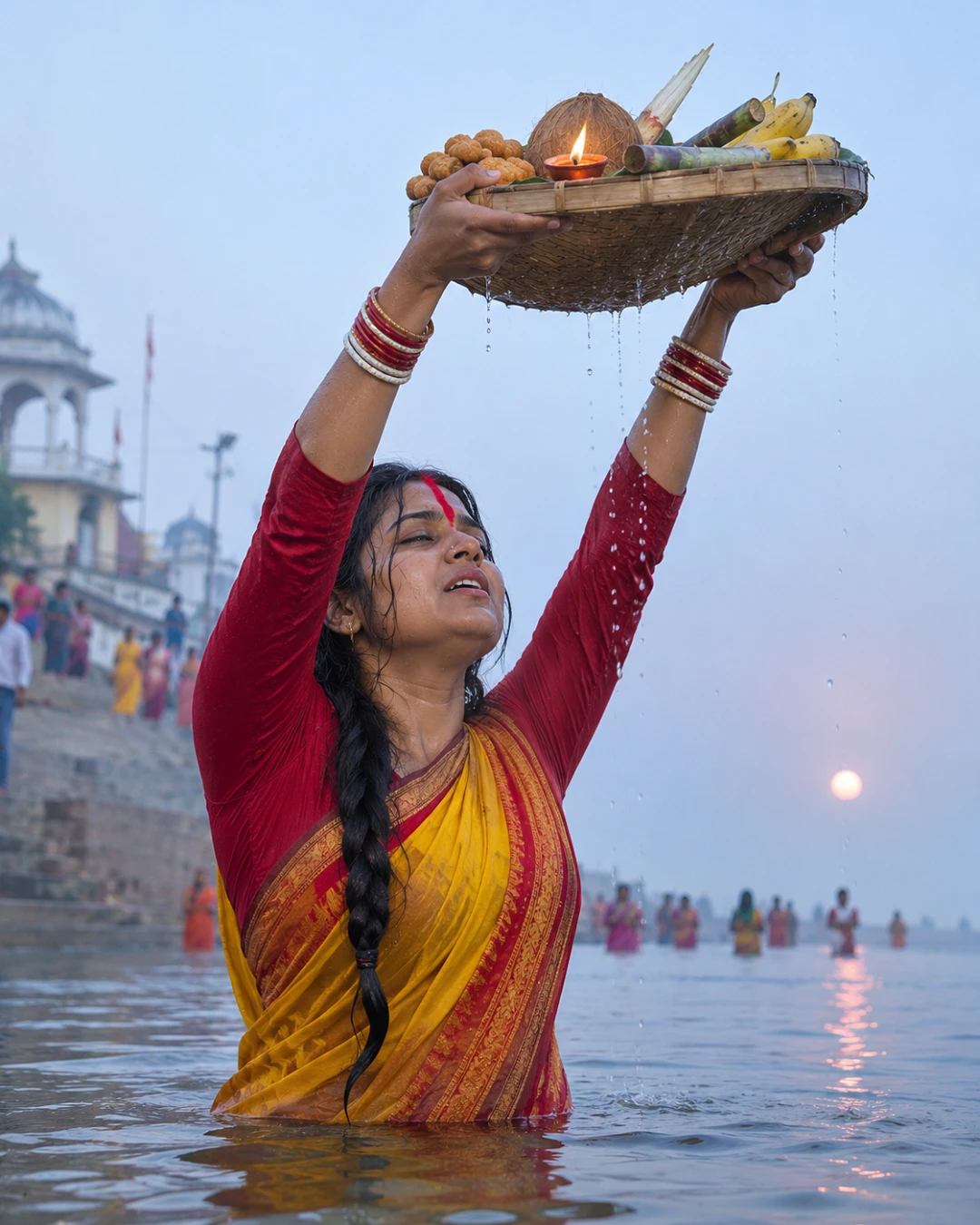
Open this prompt on its own page: Chhath arghya at Munger, the bamboo soop raised high at dawn
12. Chhath vlog thumbnail from a boat at a Patna ghat
If you film the festival for YouTube or Instagram, this thumbnail prompt puts you in a country boat in the river with the devotees behind you and two short, bold lines of text that read at phone size. Change the words to your own title.
With a photo attached: the person in the photo is the subject. Keep their face exactly as it is, with bone structure, eye shape and spacing, nose, lips, jawline, hairline, skin tone and apparent age all unchanged, and keep their own body: build, height and proportions, shoulders, arms, hands and legs, with the same skin tone on face, neck, arms and hands. Use the photo only for who the person is. Ignore its pose, expression, clothing, hairstyle, background, framing and light, and rebuild all of them exactly as described below, even when the photo shows them standing straight or dressed differently.
Base: A YouTube vlog thumbnail for a Chhath Puja dawn on the Ganga at Patna, seen from the river. A young woman creator sits in the stern of a wooden country boat in the left 40% of the frame, chest up; the right side shows the crowd of devotees in the water and the ghat steps beyond, with the dawn sky above for the words.
Text: - "CHHATH" - "AT DAWN" Nothing else is written. Spell each line exactly.
Add: pose: She sits sideways on the plank, torso turned to the lens, head tilted slightly, lips parted in quiet wonder, eyes on the camera. Her left hand rests on the wooden gunwale; her right hand holds a small steel lota against her knee.
Add: wardrobe: A deep red cotton kurta with a thin yellow border, a cream cotton dupatta over her head, red and yellow glass bangles.
Add: the river: Behind her, soft, hundreds of women in yellow and red sarees stand waist-deep, bamboo soops of fruit raised; men pour water from lotas. The ghat steps and a few lamps beyond.
Add: light, camera and type: Cool blue dawn, mist on the water, the sun a small pale disc low on the right. A 50mm lens at f/2 at seated eye level, her face sharp, real skin with pores, fine grain. "CHHATH" in heavy white condensed capitals in the upper right, "AT DAWN" below it larger in pale yellow with a black outline.
Avoid: misspelled text, extra words, logos, large orange sun, sun flare, extra people in focus, text over face, orange cast, orange sky, yellow tint, golden glow, warm wash, airbrushed skin, plastic skin, waxy face, changed face, distorted hands, extra fingers, watermark
Aspect ratio 16:9.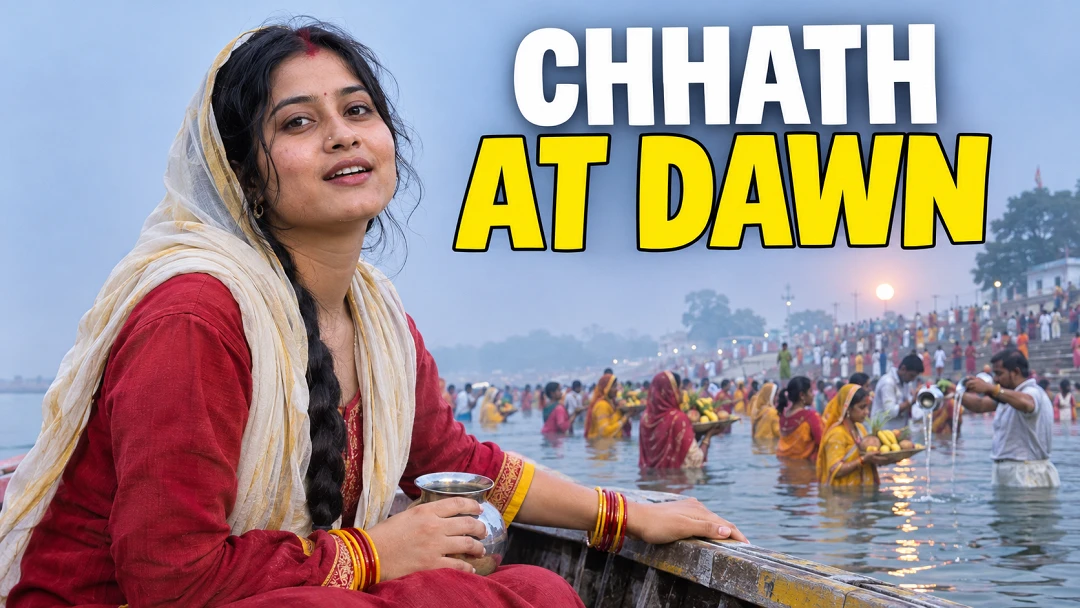
Open this prompt on its own page: Chhath at dawn vlog thumbnail from a country boat off a Patna ghat
Tips for a respectful Chhath photo
- Keep the colour cool. Delete "golden", "glowing" and "divine". Name the small warm lights one by one.
- Name the saree weave and border. Cotton and a narrow border look like the ghat; heavy silk and zari look like a wedding.
- Ask for real water. "Wet hem", "ripples" and "mist on the water" stop the river turning into glass.
- Leave sacred figures out. Add "deity in the sky" to the Avoid line and show the festival through people and offerings.
- Use your own family's details. If your family uses a brass lota or a particular fruit, add it. The sunset arghya with a brass lota shows the variation.
For more saree drapes and border colours, our Gemini saree prompts go into detail.
Frequently asked questions
Which app is best for a Chhath Puja AI photo edit, Gemini or ChatGPT?
Both handle these prompts well. Gemini is quick for a single portrait from a selfie. ChatGPT tends to follow long outfit and offering descriptions more closely. Run the same prompt in both and keep the result you like more.
Why does my Chhath photo turn completely orange?
The model reads "sunrise", "sacred" and "festival" as a request for warm colour everywhere. Ask for a cool blue-grey dawn with mist, describe the sun as a small pale disc, and put "orange or golden cast" in the Avoid line.
Can I add Chhathi Maiya or the sun god behind me?
We do not recommend it. Image models draw sacred figures inconsistently, and some edits blend the visitor's face into them. Keep the real sun low on the horizon and let the offering, the water and the people carry the meaning.
Will the AI keep my face the same?
It does far more reliably when the identity line comes first and nothing asks for skin smoothing. Use a clear, front-facing photo, and if the face drifts, ask it to change only the outfit, pose, place and light.
How do I put my name on a Chhath greeting poster?
Replace [YOUR NAME] in prompt 7 with your name, keep the rest of the text short, and say "spell every word exactly". If a letter comes out wrong, reply with only the corrected line.
Chhath Puja 2026: the four days and more prompts
Chhath Puja 2026 runs from Friday 13 November to Monday 16 November: Nahay Khay on the 13th, Kharna on the 14th, the evening arghya to the setting sun on the 15th and the dawn arghya on the morning of the 16th. Each day has its own picture, and the library has a prompt for each:
- Kharna evening: rasiya kheer with ghee roti on a banana leaf, a still life with no person.
- Evening on the rooftop: tying a sugarcane kosi canopy over clay lamps, for families who mark the night at home.
- City dawn arghya: standing in a rooftop tank above Patna apartments, when the river is too far.
- Dawn in the river: the over-under shot, waist deep with a bamboo soop, half above and half below the water line.
- Offerings: an overhead thekua soop with sugarcane and bananas and a Chhath Puja samagri list thumbnail for anyone writing a checklist post.
- Planning and greetings: a four-day family planner from Nahay Khay to Usha Arghya and a Chhath greeting post for a brand.
Where to find more
Browse all festival and devotional prompts, traditional wear prompts and baby and family prompts, or open the full image prompt library. For another quiet riverside picture, try the tussar silk kurta and Banarasi stole on the ghats at dusk or the double exposure with Dev Deepawali lamps inside the silhouette.
Related guides
- Guru Nanak Jayanti AI photo editing prompts for the next festival after Chhath, with dawn prabhat pheri and sarovar portraits
- Dev Deepawali AI photo editing prompts: Varanasi ghat looks at blue hour, from deepdaan on the Ganga to a haveli balcony.