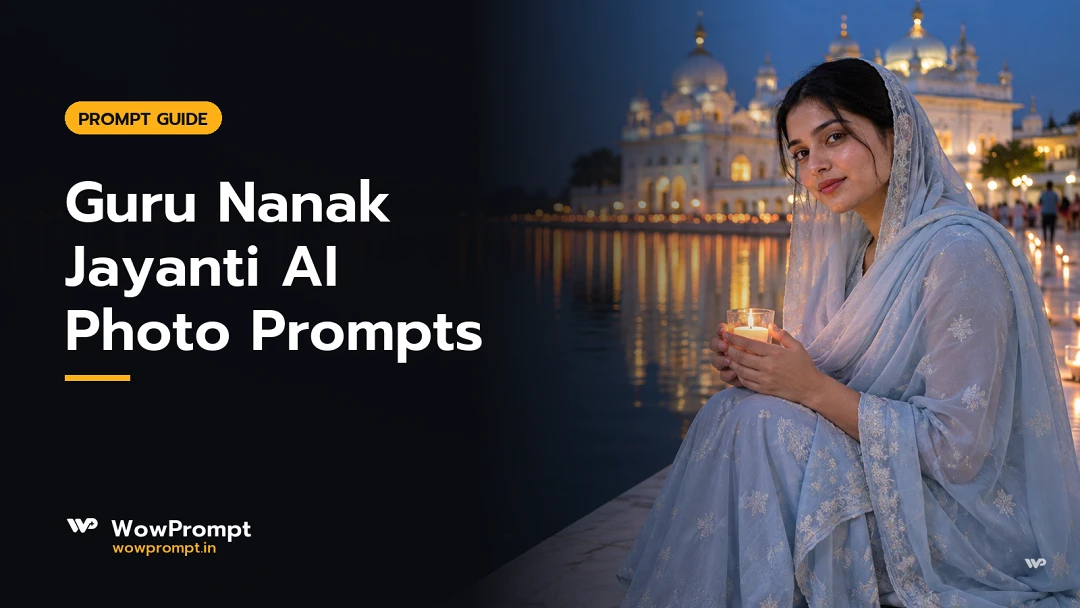
Guru Nanak Jayanti AI Photo Editing Prompts 2026: 9 Ideas
Copy-ready Guru Nanak Jayanti AI photo editing prompts: sarovar candles, langar seva, a dawn prabhat pheri, a rooftop and a Gurpurab poster, face kept.
A Guru Nanak Jayanti AI photo editing prompt works best when it places you in one real moment of Gurpurab, such as setting a candle on the marble edge of a gurdwara sarovar at dusk with your head covered, and asks for a cool blue evening with the flames as small warm points instead of "a golden divine glow". Guru Nanak Jayanti, also called Gurpurab or Prakash Purab, falls on 24 November 2026, and it is kept with prabhat pheris at dawn, langar seva, candles around the sarovar and homes lit from the roof to the doorstep. This guide gives you eight copy-ready prompts for Gemini and ChatGPT, written with care for the setting, and each one keeps the face in your photo as yours.
The pages that rank for this search today are short lists from last year and video clips with one prompt each. Here you get a full set that covers the sarovar, the langar hall, the morning procession, an Amritsar haveli, a couple, the family rooftop, an old photo and a greeting poster, with the reason behind each line.
What makes a good Guru Nanak Jayanti AI photo editing prompt
Gurpurab is a day of seva, prayer and light, and the best pictures show people taking part in it rather than posing in front of it. Models go wrong in three predictable ways: they flood the frame with gold and orange, they drop the head covering inside a gurdwara, or they try to paint a sacred figure into the background. A good prompt closes all three doors.
Six habits fix most results:
- One moment, one task. Lighting a candle, rolling a roti, singing in the pheri, carrying a lantern at dawn. A task gives the hands a job and the face a reason.
- Head covered in every gurdwara scene. Write it into the outfit line: a dupatta draped over the head, or a turban or patka for men. Models remove it unless told.
- Name the object exactly. "Candles" gives a blur. A row of white tealights on white marble, a steel bucket of dough, a brass lantern with a glass chimney gives the model something to draw.
- White and pale colours. White, ivory, powder blue and pale saffron read as Gurpurab and keep the light clean. Heavy reds and golds push the frame warm.
- No religious figure, ever. Show the people, the lights, the water and the langar hall. Never a portrait of the Guru, a painting on a wall or an idol-like figure. Image models render sacred figures badly, and it is not respectful to generate one.
- A separate Avoid line. Orange cast, golden haze, glowing aura, bare heads indoors, extra fingers and readable script go there every time.
The festival portrait prompts guide explains the full prompt structure behind every prompt below. If your family also celebrated Diwali this month, our Diwali AI photo editing prompts use the same cool-night light rules.
How to use these prompts with your own photo
- Open ChatGPT or Gemini and start a new chat.
- Attach one clear, front-facing photo taken in daylight. If you wear a turban or patka, use a photo that shows it, so the model keeps its style.
- Paste the prompt exactly as written and send it.
- If the face changes, reply: "Keep my face exactly as in the photo; change only the outfit, pose, place and light." The reference photo guide has stronger identity lines if a model keeps drifting.
- Keep the aspect ratio inside the prompt: 4:5 for an Instagram post, 9:16 for stories and WhatsApp status.
Guru Nanak Jayanti AI photo editing prompts for Gemini and ChatGPT
1. Candle at the gurdwara sarovar in the evening
The sarovar lined with candles is the picture most people want from Gurpurab night. Our sample of a Guru Nanak Jayanti candle at a gurdwara sarovar in a blue dupatta shows the cool finish this prompt aims for. More moments are in the festival and devotional prompts.
Use the person in my photo as the subject. Keep their face, skin tone, hairline and body exactly as they are; take nothing else from the photo. If they wear a turban in the photo, keep its style.
Scene: Guru Nanak Jayanti evening at a gurdwara sarovar; they set one lit candle on the white marble edge beside a long row of others.
Pose: kneeling barefoot on the marble walkway in three-quarter view, both hands cupped around the candle, eyes on the flame, a quiet, peaceful expression.
Outfit: a white cotton salwar kameez with a powder blue chiffon dupatta draped over the head (or a white kurta pyjama with a pale blue turban or patka).
Place: the still sarovar water behind, reflecting the row of candles and strings of white lights on the far walkway, other visitors far away and softly blurred.
Light: cool blue dusk; each candle is a small separate warm point; soft white light from the walkway lamps on the face; true skin tone.
Lens: 50mm, f/1.8, low angle at the height of the marble edge.
Finish: real skin texture, clean whites, the far lights as soft round bokeh on the water.
Avoid: uncovered head, shoes on the marble, any religious figure or painting, orange cast, golden haze, glowing aura, extra fingers, text, watermark.
Aspect ratio 4:5.
2. Langar seva at the giant tava
Langar is the heart of Gurpurab, and serving in it makes a warm, honest portrait. The langar seva portrait flipping rotis on a giant tava at Gurpurab is our sample of this exact scene.
Use the person in my photo as the subject. Keep their face, skin tone, hairline and body exactly as they are; take nothing else from the photo. If they wear a turban in the photo, keep its style.
Scene: Gurpurab morning in a large gurdwara langar kitchen; they flip rotis on a wide iron tava with a long flat iron spatula.
Pose: standing at the tava, sleeves rolled up, turning a roti mid-air, glancing toward a fellow volunteer with an easy smile.
Outfit: a pale saffron cotton kurta with a white dupatta tied neatly over the head (or a navy kurta with a saffron patka), a simple steel kara on the wrist.
Place: volunteers rolling dough at a long steel table behind, stacks of fresh rotis in a wide basket, steam rising, high windows.
Light: cool soft daylight from the high windows; the tava fire glows only at the bottom edge of the frame; true skin tone.
Lens: 35mm, f/2.8, eye level.
Finish: real skin texture, flour on the hands, crisp steam, light film grain.
Avoid: uncovered heads, smoke filling the frame, orange cast, plastic-looking rotis, any religious figure, extra fingers, text, watermark.
Aspect ratio 4:5.
3. Prabhat pheri at dawn with a lantern
In the weeks before Gurpurab, sangats walk the streets before sunrise singing shabads. This prompt keeps the blue of early morning and one warm lantern.
Use the person in my photo as the subject. Keep their face, skin tone, hairline and body exactly as they are; take nothing else from the photo. If they wear a turban in the photo, keep its style.
Scene: a prabhat pheri before sunrise in the week of Guru Nanak Jayanti; they walk at the front of a small group through a quiet Punjab lane.
Pose: mid-step, holding a brass lantern with a glass chimney at waist height, mouth slightly open in song, eyes ahead.
Outfit: a white cotton salwar kameez with a cream shawl and a white dupatta over the head (or a white kurta pyjama, a grey shawl and a white turban).
Place: a narrow brick lane with closed shop shutters and doorways, a few neighbours at the doors with folded hands, the group behind in soft focus, light mist.
Light: deep blue pre-dawn sky with a pale band at the horizon; the lantern is the only warm point and lights the hands and chin; true skin tone.
Lens: 35mm, f/2, eye level, slight movement in the group.
Finish: real skin texture, cool mist, fine film grain.
Avoid: uncovered heads, orange sunrise flooding the frame, any religious figure, readable signboards, extra fingers, text, watermark.
Aspect ratio 4:5.
The Chhath Puja AI photo editing prompts handle another festival of dawn with the same light rules, and the Chhath dawn walk with a bamboo daura shows how pre-dawn blue should look.
4. Phulkari dupatta in an Amritsar haveli
A festive outfit portrait at home, away from the gurdwara. See the Phulkari dupatta portrait in an old Amritsar haveli doorway, and more looks in the traditional wear prompts. The low-angle courtyard portrait under drying dupattas suits the same outfit in daylight.
Use the person in my photo as the subject. Keep their face, skin tone, hairline and body exactly as they are; take nothing else from the photo. If they wear a turban in the photo, keep its style.
Scene: the evening of Guru Nanak Jayanti at the carved wooden doorway of an old Amritsar haveli, before leaving for the gurdwara.
Pose: standing on the stone threshold, one hand resting on the door frame, looking into the lens with a calm smile.
Outfit: an ivory silk salwar suit with a cream Phulkari dupatta embroidered in pale gold and soft pink, draped over the head and one shoulder (or an ivory sherwani-style kurta with a pale pink turban).
Place: a dark carved teak door with brass studs, a row of small clay diyas along the threshold, a string of white lights over the arch, the lane behind in deep shadow.
Light: cool blue dusk; white bulb light on the face; the diyas are small warm points at the feet.
Lens: 50mm, f/2, full length, eye level.
Finish: real skin texture, clear embroidery stitches, clean ivory, not yellow.
Avoid: yellowed fabric, orange cast, heavy jewellery, any religious figure, extra fingers, text, watermark.
Aspect ratio 4:5.
5. A couple in white by the sarovar
Many couples visit the gurdwara together on Gurpurab. The Anand Karaj couple by a gurdwara sarovar at dawn shows the same setting for a wedding; for this day, keep the clothes simple. More ideas for two are in the couple prompts and the wedding prompts, and the black saree and blue rim light couple portrait with a diya shows the cool rim light at work.
Use the two people in my photo as the subjects. Keep both faces, skin tones and bodies exactly as they are; take nothing else from the photo. If only one person is in the photo, keep that person and create a partner.
Scene: Guru Nanak Jayanti evening on the marble walkway around a gurdwara sarovar; the couple walks slowly side by side.
Pose: walking barefoot, each holding a small lit candle, she looks at the water, he looks at her, both with gentle smiles.
Outfits: she wears an ivory cotton suit with a pale blue dupatta over the head; he wears a white kurta pyjama with a powder blue turban.
Place: white marble underfoot, the still water beside them reflecting rows of candles and white lights, the far walkway softly blurred.
Light: cool blue evening; the two candles and the reflected lights are the only warm points; soft white light on both faces.
Lens: 50mm, f/1.8, waist up, eye level.
Finish: real skin texture, clean whites, gentle film grain.
Avoid: uncovered heads, shoes on the marble, holding hands in a romantic pose, any religious figure, orange cast, merged faces, extra fingers, text, watermark.
Aspect ratio 4:5.
6. Family candles on the rooftop
Homes are lit from the roof down on Gurpurab night. Similar family scenes: the family of four lighting diyas by a window and three generations making a rangoli in a courtyard; more are in the family prompts.
Use the people in my photo as the subjects. Keep every face, skin tone and body exactly as they are; take nothing else from the photo. If fewer people are in the photo, keep them and add a grandfather and a child.
Scene: Guru Nanak Jayanti night on the flat roof of a family home in Punjab; the family lights candles along the parapet together.
Pose: the grandfather lights a candle from a small brass lamp; a child carefully places the last candle; the others stand close, each holding one candle, all watching the flames.
Outfits: simple white, ivory and powder blue cotton kurtas and suits; the women with dupattas loosely over the head, the men in pale turbans or patkas, the boy in a small patka.
Place: a whitewashed parapet lined with white candles, neighbouring roofs behind with their own strings of white lights, water tanks in silhouette.
Light: a deep blue night sky; each candle is a small separate warm point; soft white light from a bulb string on the faces; true skin tones.
Lens: 35mm, f/2.8, eye level, every face sharp.
Finish: real skin texture, clean whites, light grain.
Avoid: fireworks filling the sky, orange cast, golden haze, glowing aura, merged faces, any religious figure, extra fingers, text, watermark.
Aspect ratio 4:5.
7. Restore an old Gurpurab family photo
A faded picture from an old Gurpurab, brought back for the family group. Our restored 1970s Sikh wedding photo in natural colour and the restored 1960s wedding portrait show the result; more are in the old photo restoration prompts.
Use my attached old photo as the only source. Keep every face, expression, turban, dupatta, pose and the background exactly as they are; add nothing and remove no one.
Task: restore this old family photo from a past Gurpurab.
Repair: remove scratches, folds, tears, dust and stains; fill missing corners from the surrounding detail.
Colour: add natural, gentle colour; white and pastel turbans and dupattas stay clean, skin tones true and varied, no single tint over the image.
Light: keep the original light direction; lift the shadows a little without flattening the faces.
Lens: keep the original framing and perspective.
Finish: sharp but natural detail, real skin texture, fine original grain kept.
Avoid: changed faces, smoothed plastic skin, invented jewellery, orange or sepia cast, added people, text, watermark.
Aspect ratio: same as the original photo.
8. Gurpurab greeting poster with your name
A poster for the family group and your status. Put your name where it says [Name] and keep the words short. The Diwali greeting poster with a lamp-lit portrait uses the same layout.
Use the person in my photo as the subject. Keep their face, skin tone, hairline and body exactly as they are; take nothing else from the photo. If they wear a turban in the photo, keep its style.
Scene: a Guru Nanak Jayanti greeting poster; they stand beside a window at night holding a single white candle at chest height.
Outfit: an ivory suit with a powder blue dupatta over the head (or an ivory kurta with a powder blue turban).
Layout: the subject on the right third; a clean deep navy wall on the left for text; a thin string of white lights along the top edge.
Text: at the top left, "Happy Gurpurab" in a clean serif; below it, smaller, "Warm wishes from [Name]". Spell every word exactly, no other text.
Light: deep blue night; the candle is the main warm point and softly lights the hands and chin; the rest of the frame stays cool.
Lens: 50mm, f/2, waist up.
Finish: real skin texture, crisp typography.
Avoid: any religious figure or symbol, scripture or other script, misspelled text, extra words, orange cast, golden haze, extra fingers, watermark.
Aspect ratio 4:5.
9. Kneading atta for the langar
Before the rotis come the mountains of dough. This one shows a sevadar kneading atta in a metre-wide steel parat at Gurdwara Bangla Sahib in Delhi, with the saffron patka as the only warm colour in a cool white kitchen. It pairs with section 2 if you want a two-picture langar story.
Use the person in my photo as the subject. Keep their face, skin tone, hairline and body exactly as they are; take nothing else from the photo. If they wear a turban in the photo, keep its style.
Scene: Guru Nanak Jayanti morning in the langar kitchen of Gurdwara Bangla Sahib in Delhi; they knead a mound of atta in a giant steel parat.
Pose: kneeling on a low wooden platform behind the parat, torso three quarters to the camera, leaning over it; right fist pressed knuckles-down into the dough, left hand folding the far edge of the mound over; head bowed slightly, eyes lifting to the lens, a quiet half smile.
Outfit: a saffron cotton patka tied over the head and knotted at the front, a white cotton kurta with sleeves rolled to the elbow, white pyjama, a steel kara on the right wrist, flour dusting both forearms.
Set: the parat is a metre wide on the stone floor; two steel buckets of water at the left knee, a stack of steel thalis behind the right shoulder; other sevadars roll rotis at a long table, soft behind.
Light: cool white daylight from high windows on the left, soft on the flour.
Lens: 35mm at f/2.8, slightly above eye level, the parat in the foreground.
Finish: natural cool colour, true white, true steel, saffron only in the patka, real skin with pores, fine grain.
Avoid: airbrushed skin, plastic skin, changed face, distorted hands, extra fingers, orange cast, saffron clothing other than the patka, bare head, sharp faces behind, text, watermark.
Aspect ratio 4:5.
Open this prompt on its own page: Kneading atta in a giant steel parat for Guru Nanak Jayanti langar
10. A roti placed in a child's cupped hands at the langar
Seva reads best as one small, close moment. This Guru Nanak Jayanti AI photo editing prompt keeps the camera at the child's eye level as a volunteer lowers a roti into small raised palms, with the long hall and the sangat soft behind in cool morning light.
With a photo attached: the person in the photo is the subject. Keep their face exactly as it is, with bone structure, eye shape and spacing, nose, lips, jawline, hairline, skin tone and apparent age all unchanged, and keep their own body: build, height and proportions, shoulders, arms, hands and legs, with the same skin tone on face, neck, arms and hands. Use the photo only for who the person is. Ignore its pose, expression, clothing, hairstyle, background, framing and light, and rebuild all of them exactly as described below, even when the photo shows them standing straight or dressed differently. Create the child as described below.
Must hold: One quiet moment of seva: the roti leaving his fingers into a child's cupped palms. A true photograph, cool morning light, nothing staged.
The picture: He bends forward from the hips in the aisle, torso angled toward the child, head tilted down, eyes on the child's hands, a soft smile. His left hand holds a steel bucket of rotis by its handle at his hip; his right hand lowers one roti into the boy's raised palms. His feet are bare on the long woven mat. The boy sits cross-legged in the front row, a steel thali before him, looking up at the roti, wide-eyed. He wears a navy cotton patka, a white knee-length cotton kurta with full sleeves under a black sleeveless jacket, white pyjama and a steel kara.
Technical: A long hall with rows of seated sangat soft behind, white walls, high windows. Cool morning daylight in shafts from above, no warm cast. 50mm at f/2, at the child's eye level. Real skin with pores and texture, finished like a professionally retouched photograph.
Avoid: airbrushed skin, plastic skin, waxy face, changed face, distorted hands, extra fingers, orange cast, golden light, uncovered heads, shoes on the mat, looking at camera, readable text, logo, watermark
Aspect ratio 4:5.
Open this prompt on its own page: Gurpurab langar seva, a roti placed in a child's cupped hands
11. Gatka spin at the nagar kirtan in Amritsar
For the procession day, freeze a gatka performer at the top of a spin, the navy chola flaring into a full circle and rose petals falling through an old bazaar street. The tall 9:16 frame suits a story or reel cover.
With a photo attached: the person in the photo is the subject. Keep their face exactly as it is, with bone structure, eye shape and spacing, nose, lips, jawline, hairline, skin tone and apparent age all unchanged, and keep their own body: build, height and proportions, shoulders, arms, hands and legs, with the same skin tone on face, neck, arms and hands. Use the photo only for who the person is. Ignore its pose, expression, clothing, hairstyle, background, framing and light, and rebuild all of them exactly as described below, even when the photo shows them standing straight or dressed differently.
Brief: Guru Nanak Jayanti, the morning nagar kirtan in a narrow Amritsar bazaar street. A young gatka performer is caught at the top of a spin in the cleared space ahead of the procession, his chola flaring into a full circle. The key idea: the spin itself, a turning body frozen sharp while the stick tip and the flared hem carry a trace of motion.
The move: He pivots on the ball of his bare left foot, right knee lifted high, torso twisted to the left, head turned back over his right shoulder so his face meets the lens, eyes hard and focused, lips closed. His right arm swings a polished bamboo stick level at shoulder height, elbow straight, wrist locked. His left arm is flung out behind him, fingers spread for balance.
Wardrobe: A deep navy cotton chola to mid-calf with a fitted bodice and a wide flared skirt, white churidar, a saffron cotton kamarkasa wound at the waist, a tall navy dumalla with a thin saffron edge showing at the forehead, a steel kara on his right wrist.
The street: Old brick houses with carved wooden balconies on both sides, saffron and white bunting overhead, pink and deep red rose petals falling through the air and lying on the stone. The sangat in white and saffron stands soft and blurred at the far end.
Camera and light: Cool overcast morning light, true navy and saffron. 35mm at f/2.2 from a low angle, 1/500s with only the stick tip and the hem softened. Real skin with pores, finished like a professionally retouched photograph.
Avoid: airbrushed skin, plastic skin, waxy face, changed face, distorted hands, extra fingers, orange cast, warm wash, shield, metal sword, blood, weapons pointed at people, religious figures, readable signboards, motion-blurred face, logo, watermark
Aspect ratio 9:16.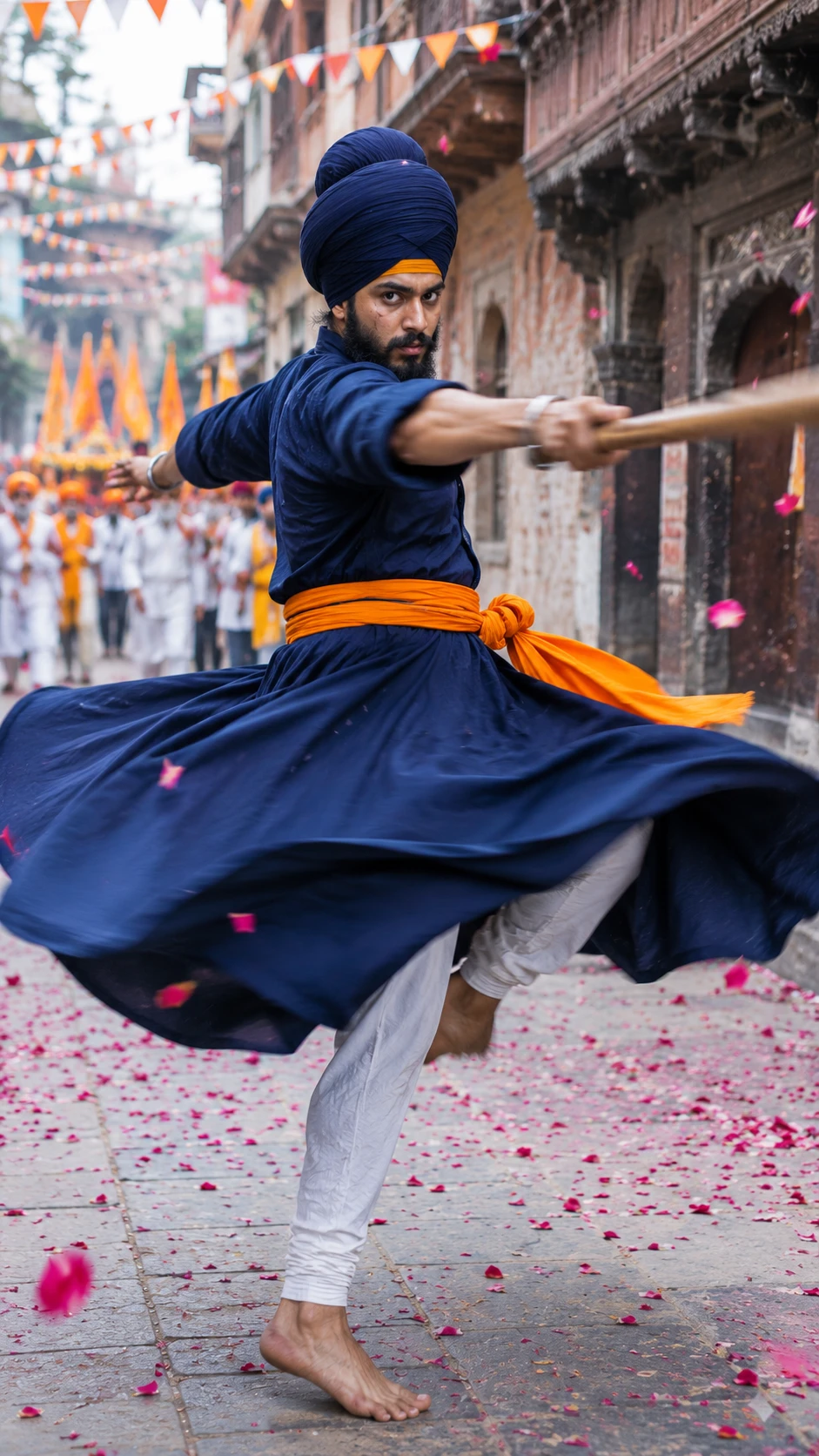
Open this prompt on its own page: Gatka spin with a single stick in an Amritsar street at nagar kirtan
12. Gurpurab post for a community kitchen
Running a langar or a community kitchen page? This social post leads with the food being served, hands only and no faces, with three short lines of type. Swap the kitchen name for your own.
Logline: A community kitchen's Gurpurab greeting that leads with the food being served: a volunteer's hands ladle dal into a steel thali, close and still, with no faces in frame.
Subject: The hands come in from the top right. The left hand, medium brown skin with a small healed cut on the thumb and a steel kara on the wrist, tilts a dented steel bucket of yellow dal; the right hand holds a long steel ladle, mid-pour, a thick ribbon of dal falling into the thali. White cotton sleeves are rolled to the forearm, and a saffron cloth covers the head of a second volunteer who is out of frame.
Set: The steel thali sits in the lower centre on a long strip of plain cream cloth laid on the floor, holding two folded rotis, a mound of white rice and a small steel bowl of kheer. Two more empty thalis sit soft in the background. No religious images, no pictures on walls, no people beyond the hands.
Text: - "Happy Gurpurab" - "[Brand]" (sample: SEVA COMMUNITY KITCHEN) - "Langar every Sunday" Nothing else is written. Spell each line exactly; the steel carries no words or marks.
Lens: A 50mm look at f/4 from slightly above, the dal ribbon and thali sharp.
Grade: Cool soft morning light from a doorway on the left, true colour, real steel reflections and skin texture, fine grain. "Happy Gurpurab" in large deep blue serif across the top quarter, "[Brand]" in small spaced charcoal capitals below it, "Langar every Sunday" on a slim cream band at the bottom.
Avoid: misspelled text, extra words, logos, readable labels, faces, religious figures, portraits on walls, extra hands, spilled food, orange cast, yellow tint, golden glow, warm wash, cgi render, airbrushed skin, plastic skin, distorted hands, extra fingers, watermark
Aspect ratio 4:5.
Open this prompt on its own page: Gurpurab community kitchen post with dal served into a steel thali
Tips for a respectful Guru Nanak Jayanti photo
- Respect the setting first. Heads covered and feet bare in every gurdwara scene, modest clothes, no alcohol, tobacco or party props anywhere in the frame, and no romantic poses at the sarovar.
- Never generate the Guru. No portraits of gurus, no paintings on the wall behind you, no figures in the sky. Let the candles, the water and the seva carry the meaning.
- Keep sacred text out of the image. Models garble Gurmukhi and scripture. If you want a line of Gurbani on a poster, add it afterwards in a text app where you can check every letter.
- Choose cool evening light so candles do not turn the photo orange. Ask for blue dusk and white bulb light, then let each candle be a small warm point. Remove "golden glow" and "divine light" from your prompt.
- Keep the face unchanged. Put the identity line first, attach a sharp daylight photo, and keep your turban or patka style from the photo. If a model changes it, reply asking it to restore the original turban and face.
- Make a wallpaper for the day. A single brass diya on a deep indigo lock screen or a row of clay diyas on a balcony ledge fits Gurpurab well; more are in the wallpaper prompts.
Frequently asked questions
What is the best Guru Nanak Jayanti AI photo editing prompt for a solo picture?
Prompt 1, setting a candle on the edge of the sarovar, gives the most natural solo result because the pose has a clear task and the reflected lights frame the face. Prompt 4 is better for a full-length festive outfit at home.
Why does my Gurpurab photo turn orange or gold?
Words like "golden", "divine glow" and "warm light" push the whole frame warm, and dozens of candles add to it. Ask for a cool blue evening with white bulb light, let the candles be small warm points, and add "orange cast, golden haze" to the Avoid line.
Can I add an image of Guru Nanak Dev Ji to my picture?
We do not recommend it. Generated figures are inaccurate and often disrespectful, and models sometimes merge your face into them. Every prompt here shows the day through seva, candles, water and the people celebrating.
Will the AI keep my turban or patka the way I tie it?
Usually, if your photo shows it clearly and the prompt says to keep its style. Each prompt here includes that line. If the shape changes, reply asking the model to keep the turban exactly as in the photo.
Should I use Gemini or ChatGPT for these prompts?
Both work. Gemini is quick for a single portrait from a selfie, while ChatGPT tends to follow long scene lists and poster text more closely. Run the same prompt in both and keep the better picture.
Where to find more
Open the full image prompt library to see every prompt with its sample picture, or browse the festival and devotional prompts for the rest of the season. For a festive outfit with movement, try the mustard dupatta whipping across the lens on a fort rampart, and the Diwali and Chhath guides linked above carry the same light and identity rules across the festival calendar.
Related guides
- Dev Deepawali AI photo editing prompts: Varanasi ghat looks at blue hour, from deepdaan on the Ganga to a haveli balcony.