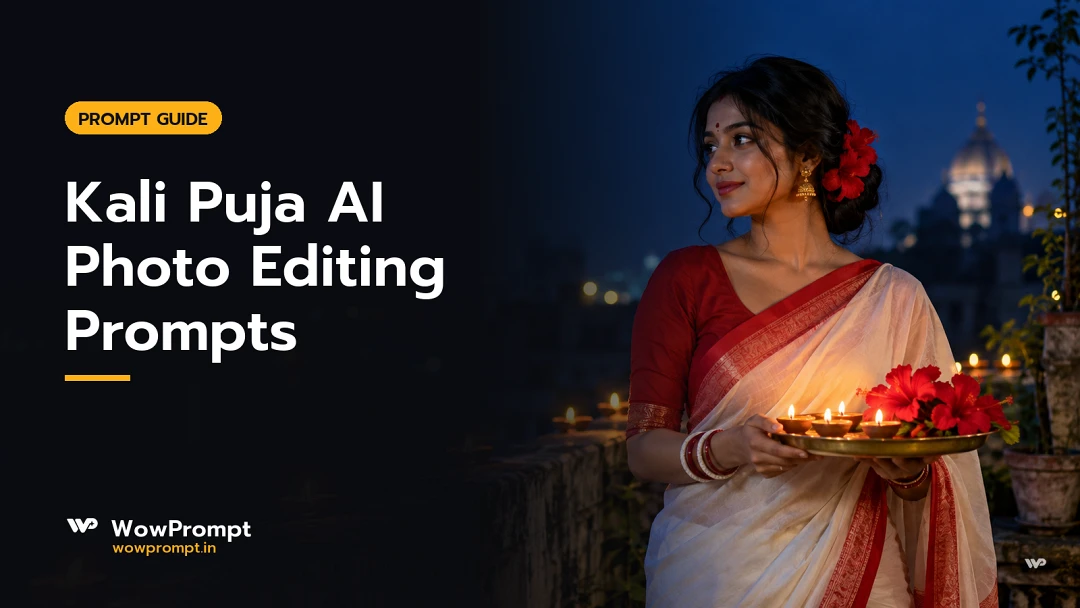
Kali Puja AI Photo Editing Prompts for Gemini and ChatGPT
Copy-ready Kali Puja AI photo editing prompts: terrace lamps, a red-bordered saree, the pandal at night, 14 lamps and a name poster, face kept.
A Kali Puja AI photo editing prompt works best when it places you in one real moment of the night, such as setting the last clay lamp on a terrace parapet, and asks for deep blue darkness with the lamps as small warm points instead of "a red and orange divine glow". Kali Puja falls on the night of 8 November 2026, the same new-moon night as Diwali, and it is kept above all in Bengal, Assam and Odisha with lamps on every ledge, hibiscus garlands, pandals that stay open until dawn and a family evening of fourteen lamps the night before. This guide gives you seven copy-ready prompts for Gemini and ChatGPT, each written for the people celebrating that night, and each one keeps the face in your photo as yours.
The pages that rank for this search today offer one prompt each, or a video. Here you get a full set that covers the terrace, the saree, the pandal, the family, a couple and a greeting poster, with the reasons each line is there. If you are celebrating Diwali in the same home, our Diwali AI photo editing prompts cover the doorway diyas, rangoli and sparklers of the same evening.
Why most Kali Puja AI photo editing prompts give harsh results
Kali Puja is a night festival, and that is where models go wrong. A prompt that combines "Kali Puja", "red" and "fire" tends to flood the whole frame with orange: the skin turns copper, the sky glows like an ember and the lamps vanish into the colour around them. Some models also try to paint a fierce figure into the background, which is neither respectful nor something you can send to the family group.
The real night looks different. It is one of the darkest nights of the year, the sky is close to black with a deep blue edge, and the light comes from hundreds of separate small flames and strings of white bulbs. Keep that contrast and the photo looks like Kolkata on Kali Puja rather than a poster of a fire.
Five habits fix most results:
- One moment, one task. Lighting a lamp, tying a garland, carrying a plate of lamps up the stairs, waiting in the pandal queue. A task gives the hands a job and the face a reason.
- Name the object exactly. "Lamps" gives a blur. Unglazed clay pradip with cotton wicks, a string of red hibiscus with marigold beads, a brass pancha pradip with five spouts gives the model something to draw.
- Cool light with small warm points. Ask for a deep blue night and white bulbs, then let the lamp flames be the only warm sources. Never ask for an orange or red glow over the scene.
- A separate Avoid line. Orange cast, red haze, copper skin, glowing aura, extra fingers and readable text go there every time.
- No deity in the frame. Show the people, the lamps, the garlands and the pandal lights, never a drawn image or idol of the goddess. Image models render sacred figures poorly, and a respectful picture is the one people actually share.
The festival portrait prompts guide explains the full prompt structure, and every prompt below follows it.
How to use these prompts with your own photo
- Open ChatGPT or Gemini and start a new chat.
- Attach one clear, front-facing photo taken in daylight. Avoid sunglasses, beauty filters and group photos for the solo prompts.
- Paste the prompt exactly as written and send it.
- If the face changes, reply: "Keep my face exactly as in the photo; change only the outfit, pose, place and light." The reference photo guide has stronger identity lines if a model keeps drifting.
- Keep the aspect ratio inside the prompt: 4:5 for an Instagram feed post, 9:16 for stories and WhatsApp status.
Kali Puja AI photo editing prompts for Gemini and ChatGPT
1. Lamps on the terrace parapet
The terrace lined with clay lamps is the picture most people want from Kali Puja night. The light is the hard part, so this prompt spells it out. For the same mood a few days earlier, see painting clay diyas on a balcony before Diwali.
Use the person in my photo as the subject. Keep their face, skin tone, hairline and body exactly as they are; take nothing else from the photo.
Scene: Kali Puja night on the flat roof terrace of an old Kolkata house; they set the last clay lamp at the end of a long row along the parapet.
Pose: crouched at the parapet in three-quarter view, the right hand placing an unglazed clay pradip, the left hand shielding the flame, eyes on the wick, a quiet smile.
Outfit: a white cotton saree with a broad red border and a red blouse (or a white kurta with a red gamchha over one shoulder), a thin gold chain.
Place: a whitewashed parapet with forty small lamps in a line, neighbouring rooftops behind with their own rows of lamps and strings of white bulbs, water tanks and TV antennas in silhouette.
Light: a moonless deep blue night sky; each lamp is a small separate warm point; soft white bulb light from the next roof falls on the face; true skin tone.
Finish: 35mm, f/1.8, low angle at parapet height, real skin texture, the far lamps as soft round bokeh.
Avoid: orange cast, red haze, copper skin, glowing aura, fireworks filling the sky, extra fingers, text, watermark.
Aspect ratio 4:5.
2. The red-bordered white saree portrait
The white saree with a red border is the look of the Bengal puja season, and it photographs beautifully against a dark night if the white stays white. Our sample of a white tant saree on a red oxide floor shows how the weave should read, and the Durga Puja pandal portrait in a red-bordered saree shows the same saree under festival lights. More looks are in the traditional wear prompts.
Use the person in my photo as the subject. Keep their face, skin tone, hairline and body exactly as they are; take nothing else from the photo.
Scene: Kali Puja night at the green wooden door of an old north Kolkata house, just before leaving for the pandal.
Pose: standing on the doorstep, one hand on the door frame, the other holding the pleats of the saree, looking straight into the lens, calm and confident.
Outfit: a starched white tant saree with a thick red border and a small red check on the pallu, a red blouse, shankha and pola bangles on both wrists, a red bindi, a small hibiscus tucked into a low bun.
Place: a red oxide step, a row of clay lamps along the threshold, a string of white bulbs over the door, the lane behind in deep shadow.
Light: deep blue night; cool white light from the bulbs on the face; the threshold lamps are small warm points at the feet; the saree stays clean white, not cream.
Finish: 50mm, f/2, full length, eye level, real skin texture, fine cotton weave visible.
Avoid: yellowed saree, orange cast, red haze, copper skin, glowing aura, changed face, extra fingers, text, watermark.
Aspect ratio 4:5.
Browse more festival moments in the festival and devotional prompts.
3. Walking through the pandal lane at night
Kali Puja pandals stay open most of the night, and the best picture is often the lane outside rather than the crowded front. This prompt keeps the camera on you with the lights and the crowd behind, and keeps the pandal's altar out of view. The isometric miniature of a Kolkata puja lane at night is a fun alternative if you want a small model of the street instead of a portrait.
Use the person in my photo as the subject. Keep their face, skin tone, hairline and body exactly as they are; take nothing else from the photo.
Scene: Kali Puja night in a narrow Kolkata lane leading to a neighbourhood pandal; they walk toward the camera with friends a few steps behind.
Pose: mid-stride, one hand holding a small clay cup of tea, the other loose at the side, glancing back over the shoulder and laughing.
Outfit: a black cotton saree with a thin red border (or a black kurta with white pyjamas), silver jhumkas, a small hibiscus garland around the wrist.
Place: overhead arches of white and pale blue LED lights across the lane, a tea stall with a steel kettle on the right, the pandal entrance as a soft glow far behind, the crowd blurred.
Light: dark night; cool white and pale blue light from the arches; a single kerosene lamp at the tea stall is the only warm point.
Finish: 35mm, f/2, eye level, slight motion in the crowd, real skin texture, light film grain.
Avoid: deity image or idol in the frame, orange cast, red haze, faces in the crowd sharper than the subject, extra fingers, readable signboards, text, watermark.
Aspect ratio 4:5.
The Durga Puja night adda with clay-cup tea on an old Kolkata porch carries the same street mood into a quieter scene, and our Durga Puja AI photo editing prompts cover the rest of the Bengal puja season.
4. Tying the hibiscus garland at home
Red hibiscus is the flower of this night, and many homes string their own garlands in the afternoon. This is a close, gentle portrait with the flowers doing the work. The shankha and pola bangles raised at a pandal at dusk shows how close hands and bangles can look.
Use the person in my photo as the subject. Keep their face, skin tone, hairline and body exactly as they are; take nothing else from the photo.
Scene: the evening of Kali Puja at home; they thread fresh red hibiscus flowers onto a long cotton string for a garland.
Pose: seated on a cool stone floor by a window, a bamboo basket of hibiscus in the lap, a needle and thread in the right hand, a half-finished garland draped over the left wrist, looking down with a soft expression.
Outfit: a red and white cotton saree with a temple border (or a maroon cotton kurta), shankha and pola bangles, small gold studs.
Place: an old window with green louvred shutters half open, three clay lamps on the window ledge, a brass plate with a few marigolds beside the basket.
Light: cool blue dusk through the window on the face and hands; the three lamps are the only warm points; the hibiscus stays a deep true red, not orange.
Finish: 50mm, f/2, slightly above eye level, real skin texture, crisp petal detail.
Avoid: deity image or idol, orange petals, red haze over the frame, copper skin, plastic flowers, extra fingers, text, watermark.
Aspect ratio 4:5.
5. Fourteen lamps on Bhoot Chaturdashi with the family
The night before Kali Puja is Bhoot Chaturdashi, when Bengali families light fourteen lamps around the house, one for each of fourteen generations of ancestors, and eat a dish of fourteen leafy greens. It is the most family-centred moment of the festival. Similar scenes include three generations making a paper kandeel for Diwali and a family of four lighting diyas by a window; more are in the family prompts.
Use the people in my photo as the subjects. Keep every face, skin tone and body exactly as they are; take nothing else from the photo. If fewer people are in the photo, keep them and add a grandmother and a child.
Scene: Bhoot Chaturdashi evening, the night before Kali Puja; the family sets out fourteen clay lamps in a curving line along the courtyard steps of an old house.
Pose: the grandmother lights the first lamp from a brass lamp in her hand; a child carefully places the last lamp; the others kneel in between, each holding one lamp, all watching the flames.
Outfits: the grandmother in a white saree with a thin red border; the others in simple cotton sarees and kurtas in white, red and indigo.
Place: worn red oxide steps, a tulsi planter at the top, a wooden door with a brass knocker, a small brass bowl of chopped leafy greens on the step.
Light: deep blue night; exactly fourteen lamp flames as small warm points; faint white light from an inside room through the door; true skin tones.
Finish: 35mm, f/2.8, eye level with the kneeling family, real skin texture, every face sharp.
Avoid: ghosts or spooky figures, orange cast, red haze, glowing aura, merged faces, extra fingers, more or fewer than fourteen lamps, text, watermark.
Aspect ratio 4:5.
6. A couple on the rooftop as the lamps come on
Kali Puja and Diwali share a night, so couples often spend it on a roof watching the whole neighbourhood light up. The rooftop sparkler couple before Diwali night and the black saree and blue rim light couple portrait with a diya show the cool, dark finish this prompt aims for. More ideas for two are in the couple prompts, and the Durga Puja night couple on a Kolkata tram line suits the same pair a few weeks earlier.
Use the two people in my photo as the subjects. Keep both faces, skin tones and bodies exactly as they are; take nothing else from the photo. If only one person is in the photo, keep that person and create a partner.
Scene: Kali Puja night on a Kolkata rooftop; the couple stands at the parapet as rows of lamps light up on every roof across the neighbourhood.
Pose: she holds a brass plate with five small lamps; he cups one hand around the nearest flame against the breeze; both look at each other and smile.
Outfits: she wears a deep red Baluchari silk saree with a black blouse; he wears an off-white cotton panjabi with a red and white gamchha over the shoulder.
Place: a whitewashed parapet lined with clay lamps, rooftops stretching behind with their own lamps and white bulb strings, one distant sky lantern.
Light: a dark blue moonless sky; the lamps are small separate warm points; cool white light from a neighbour's bulb string on their faces.
Finish: 50mm, f/1.8, waist up, real skin texture, light film grain, the far lamps as soft bokeh.
Avoid: orange cast, red haze, sky full of fireworks, glowing aura, changed faces, extra fingers, text, watermark.
Aspect ratio 4:5.
7. Kali Puja greeting poster with your name
A poster for the family group, the office chat and your status. Put your name where it says [Name], keep the words short and ask for exact spelling. The Diwali greeting poster with a lamp-lit portrait uses the same layout for the main Diwali wish, and the Diwali wishes for family, friends and colleagues prompt writes the message you send with it.
Use the person in my photo as the subject. Keep their face, skin tone, hairline and body exactly as they are; take nothing else from the photo.
Scene: a Kali Puja greeting poster; they stand beside a window at night holding a brass pancha pradip with five lit wicks at chest height.
Outfit: a white silk saree with a deep red border (or a white silk panjabi with a red stole), a small red bindi, a short hibiscus garland at the wrist.
Layout: the subject on the right third; a clean deep navy wall on the left for text; a single string of red hibiscus and marigold across the top edge.
Text: at the top left, "Shubho Kali Puja" in a clean serif; below it, smaller, "Warm wishes from [Name]". Spell every word exactly, no other text.
Light: deep blue night; the five flames are the main warm point and softly light the hands and chin; the rest of the frame stays cool.
Finish: 50mm, f/2, real skin texture, crisp typography.
Avoid: deity image or idol, misspelled text, extra words, orange cast, red haze, glowing aura, changed face, extra fingers, watermark.
Aspect ratio 4:5.
Tips for a Kali Puja photo that looks like the real night
- Remove "fiery", "divine glow" and "red aura". Name each warm source instead: one clay lamp, a row of lamps, a five-wick brass lamp.
- Keep red for cloth and flowers. A red border, a hibiscus or a red blouse looks rich when the light around it is cool. Red light over everything makes skin look burnt.
- Count the lamps when it matters. For Bhoot Chaturdashi, saying "exactly fourteen" helps the model keep the number close, and it tells anyone who sees the picture which night it is.
- Keep the altar out of frame. Show the pandal lane, the queue, the lights and the people. It keeps the image respectful and avoids the strange results models give for sacred figures.
- Make a wallpaper for the night. A single brass diya on a deep indigo lock screen fits Kali Puja well; more are in the wallpaper prompts.
- Plan the sweets shot too. A brass thali of rosogolla, sandesh and mishti doi is the picture that goes up the morning after.
Frequently asked questions
What is the best Kali Puja AI photo editing prompt for a solo picture?
Prompt 1, setting the last lamp on the terrace parapet, gives the most natural solo result because the pose has a clear task and the lamps frame the face. Prompt 2 is better if you want a full-length look in a red-bordered white saree.
Why does my Kali Puja photo turn orange or red?
Words like "fire", "fiery", "divine" and "red glow" push the whole frame warm. Ask for a deep blue night with white bulb light, let the lamp flames be the only warm points, and add "orange cast, red haze, copper skin" to the Avoid line.
Can I add the goddess to the picture?
We do not recommend it. Image models render sacred figures inconsistently and sometimes merge your face into them, which is neither respectful nor something you can share. Every prompt here shows the night through the lamps, the garlands, the pandal lights and the people celebrating.
Should I use Gemini or ChatGPT for these prompts?
Both work. Gemini is quick for a single portrait from a selfie, while ChatGPT tends to follow long object lists, such as the fourteen lamps and the courtyard in prompt 5, more closely. Run the same prompt in both and keep the better picture.
When is Kali Puja in 2026, and is it the same night as Diwali?
Kali Puja falls on the night of 8 November 2026, the same new-moon night as Diwali, and Bhoot Chaturdashi with its fourteen lamps is the night before. If your family celebrates both, use the prompts here for the lamps and the pandal, and the Diwali guide for rangoli and sparklers.
Where to find more
Open the full image prompt library to see every prompt with its sample picture, or browse the festival and devotional prompts for the rest of the season. For more Bengal puja looks, try the dhunuchi smoke portrait in a maroon Baluchari saree, and the Diwali and Durga Puja guides linked above carry the same light and identity rules across the whole festival calendar.