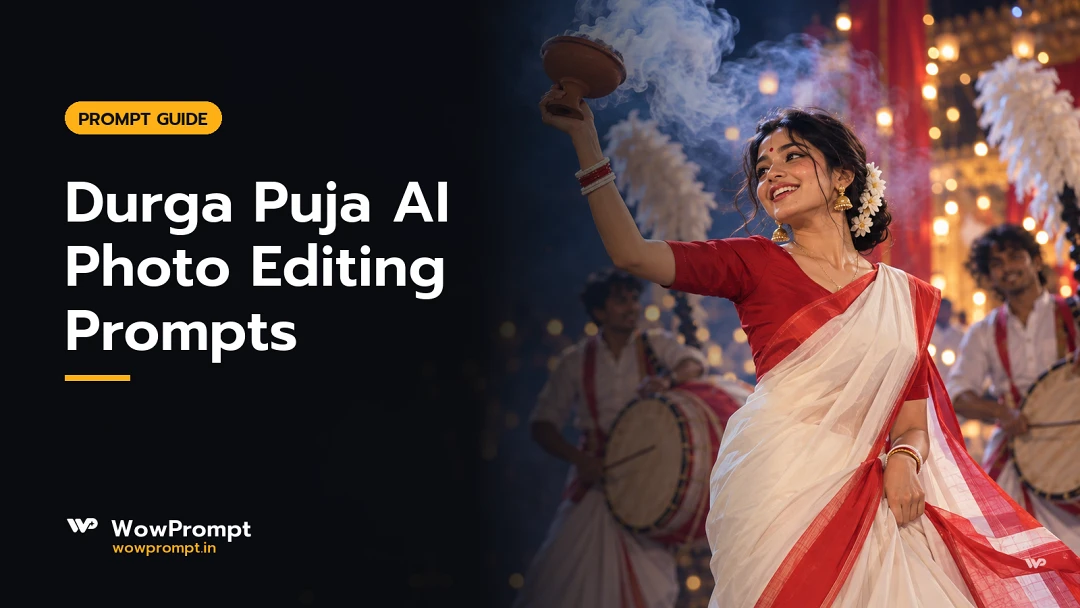
Durga Puja AI Photo Editing Prompts for Gemini and ChatGPT
Copy-ready Durga Puja AI photo editing prompts for Gemini and ChatGPT: dhunuchi, dhak, sindoor khela and pandal nights, with your own face kept.
A Durga Puja AI photo editing prompt works best when it puts you inside one real pandal-night moment, names your outfit down to the border of the saree, and asks for cool night light with a few small warm sources, instead of "goddess Durga behind me with golden glow". Durga Puja is on right now, and Vijaya Dashami, the day of sindoor khela, falls on 20 October 2026. This guide gives you seven copy-ready prompts for Gemini and ChatGPT: pandal hopping in a lal paar saree, the dhunuchi dance, standing beside the dhaki, Ashtami anjali, a Puja adda over clay-cup tea, a couple on a Kolkata tram line and sindoor khela. Every one of them keeps the face in your photo as yours.
Most Durga Puja edits online repeat one picture. The whole frame is washed in gold, the skin turns orange, and an idol or a painted goddess face fills the background, sometimes with the visitor's own face blended into it. The prompts below go where the festival actually lives: the lanes, the smoke, the drums and the friends. Each section links to a sample picture on our site, so you can see the look before you copy.
What makes a Durga Puja AI photo editing prompt work
Puja nights are blue and dark. The warm light comes from small things: a string of fairy bulbs on a lane, the ember glow inside a dhunuchi, a tea stall lamp, the headlight of a passing tram. When a prompt asks for "warm golden festive light", the model paints everything amber, flattens the crowd and loses the texture of the saree. When it asks for cool night with named small warm points, you get depth, true skin and a picture that looks like it was shot on the street.
Five habits make the difference:
- One real moment. Walking between pandals, swinging a dhunuchi, offering flowers at anjali, laughing over tea at the para adda. A moment gives every hand a job.
- A named outfit. "Bengali traditional dress" gives a costume. A white tant saree with a broad red border, a maroon Baluchari, a cream dhoti with a mustard panjabi gives a real garment with real folds.
- Hands with one job each. Name what the left hand and the right hand are doing. Most broken pictures break at the fingers.
- An explicit Avoid line. Orange cast, plastic skin, changed face, extra fingers and text all go in the negative line, every time.
- No deity or idol as the subject. The pandal can be there, softly out of focus, but the prompt never asks the model to draw the goddess or put your face on an idol. Models draw sacred figures badly, and a respectful picture is one anyone in the family can share.
Our festival portrait prompts guide explains this structure in full, and every prompt below follows it.
How to use these prompts with your own photo
- Open Gemini or ChatGPT and start a new chat.
- Attach one clear, front-facing photo taken in daylight. Avoid sunglasses, beauty filters and group shots for the solo prompts.
- Paste the prompt exactly as written and send.
- If the face drifts, reply: "Keep my face exactly as in the photo; change only the outfit, pose, place and light." Our reference photo guide has stronger identity lines if you need them.
- Leave the aspect ratio in the prompt. Use 4:5 for an Instagram feed post and 9:16 for stories, reels covers and WhatsApp status. A ratio inside the prompt makes the model compose for that shape rather than crop a square afterwards.
Gemini is quick for a single portrait from one selfie. ChatGPT tends to follow long outfit and place descriptions more closely. If you have time, run the same prompt in both and keep the better picture.
Durga Puja AI photo prompts for Gemini and ChatGPT: solo portraits
1. Pandal hopping in a lal paar saree
The picture everyone wants from Shashthi to Navami: a night walk between pandals in the classic red and white. See the sample Durga Puja pandal portrait in a red-bordered saree, and the close detail of shankha and pola bangles raised at a pandal at dusk.
Use the person in my photo as the subject. Keep their face, skin tone, hairline and body exactly as they are; take nothing else from the photo.
Scene: pandal hopping on a Durga Puja night in north Kolkata; they pause in a crowded lane between two pandals and look back at the camera.
Pose: walking, body three-quarters to the camera; right hand lifts the pallu off the shoulder, left hand holds a small jute potli bag at the hip; an easy smile.
Outfit: a white tant cotton saree with a broad red lal paar border, a red blouse, shankha and pola bangles on both wrists, a small red bindi, jasmine in a low bun.
Place: a narrow lane lit by strings of small bulbs, a lit pandal entrance far behind and out of focus, people walking in both directions.
Light: cool blue night; the bulb strings and a sweet shop lamp are the only warm points; a soft fill keeps the face true.
Finish: 50mm, f/1.8, eye level, real skin texture with pores, crisp cotton weave, light film grain.
Avoid: deity or idol as the subject, goddess likeness on the face, orange or golden cast, plastic skin, changed face, extra fingers, text, watermark.
Aspect ratio 4:5.
For a red and white saree in more settings, our Gemini saree prompts cover drape, colour and border in detail.
2. The dhunuchi dance AI photo
The dhunuchi dance, with a clay burner of coconut husk and incense smoking in the hand, is the most photographed moment of Puja evenings and the hardest one for a model. Smoke goes white and flat unless you say where the light sits. Compare the samples: dhunuchi dance in a white dhoti with dhak drummers behind, the dhunuchi smoke portrait in a maroon Baluchari saree and the studio-style Durga Puja dhunuchi portrait under a red rim light.
Use the person in my photo as the subject. Keep their face, skin tone, hairline and body exactly as they are; take nothing else from the photo.
Scene: the dhunuchi dance on a Durga Puja evening, in the open space in front of a pandal; they dance mid-turn as the drums play.
Pose: body turning to the left, right hand raises a clay dhunuchi with smoke rising from its glowing husk, left hand lifted open at shoulder height, eyes half closed, smiling.
Outfit: a maroon Baluchari silk saree with a woven motif pallu tucked at the waist, a gold-thread border, a small gold nose pin (or a cream dhoti with an ivory cotton panjabi and a red gamcha at the waist).
Place: a pandal ground at night, a ring of onlookers blurred behind, two dhakis with feathered drums at the edge of the frame.
Light: cool night; the ember inside the dhunuchi is a small warm point lighting the hand and chin from below; the smoke is backlit softly by a distant bulb string.
Finish: 35mm, f/2, slight motion blur in the smoke only, the face sharp, real skin and silk texture.
Avoid: deity or idol as the subject, fire near the face, orange cast, smoke covering the eyes, plastic skin, changed face, extra fingers, text, watermark.
Aspect ratio 4:5.
3. Beside the dhaki and the dhak
The dhak is the sound of the festival, and the drummers who travel in for the five days are some of its best faces. This prompt puts you next to one, sharing the frame rather than taking it over. See the dhaki drummer portrait with a feathered dhak.
Use the person in my photo as the subject. Keep their face, skin tone, hairline and body exactly as they are; take nothing else from the photo. Create the drummer.
Scene: late evening during Durga Puja; they stand beside a dhaki who plays a large dhak topped with white kash-style feathers.
Pose: the subject stands half a step in front of the drummer; right hand holds one drumstick he has handed over, left hand rests on the drum strap; both look at the camera, laughing.
Outfit: the subject wears a mustard cotton panjabi with a fine white kantha stitch on the placket and a white dhoti (or a cream jamdani saree with a mustard border); the dhaki wears a plain white kurta with a red gamcha.
Place: the side of a pandal, the lit entrance far behind and soft, plastic chairs and a tea flask on the ground.
Light: cool blue night; a single bulb above the drummer is the warm point; true colours on the feathers and fabric.
Finish: 35mm, f/2.8, eye level, documentary feel, real skin texture on both faces.
Avoid: deity or idol as the subject, orange cast, extra drumsticks, extra fingers, changed face, text, watermark.
Aspect ratio 4:5.
4. Ashtami anjali with flowers in folded hands
Ashtami morning is the one daylight picture of the festival, when families offer flowers together. The camera faces you, with the pandal behind softly out of focus, so nothing sacred becomes the subject. See the Ashtami anjali portrait with flowers in folded hands.
Use the person in my photo as the subject. Keep their face, skin tone, hairline and body exactly as they are; take nothing else from the photo.
Scene: Ashtami anjali on a Durga Puja morning; they stand in a row of devotees waiting for the priest's words before offering flowers.
Pose: standing straight, both hands folded at the chest holding marigold petals and bel leaves, eyes lowered, a calm expression.
Outfit: a peach Dhakai jamdani saree with a small woven motif and a silver-grey border, a matching blouse, a thin gold chain, hair in a loose plait (or an off-white silk panjabi with a beige churidar).
Place: inside a community pandal, other devotees softly blurred on both sides; the stage behind fully out of focus as shapes and colour only.
Light: soft morning daylight through the pandal cloth, cool and even; no spotlight on the subject.
Finish: 85mm, f/2, shallow depth, real skin texture, fine detail in the petals.
Avoid: deity or idol in focus, halo or divine glow, orange cast, plastic skin, changed face, extra fingers, text, watermark.
Aspect ratio 4:5.
Durga Puja photo editing prompts for ChatGPT with friends and partners
5. Puja adda with clay-cup tea
Every para has its Puja adda, the long late-night talk on a porch or a rock, with clay-cup tea and nobody in a hurry. See the Durga Puja night adda with clay-cup tea on an old Kolkata porch.
Use the person in my photo as the subject. Keep their face, skin tone, hairline and body exactly as they are; take nothing else from the photo. Create two friends beside them.
Scene: a Puja adda after midnight on the porch of an old north Kolkata house; the friends are mid-story and the subject is laughing.
Pose: seated on the porch step, right hand holds a clay bhanr of tea, left elbow rests on one knee, head tipped back laughing; the friends sit on either side, turned toward the subject.
Outfit: a bottle-green khadi panjabi with wooden buttons and white pyjamas (or a teal Bishnupuri silk saree with a black border); the friends wear simple cotton kurtas in indigo and rust.
Place: a crumbling porch with green wooden shutters and a cast-iron railing, a pandal glow far down the lane.
Light: cool blue night; a single bare bulb over the door and the tea stall lamp across the lane are the warm points.
Finish: 35mm, f/2, eye level, candid, real texture on skin, khadi and old plaster.
Avoid: deity or idol as the subject, orange cast, extra cups, extra fingers, changed face, text, watermark.
Aspect ratio 4:5.
6. A couple on a Kolkata tram line
The tram, the yellow taxi and the old Ambassador are the city's own Puja backdrop. Samples to compare: the Durga Puja night couple on a Kolkata tram line, a solo look seated on a vintage Ambassador bonnet in a Kolkata lane, and a Kolkata tram in the rain at dusk if you want a phone wallpaper instead.
Use the two people in my photo as the subjects. Keep both faces, skin tones and bodies exactly as they are; take nothing else from the photo. If only one person is in the photo, keep that person and create a partner.
Scene: a couple walking along a tram line on a Durga Puja night, a tram approaching slowly far behind them.
Pose: walking side by side toward the camera; her left hand holds his right hand, her right hand holds a small paper cone of jhalmuri; his left hand rests in his pocket; both look at each other, smiling.
Outfits: she wears a red Garad silk saree with a cream body and a gold-thread border, a red bindi, a jasmine gajra; he wears a cream cotton panjabi with a maroon shawl over one shoulder and a white dhoti.
Place: a wide old Kolkata street, tram tracks shining on wet tarmac, bulb strings across the road, a pandal glow far behind.
Light: cool blue night after light rain; the tram headlight and the bulb strings are small warm points reflected in the tracks.
Finish: 50mm, f/1.8, eye level, real skin texture, gentle film grain, the tram soft.
Avoid: deity or idol as the subject, orange cast, changed faces, extra fingers, a third hand, text, watermark.
Aspect ratio 4:5.
For more ideas built around two people, see the full set of couple prompts.
Sindoor khela AI photo for Vijaya Dashami
7. Sindoor khela with a friend
On Vijaya Dashami, 20 October 2026, married women smear sindoor on each other's faces after bidding the goddess farewell. The fun of the picture is the colour, but a single red word in the wrong place turns the whole frame red. Name the powder, keep the daylight cool and let the red stay on the faces. See the sindoor khela portrait of two friends on Vijaya Dashami.
Use the person in my photo as the subject. Keep their face, skin tone, hairline and body exactly as they are; take nothing else from the photo. Create a friend beside them.
Scene: sindoor khela on Vijaya Dashami afternoon in a neighbourhood pandal; the friend dabs sindoor on the subject's cheek and both burst out laughing.
Pose: faces close, cheek to cheek; the subject's right hand holds a small brass sindoor box, left hand rests on the friend's shoulder; eyes half closed with laughter.
Outfit: both wear white Garad silk sarees with broad red borders, red blouses, shankha and pola bangles; the subject has a gold nose pin and a red bindi.
Place: the open front of a pandal, other women in red and white blurred behind, the stage area soft and out of focus.
Light: cool afternoon daylight through the pandal fabric; the red sindoor is the strongest colour in the frame.
Finish: 50mm, f/2, real skin texture, sindoor as fine dry powder on the skin, not paint.
Avoid: deity or idol as the subject, red cast over the whole frame, orange cast, changed face, extra fingers, text, watermark.
Aspect ratio 4:5.
Our Dussehra AI photo editing prompts cover the same day as it is celebrated across the rest of India.
Common mistakes and how to fix them
- The frame turns gold or orange. Remove "golden", "glowing" and "warm festive". Ask for a cool blue night and name the small warm lights one by one.
- A goddess appears in the picture, or your face is blended with one. Add "deity or idol as the subject" to the Avoid line, and describe people, drums, smoke and lanes instead.
- The face changes. Put the identity line first, and leave out beauty words such as "flawless" or "glowing skin".
- Hands melt around the dhunuchi or the tea cup. Name what each hand does, and keep "extra fingers" in the Avoid line.
- The saree looks like plastic. Name the weave: tant, Garad, Baluchari, jamdani. A named weave gives the model real texture to draw.
Durga Puja prompts for creators, food and fun styles
If you post about the festival rather than appear in it, start with the Durga Puja looks YouTube thumbnail in a white red-bordered saree and browse more thumbnail prompts. Shops and boutiques can adapt the Durga Puja saree collection Instagram post. For bhog, the Durga Puja bhog plate of khichuri and labra on a banana leaf is ready to copy. For a playful style, try the anime film still in a red-bordered saree at a Durga Puja lane or the isometric miniature of a Kolkata Puja lane at night.
Frequently asked questions
Which app is best for a Durga Puja AI photo edit, Gemini or ChatGPT?
Both handle these prompts well. Gemini is fast for a single portrait from a selfie. ChatGPT tends to follow long outfit and place descriptions more closely. Run the same prompt in both and keep the result you like more.
Can I put the goddess or the pandal idol behind me?
We do not recommend it. Image models draw sacred figures inconsistently and sometimes disrespectfully, and some edits blend the visitor's face into the idol. Keep the pandal soft in the background and show the festival through people, drums, smoke and lanes.
How do I get a realistic dhunuchi dance AI photo?
Say where the ember glows and where the smoke is lit from. Ask for motion blur in the smoke only, keep the face sharp, and add "fire near the face" and "smoke covering the eyes" to the Avoid line.
Will the AI keep my face the same?
It does far more reliably when the identity line comes first and nothing asks for skin smoothing. Use a clear, front-facing photo, and if the face drifts, ask it to change only the outfit, pose, place and light.
What aspect ratio should I use for a Durga Puja post?
Use 4:5 for Instagram feed posts and 9:16 for stories, reels covers and status updates. Keep the ratio inside the prompt so the model composes for that shape.
Where to find more
Browse all festival and devotional prompts, traditional wear prompts and food and drink prompts, or open the full image prompt library. For a calm riverside picture after the immersion, the cream saree portrait on the Hooghly riverbank with Howrah Bridge is a good next stop.