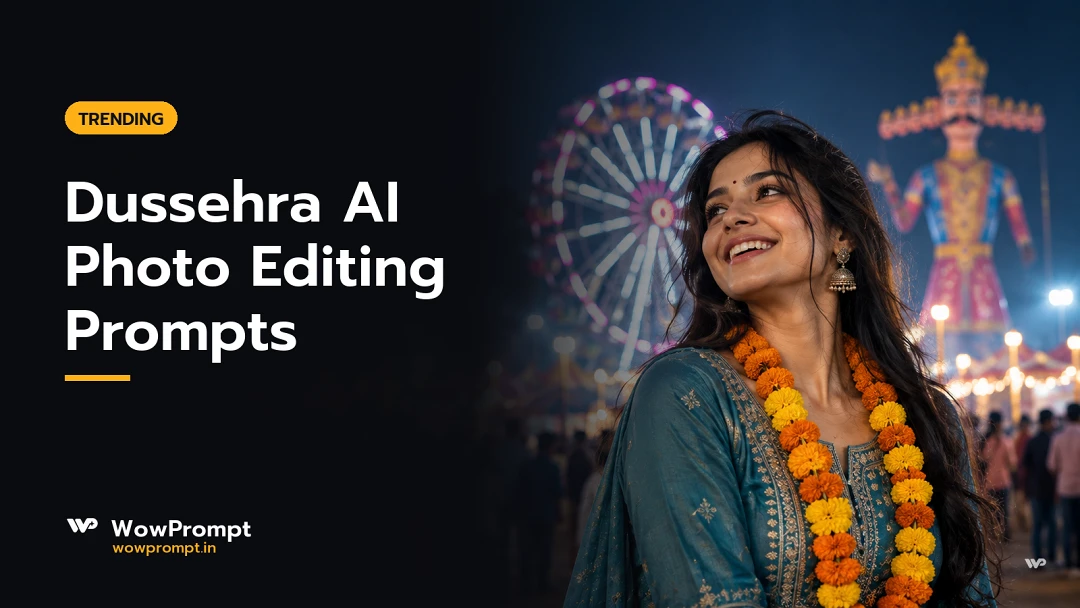
Dussehra AI Photo Editing Prompts for Gemini and ChatGPT
Copy-ready Dussehra AI photo editing prompts for Gemini and ChatGPT: mela, Ram Lila, Mysuru Dasara and sindoor khela, with your own face kept exactly.
A Dussehra AI photo editing prompt works best when it describes one real moment of the day, a named outfit and a cool evening light, instead of asking for "Ravan dahan with fire behind me". Dussehra, also called Vijayadashami, falls on 20 October 2026, and this guide gives you eight copy-ready prompts for Gemini and ChatGPT: a mela portrait, an effigy maker's yard, Ram Lila backstage, the Shami leaves exchange, Mysuru Dasara, Kullu Dussehra, sindoor khela and a couple at the fair. Each one keeps the face in your photo as yours.
Most Dussehra edits online repeat the same picture: a person pasted in front of a burning effigy, the whole frame drowned in orange, sparks across the face. The prompts below go to the places where the festival actually happens, and each links to a sample picture on our site so you can see the result before you copy.
What makes a Dussehra AI photo editing prompt work
Dussehra is an evening festival, and evening light is mostly blue. The warm points are small: a string of fair bulbs, a lamp in a green room, the palace outline in Mysuru. When a prompt asks for "fiery festive glow", the model paints the skin orange and flattens the scene. When it asks for blue dusk with a few warm lights, you get depth and true skin.
Four habits make the difference:
- One real moment. Buying a garland at the mela, painting an effigy, waiting backstage, touching an elder's feet while offering Shami leaves. A moment gives the pose a reason.
- A named outfit. "Traditional dress" gives a costume. An ivory chanderi kurta, a red-bordered garad saree or a Kullu pattu jacket gives a real garment.
- Distance from the fire. If an effigy burns, it burns far away, small in the frame. Fire near a face is where hands melt and skin goes orange.
- No deity likeness. Ram Lila actors, idols and processions appear as people, crowds and objects. The prompts never ask the model to draw a god, which keeps the picture respectful and avoids strange results.
Our festival portrait prompts guide explains the full structure, and every prompt here follows it.
How to use these prompts with your own photo
- Open Gemini or ChatGPT and start a new chat.
- Attach one clear, front-facing photo in daylight. Skip sunglasses, heavy filters and group shots for the solo prompts.
- Paste the prompt as written and send.
- If the face drifts, reply: "Keep my face exactly as in the photo; change only the outfit, pose, place and light." Our reference photo guide has stronger identity lines if you need them.
- Keep the ratio in the prompt. 4:5 suits feed posts and 9:16 suits stories; the aspect ratio guide explains the rest.
Which Dussehra moment to pick
Dussehra looks different in every part of India, and the best picture is the one that matches your own festival. In the north, the week builds through Ram Lila and the mela to the effigy on the final evening, so prompts 1 to 3 fit. In Maharashtra and Karnataka the day is about Shami leaves, visits to elders and, in Mysuru, the palace and the procession; try prompts 4 and 5. In Himachal the Kullu fair only begins on Vijayadashami, which makes prompt 6 a good choice for the week after. In Bengal, Odisha and Assam the same day closes Durga Puja, and prompt 7 belongs there. If you simply want a picture with your partner, prompt 8 works anywhere a fair sets up.
Dussehra AI photo editing prompts for a solo portrait
1. A marigold garland at the Dussehra mela
The everyday Dussehra picture, done with real fair light. See the sample: Dussehra fair portrait with a marigold garland.
Use the person in my photo as the subject. Keep their face, skin tone and body exactly as they are; take nothing else from the photo.
Scene: a Dussehra mela at dusk; they have just bought a marigold garland from a flower stall and hold it up, laughing.
Pose: standing, body three-quarters to the camera, both hands lifting the garland at chest height, looking at the camera.
Outfit: an ivory chanderi kurta with a fine self-stripe, a rust cotton dupatta over one shoulder, kolhapuri sandals.
Place: a fairground lane with balloon sellers, a small giant wheel and, far in the background, a tall effigy standing unlit.
Light: cool blue dusk; strings of small bulbs and the stall lamp are the only warm points.
Finish: 50mm, f/1.8, eye level, real skin texture with pores, gentle film grain.
Avoid: orange cast, fire, sparks near the face, deity likeness, changed face, extra fingers, text, watermark.
Aspect ratio 4:5.
2. In the effigy maker's yard
In the week before Dussehra, whole lanes fill with bamboo frames and painted faces. Our sample is the Ravan effigy maker painting a giant face before Dussehra.
Use the person in my photo as the subject. Keep their face, skin tone and body exactly as they are; take nothing else from the photo.
Scene: an effigy makers' yard two days before Dussehra; they stand on a low wooden ladder painting a moustache on a giant paper face.
Pose: one foot on a rung, right hand holding a flat brush to the paper, left hand on the ladder, eyes on the brushstroke, focused.
Outfit: a faded indigo cotton kurta with sleeves rolled, a checked gamcha round the neck, paint on the fingers.
Place: a dusty yard of bamboo frames, paper heads drying in a row, paint tins on the ground.
Light: soft overcast late afternoon, cool and even; true colours on the paper and skin.
Finish: 35mm, f/2.8, slightly low angle, documentary feel, real texture.
Avoid: fire, smoke, orange cast, deity likeness, changed face, extra fingers, text, watermark.
Aspect ratio 4:5.
3. Ram Lila backstage at the mirror
The quiet moment before the final night of Ram Lila. Sample: Ram Lila backstage portrait of a young actor at the mirror.
Use the person in my photo as the subject. Keep their face, skin tone and body exactly as they are; take nothing else from the photo.
Scene: a Ram Lila green room on Dussehra night; they sit at a bulb-lit mirror finishing stage makeup before going on.
Pose: seated, turned slightly to the mirror, right hand touching up a line of kajal, eyes meeting the camera through the reflection.
Outfit: a stage costume of deep green brocade with a cream sash, a simple painted cardboard crown resting on the table, not worn.
Place: a cramped canvas room, costumes on a rope line, a tin trunk, other actors blurred behind.
Light: cool blue ambient light from the open flap; the mirror bulbs are small warm points that light the face softly.
Finish: 50mm, f/2, real skin texture, the makeup clearly paint on a real face.
Avoid: deity likeness, divine glow or halo, orange cast, changed face, extra fingers, text, watermark.
Aspect ratio 4:5.
For a bolder poster look, compare the studio-style Dussehra poster in a black raw silk kurta.
Regional Vijayadashami AI photo prompts
4. Exchanging Shami leaves with an elder
In Maharashtra and parts of Karnataka, people give each other Shami or apta leaves as "sona", gold, on Dussehra. Nobody on the ranking pages covers it.
Use the person in my photo as the subject. Keep their face, skin tone and body exactly as they are; take nothing else from the photo. Create the elder.
Scene: Dussehra evening at a family doorway; they bend to offer a small bunch of apta leaves to an elderly relative, who blesses them.
Pose: the subject leans forward, both hands holding out the leaves; the elder rests one hand on the subject's head, smiling.
Outfit: a peacock-blue Paithani-bordered saree with a nath (or a cream kurta with a maroon Nehru jacket and a Puneri pagdi); the elder wears a simple white cotton saree.
Place: an old wada doorway with a marigold toran and a small rangoli on the step.
Light: cool blue evening; one small brass lamp inside the door gives a warm point.
Finish: 35mm, f/2.2, eye level, real skin texture on both faces.
Avoid: orange cast, deity likeness, plastic skin, changed face, extra fingers, text, watermark.
Aspect ratio 4:5.
5. Mysuru Dasara before the lit palace
Mysuru lights its palace with nearly a hundred thousand bulbs through Dasara. See the Mysuru Dasara night portrait before the lit palace, or the playful clay miniature of a Mysuru Dasara elephant procession.
Use the person in my photo as the subject. Keep their face, skin tone and body exactly as they are; take nothing else from the photo.
Scene: Mysuru Dasara night; they stand on the palace lawn with the illuminated palace behind them.
Pose: standing, weight on one leg, hands holding the pallu (or clasped in front), head turned to the camera, calm smile.
Outfit: a bottle-green Mysore silk saree with a slim gold zari border, jasmine in the hair (or an ivory silk shirt with a green-bordered veshti and an angavastram).
Place: the palace outline traced in small bulbs, filling the background, a few visitors far behind.
Light: deep blue night sky; the palace bulbs are fine warm points; a soft front fill keeps the face true.
Finish: 50mm, f/1.8, palace slightly soft, real skin and silk texture.
Avoid: orange cast, gold wash on skin, deity likeness, changed face, extra fingers, text, watermark.
Aspect ratio 4:5.
6. Kullu Dussehra in the valley
Kullu's Dussehra begins on Vijayadashami and runs for a week in the Dhalpur maidan. Our mountain road portrait in a Kullu pattu wool jacket shows the outfit.
Use the person in my photo as the subject. Keep their face, skin tone and body exactly as they are; take nothing else from the photo.
Scene: the Kullu Dussehra fair at Dhalpur in late afternoon; they walk through the crowd holding a paper cup of tea.
Pose: mid-step toward the camera, tea in the right hand, left hand adjusting the cap, a relaxed smile.
Outfit: a Kullu pattu wool jacket in charcoal with a geometric border in red and mustard, a Kullu topi with a green band, dark trousers.
Place: a wide meadow with stalls, pine slopes and snowy peaks behind, local musicians far off.
Light: clear, cool mountain light, low sun from the side, blue shadows.
Finish: 35mm, f/4, crowd softly blurred, real texture on wool and skin.
Avoid: orange cast, deity likeness, palanquin close-ups, changed face, extra fingers, text, watermark.
Aspect ratio 4:5.
7. Sindoor khela on Vijaya Dashami
In Bengal, Durga Puja ends on Vijaya Dashami with married women smearing sindoor on each other. Sample: sindoor khela portrait of two friends on Vijaya Dashami.
Use the person in my photo as the subject. Keep their face, skin tone and body exactly as they are; take nothing else from the photo. Create a friend beside them.
Scene: sindoor khela inside a pandal on Vijaya Dashami afternoon; the friend dabs sindoor on their cheek and both laugh.
Pose: faces close, the subject's eyes half closed with laughter, one hand holding a small brass sindoor box.
Outfit: a white garad saree with a broad red border, red and white shakha-pola bangles, a small gold nose pin.
Place: a pandal with a decorated backdrop softly out of focus, other women in red and white behind.
Light: cool daylight through the pandal fabric; the red of the sindoor is the strongest colour.
Finish: 50mm, f/2, real skin texture, sindoor as fine powder, not paint.
Avoid: idol or deity likeness, orange cast, red cast on the whole frame, changed face, extra fingers, text, watermark.
Aspect ratio 4:5.
Other Durga Puja pictures to pair it with: the dhaki drummer portrait with a feathered dhak and the dhunuchi smoke portrait in a maroon Baluchari saree.
Dussehra couple photo prompt at the mela
8. A selfie by the giant wheel
The couple picture that most people want from the fair. Sample: couple selfie by a lit giant wheel at a Dussehra mela.
Use the two people in my photo as the subjects. Keep both faces, skin tones and bodies exactly as they are; take nothing else from the photo. If only one person is in the photo, keep that person and create a partner.
Scene: a couple taking a selfie at a Dussehra mela, the giant wheel turning behind them.
Pose: she holds the phone at arm's length, he leans in with his chin near her shoulder, both grinning; her free hand holds a stick of candy floss.
Outfits: she wears a mustard cotton anarkali with a rani-pink dupatta; he wears a sage linen kurta with white pyjamas.
Place: the fairground at blue hour, stalls and balloon sellers, the wheel ringed with small bulbs.
Light: cool blue sky; the wheel bulbs are small warm points; faces lit softly by the phone side.
Finish: phone-camera wide angle, slight motion in the wheel, real skin texture.
Avoid: orange cast, fireworks near faces, deity likeness, changed faces, extra fingers, text, watermark.
Aspect ratio 4:5.
For another evening couple idea, the Durga Puja night couple on a Kolkata tram line works well, and our couple photo editing prompts cover more.
Common mistakes and how to fix them
- The frame turns orange. Remove "fiery", "golden" and "burning glow". Ask for blue dusk and name the small warm lights.
- Fire touches the person. Put any burning effigy far behind and small, or leave it unlit. Keep "fire close to people" in the avoid line.
- A god appears in the picture. Add "no deity likeness" and describe people, costumes and objects instead of figures from the epic.
- The face changes. Put the identity line first and leave out beauty words such as "flawless".
- Hands melt around garlands and cups. Give each hand one job, and keep "extra fingers" in the avoid line.
Dussehra prompts for creators and food
If you post about the festival rather than appear in it, start with the YouTube thumbnail for a Dussehra mela night vlog and browse more in thumbnail prompts. For Bengali Vijaya food, the Durga Puja bhog plate of khichuri and labra is ready to copy. Karwa Chauth follows on 29 October and Diwali on 8 November; see our Karwa Chauth AI photo editing prompts and Diwali AI photo editing prompts.
Frequently asked questions
Which app is best for a Dussehra AI photo edit?
Both Gemini and ChatGPT handle these prompts. Gemini is quick for a single portrait from a selfie; ChatGPT tends to follow long outfit and place descriptions closely. Run the same prompt in both and keep the better result.
Can I put a burning Ravan effigy behind me?
Yes, but keep it far away and small in the frame, and describe the sky as blue. Close fire is what turns the skin orange and breaks hands. An unlit effigy at dusk often looks better.
Why should a Dussehra prompt avoid deity likeness?
Image models draw gods inconsistently and often disrespectfully. Showing the festival through people, costumes, crowds and places gives a cleaner picture that anyone can share.
Will the AI keep my face the same?
It does far more reliably when the identity line comes first and nothing asks for skin smoothing. Use a clear, front-facing photo, and if the face drifts, ask it to change only the outfit, pose, place and light.
What size is best for a Vijayadashami post?
Use 4:5 for Instagram feed posts and 9:16 for stories and status. Keep the ratio inside the prompt so the model composes for that shape.
Where to find more
Browse all festival and devotional prompts, traditional wear prompts, couple prompts and food and drink prompts, or the full image prompt library. Still in Navratri mood? The Navratri garba photo prompts and the garba night portrait in a mirror-work chaniya choli are a good next stop.